
Category: Social media
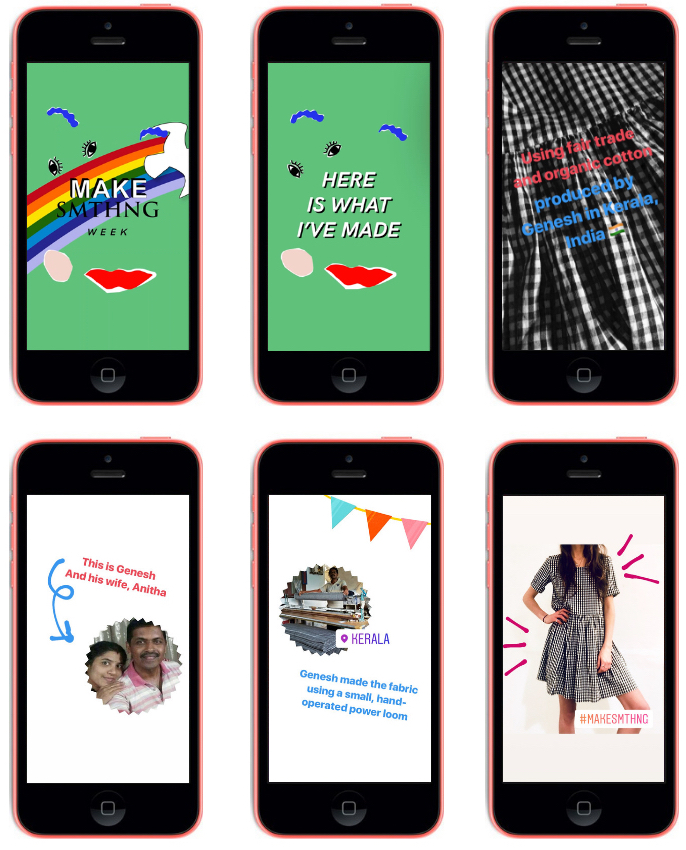
Guest blog: stitched together in this dress
The pages on the followthethings.com begin as coursework set for groups of students taking a Geographies of Material Culture module at the University of Exeter. They also their own experiments of cultural activism, and write personal reflective journals on what they learn. Kate Brockie’s group were tasked to find a way to draw public attention to the work of mineral justice NGO Global Witness through cultural activism. They chose a talc mining report to work with. Sarah Ditty, the policy director for the Fashion Revolution movement, had kicked off that part of the talk. How could the work of Global Witness and Fashion revolution be connected? Kate scoured the internet, took out her sewing machine, and made her case.
Eye shadows
Global Witness’s investigations into the ways in which talc mining finances insurgency in Afghanistan shocked me. How could products as harmlessly trivial as eye shadow be fuelling terrorism, disrupting the lives of thousands of civilians (Global Witness 2018)? The Global Witness campaign gave me an unsettling feeling of being entangled in global webs of exploitation, wondering whether everything else I use throughout my day contributes to some kind of injustice. Continue reading
How strategic impact documentary can contribute to the Fashion Revolution: the True Cost
It’s Fashion Revolution Week this week. To mark this, we’re showcasing our favourite examples of cultural activism which have supported its #whomademyclothes call to action. On Monday, we showcased the Guerrilla Projections of documentary photographer Ismael Ferdous. On Tuesday, we showcased the gentle Shop-dropping activism of the Craftivist Collective. And yesterday we showcased the power of Disobedient Objects like Fashion Revolution Germany & BDDO’s €2 T-shirt vending machine.
Today’s post focuses on a strategic impact documentary called the True Cost. This aims to unravel fast fashion’s grim and gritty supply chains in the wake of the Rana Plaza collapse. It juxtaposes scenes of fashion models strutting catwalks, YouTube shopping hauls, footage of Black Friday shopping chaos, TV news footage of garment workers sewing clothes in cramped factory spaces, talking head interviews with factory workers and owners, farmers, former corporate executives, academic experts, famous activists and ethical fashion royalty, brands working ethically, key people from NGOs like War on Want, and champions of free market economics.
What’s distinctive about the True Cost and the impacts that it has had is that it was crowd-funded, released via iTunes and Netflix, and tries to channel its audiences’ concerns to ‘do something’ through public screenings with panel discussions, its website and associated social media. This film enrolled its audiences from its crowd-funding forwards. It was a conversation, a collaborative ‘do something’, from the beginning. Despite its lack of mainstream funding or cinema listing, the making, reception and impacts of this film in relation to the Fashion Revolution have been nothing short of stunning. We’re posting this today because CEO Ian is on a True Cost panel in Portsmouth tonight. It’s a textbook example of the emerging genre of strategic impact documentary.
Further reading
Judith Hefland & Anna Lee (2012) Put movies in the hands of movements. in Andrew Boyd (comp.) Beautiful trouble: a toolbox for revolution. New York: O/R, 164-5
Kate Nash & John Corner (2016) Strategic impact documentary: contexts or production and social intervention. European Journal of Communication 31(3) 227-242
#whomademyclothes? Fazlul Ashraf?
A week ago PhD student Thomas Dekeyser tweeted a photograph of a note found in someone’s Zara jeans. We circulated it at work, and loads of people discussed what language it might be written in and what it could say. We’d found a note on a CD player and found help to translate it before.
There’s a genre of shop-dropping in which factory workers leave notes for consumers in the things they make. Sometimes they’re genuine. Sometimes they’re hoaxes. Sometimes they’re part of activist campaigns. See our post The 13 best examples of shop-dropping … ever for more.
This one was particularly relevant for the Fashion Revolution movement, whose core question is ‘Who made my clothes?’ This note could simply be a direct answer. According to Reddit. Or is there more to it?
Thanks to Thomas and to Brad Garrett for the tipoff.
Beautiful Trouble: $1 eBook
In the wake of the Trump election in the USA, our favourite book is now available at discount prices – e.g. $1 as an eBook – until the end of this week:
It’s perfect of our purposes and is available until the end of this week – in the wake of the Trump election – for only $1 as an eBook. It comes with a free study guide. There’s a website, too. But books are best!
Brandjamming the John Lewis Christmas ad to #stopfundinghate
We’re brandjamming the John Lewis Christmas ad! Please share & urge @JohnLewisretail & @Waitrose to #StopFundingHate #bustertheboxer pic.twitter.com/drYlgKNt6j
— Stop Funding Hate (@StopFundingHate) November 10, 2016
On the making of followthethings.com

Here’s Ian et al’s first paper about the making of followthethings.com. It was published in French in 2014 and has recently been made available on open access. You can now download the paper as it was originally written in English. If you want the French version, click here.
followthethings.com was not designed and then made, but emerged from an iterative, creative, collaborative, conversation-infused, open-ended, making project. The paper is written to reflect this. Here’s the abstract: Continue reading
Fashion Revolution call for papers at RGS(IBG) annual conference
We’re involved in running a session at the Royal Geographical Society (Institute of British Geography) annual conference this summer whose aim is to bring academic fashion experts into dialogue with the Fashion Revolution movement. We’re asking how fashion research can contribute to what is becoming a worldwide movement for a more ethical / sustainable fashion industry in the wake of the Rana Plaza factory collapse in April 2013. We’re looking for academic research from any discipline that can contribute to Fashion Revolution’s five year planning. Here’s what we’re doing. Please get in touch with Ian, Lousie and/or Alex to discuss any ideas. The deadline for abstracts is Friday 12th February.
– Call for papers –
Scholar activism and the Fashion Revolution: ‘who made my clothes?’

Abstract
The collapse of the Rana Plaza factory complex on April 24th 2013, which crushed to death over 1,000 people making clothes for Western brands, was a final straw, a call to arms, for significant change in the fashion industry. Since then, tens of thousands of people have taken to social media, to the streets, to their schools and halls of government to uncover the lives hidden in the clothes we wear. Businesses, consumers, governments, academics, NGOS and others working towards a safer, cleaner and more just future for the fashion industry have been galvanised.
How to run a subvertisement workshop
One of our former interns, Eeva Kemppainen, now works in Helsinki for the pro-Fair Trade NGO Eettisen kaupan puolesta (Pro Ethical Trade Finland). In 2014, she published a paper in the Finnish journal Natura about ways in which she tries to engage students in humorous critiques of consumption and advertising. They examine, then cut up, rearrange and/or scribble on magazine adverts. They try to subvert their messages so that the information that they hide is made visible. What they produce are what’s called subvertisments. Here Eeva describes how she organises subvertisement workshops, and showcases some of the work that students have produced.

Figure 1: An example of a student-produced subvertisment: rearranging kids in an H&M advert to show connections between who makes and wears their clothes
Political LEGO: an interview with Legofesto
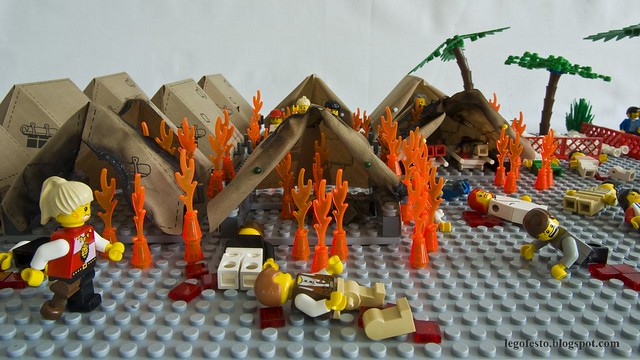
Sri Lanka: Bombing a refugee camp 4 (Legofesto 2009).
We re-create scenes from the trade justice documentaries, art and activist work in LEGO. We photograph them, put them online and embed them on our site’s pages. You can see what we’ve done here. This work was inspired by LEGO scenes from the ‘War on Terror’ produced by a person calling herself Legofesto. We read interviews with and articles about her that were published in 2009, but hadn’t found anything since. This year, after teaching Political LEGO on the MRes Critical Human Geographies at Exeter University, one student – Julia Zielke – emailed Legofesto to interview her for an essay. What questions hadn’t been asked in those 2009 pieces? What had Legofesto been doing since then? Can we expect any new Legofesto work? This is what she said… Continue reading
Next week: we’re in a shopping centre talking clothes
We’ve been working on one of 12 ‘Grand Challenges’ that the University of Exeter runs each year for first year students. The idea is that academic staff introduce first year students from across the university to the Grand Challenges of the 21st Century, through some hands-on learning and with the help of visiting experts (who students refer to as ‘real people’, in my experience).
Challenges this year include Climate Change, Global Security and Mental Health, and the one that we’re running is on Fashion ethics after the Rana Plaza collapse.
There are four ways to find out more, to get involved, and to follow us next week:
1) Our blog
All the background information we’ve put together to prepare for this challenge. The Rana Plaza collapse and its ripple effects, and how we’re trying to appreciate and work with these ripples in the space of Exeter’s Guildhall Shopping centre, where we’re be occupying 2 disused shops and its main square for 4 days next week.
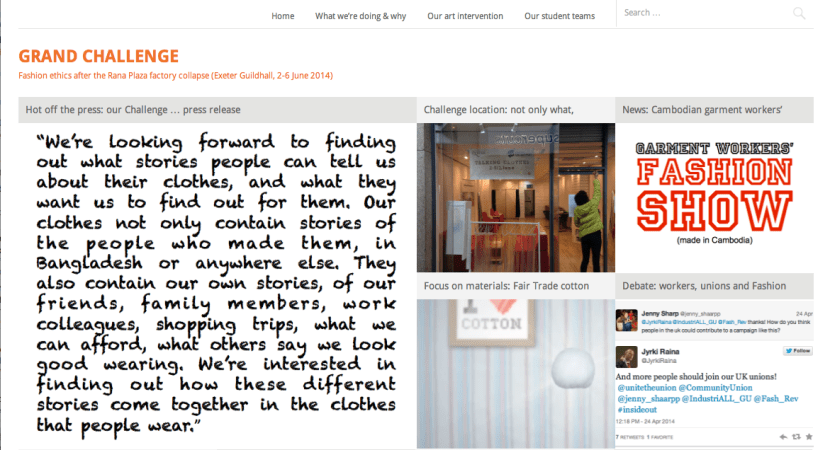
Click image for blog
 the back office