
Category: public pedagogy
New publication: Teaching media literacy and the geographies of consumption
How can encouraging students to cut up, rearrange and otherwise mess with adverts’ imagery and messages help them to better appreciate the complex geographies of consumption and international trade? How can the teaching of controversial issues build on students’ senses of injustice, mischief and creativity? We have a suggestion…
Earlier this year, a booklet called Medialukutaitoa vastamainoksista became a booklet called Teaching media literacy and the geographies of consumption. These booklets come from a series of workshops developed by former followthethings.com intern Eeva Kempainnen in a variety of educational settings in Finland. The hands-on and entertaining methods she sets out are suitable for a variety of ages, and the booklets are crammed with ‘how to’ advice and excellent examples of student work. Watch our cheaply produced promo, download the booklets by clicking the links, and find out more about Eeva’s work here.
Thanks to Mary Biddulph and Alan Parkinson for their help in this process.
followthethings.com as digital geography
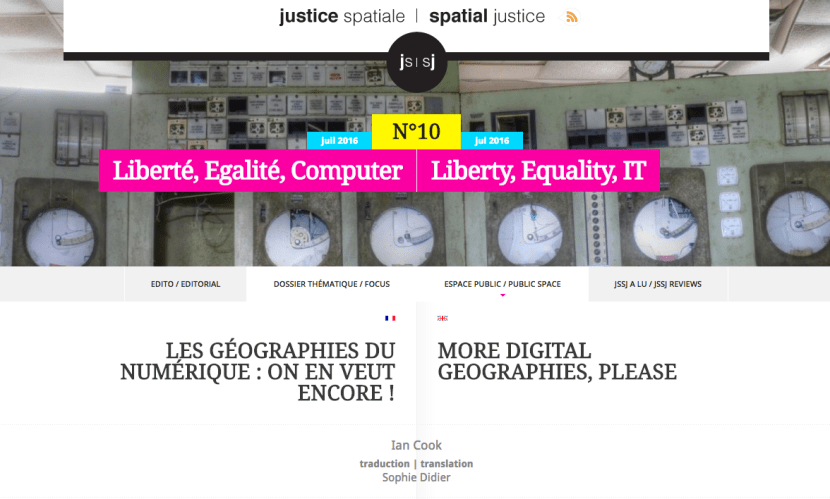
Ian was asked recently to write a short article about the subversive possibilities of digital geographic practice for the journal Justice Spatiale | Spatial Justice and to place followthethings.com in this emerging, absent, who knows what, tradition. It’s just been published.
We noticed that followthethings.com, or anything that seems (to us) to be anything like it, was not being discussed in reviews of digital geographies. So, we imagined the kind of review in which it would be a central example. A review that’s based on already-published literature that’s informed and helped us to make sense of what we’ve made and what we can do with it. A review whose plea for ‘more digital geographies’ is a plea both for more experiments in digital geography, and for experiments that are themselves more digital.
This kind of work more fully lives in and works through the new media ecology of web2.0. followthethings is an example of what this can look like, how it can operate, the kinds of arguments it can make, how it can make those arguments, how it could be assessed, what we could and should write about ‘it’ in academic journals.
Other examples are, of course, available. For us, the Museum of Contemporary Commodities (MoCC) project also fits this bill, in its own unique ways.
See what you think. Click the image to read the full argument.
Thanks to our friends at Paris 7 University for this opportunity to express ourselves.
On the making of followthethings.com

Here’s Ian et al’s first paper about the making of followthethings.com. It was published in French in 2014 and has recently been made available on open access. You can now download the paper as it was originally written in English. If you want the French version, click here.
followthethings.com was not designed and then made, but emerged from an iterative, creative, collaborative, conversation-infused, open-ended, making project. The paper is written to reflect this. Here’s the abstract: Continue reading
Fashion Revolution call for papers at RGS(IBG) annual conference
We’re involved in running a session at the Royal Geographical Society (Institute of British Geography) annual conference this summer whose aim is to bring academic fashion experts into dialogue with the Fashion Revolution movement. We’re asking how fashion research can contribute to what is becoming a worldwide movement for a more ethical / sustainable fashion industry in the wake of the Rana Plaza factory collapse in April 2013. We’re looking for academic research from any discipline that can contribute to Fashion Revolution’s five year planning. Here’s what we’re doing. Please get in touch with Ian, Lousie and/or Alex to discuss any ideas. The deadline for abstracts is Friday 12th February.
– Call for papers –
Scholar activism and the Fashion Revolution: ‘who made my clothes?’

Abstract
The collapse of the Rana Plaza factory complex on April 24th 2013, which crushed to death over 1,000 people making clothes for Western brands, was a final straw, a call to arms, for significant change in the fashion industry. Since then, tens of thousands of people have taken to social media, to the streets, to their schools and halls of government to uncover the lives hidden in the clothes we wear. Businesses, consumers, governments, academics, NGOS and others working towards a safer, cleaner and more just future for the fashion industry have been galvanised.
Guest blog: developing global perspectives on sustainability with followthethings.com
In February this year, Ian, Charlotte Brunton and Jenny Hart contributed to a Pedagogy Cafe seminar at Plymouth University’s Centre for Sustainable Futures. They talked about Geographies of Material Culture coursework (a university lifestyle catalogue and a singing heart pacemaker) now published on our site. What happened next was surprising. Plymouth lecturer Helen Bowstead talked about her use of ‘follow the things’ research to teach English as a Foreign Language. Here’s what she said.

International students discuss complex and overlooked understandings of things.
The benefits of group work have been well-documented: Gibbs claims working as a group “has the potential measurably to improve student engagement, performance, marks and retention and usually succeeds in achieving this potential” (Gibbs 2010:1). However, successfully implementing and assessing a piece of group work is also often fraught with challenges, particularly when the students do not share a common language and/or cultural background. In groups where some or all students are non-native English speakers, there may be an ‘imbalance’ in power relations, as the ideas and views of the students with ‘stronger’ language skills often end up dominating. In many instances, non-native speakers find themselves side-lined within the group, sometimes because their language skills are weaker than other members, but also because, due to cultural and educational differences, their knowledge base is perceived as having less ‘value’.
Next week: we’re in a shopping centre talking clothes
We’ve been working on one of 12 ‘Grand Challenges’ that the University of Exeter runs each year for first year students. The idea is that academic staff introduce first year students from across the university to the Grand Challenges of the 21st Century, through some hands-on learning and with the help of visiting experts (who students refer to as ‘real people’, in my experience).
Challenges this year include Climate Change, Global Security and Mental Health, and the one that we’re running is on Fashion ethics after the Rana Plaza collapse.
There are four ways to find out more, to get involved, and to follow us next week:
1) Our blog
All the background information we’ve put together to prepare for this challenge. The Rana Plaza collapse and its ripple effects, and how we’re trying to appreciate and work with these ripples in the space of Exeter’s Guildhall Shopping centre, where we’re be occupying 2 disused shops and its main square for 4 days next week.
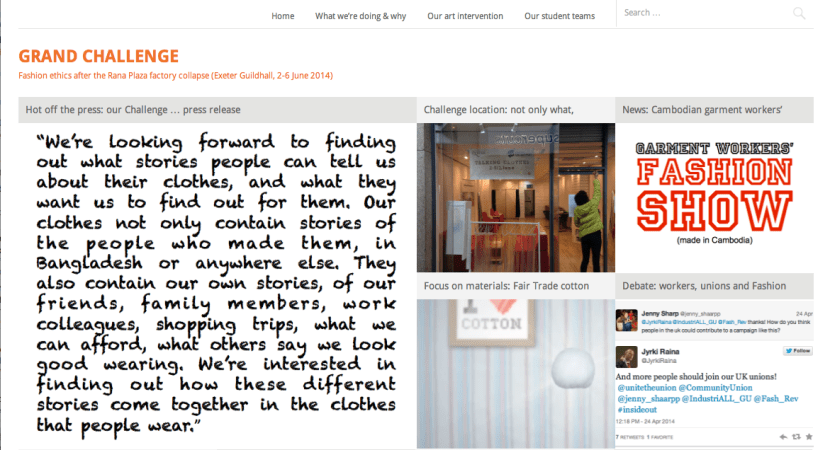
Click image for blog
Why Eeva Legoed the kidnapping of Ronald McDonald
#followtheteachers blog post No.5
‘Kidnapping Ronald McDonald’ (Jani Leinonen, Finland) made in #lego by @EevaKemppainen @ #gaconf14 #ideazone pic.twitter.com/h1FGNk4g7P
— followthethings.com (@followthethings) April 16, 2014
Our 4th #followtheteachers post: on subvertisement workshops

“What the §^*! are we doing here?”
A couple of weeks ago, we published a guest post from Eeva Kemppainen describing the ways in which her work for followthething.com and her masters thesis on trade justice pedagogy in the UK and Finland, had led to her work on a ‘Closing the Gap’ project with Finnish pro-ethical trade NGO Eetti . This is Eeva’s second post, in which she describes how she works with diverse groups of students (using followthethings.com as a resource) and shows the kinds of subverts that her students create.
Show us your @fash_rev trump cards!
Today, we started to play with the Fashion Ethics Trump card game we’ve made for, and with, Fashion Revolution Day.
We ended up tweeting some #fashtrumps selfies and a step by step guide for anyone who wants to join the #fashtrumps conversation.
We present to you here: some examples of #fashtrumps selfies, those guiding tweets and a twitter box that will show the ones that you have made…
Give this a go!
Some examples
followthethings & research impact
There’s a new special issue of the online, open access Geography journal ACME on the impact of academic research. This has become one of the ways in which the value of academic research is assessed in UK Higher Education, through the Research Excellence Framework.
One of the papers is by Ian Cook et al (that’s me/us), about the longstanding ‘follow the things’ research and public pedagogy that led to the creation and opening of followthethings.com in October 2008. To give a flavour of its approach to impact, here’s an extract from the paper:
When you publish academic work and make it freely available online, people read it and get in touch with you asking if you’d like to take part in work they’re (thinking of) doing. So you end up doing all kinds of unexpected things. This way of working is a core principle of ‘organic public geographies’ (Fuller and Askins, 2010; Hawkins et al., 2012). And it involves writing critical, radical, scholarly papers that are both publishable in academic journals and books, and accessible to more than academic audiences – like school teachers, journalists, filmmakers and artists: the people who make and use the work you’re researching. This is not the kind of “unidirectional knowledge” transfer that aims to make clear interventions in public debates (Pain et al., 2010, 185). It’s the kind that has critical pedagogy at its heart, that treats knowledge as “emerg[ing] only through invention and re-invention, through the restless, impatient, continuing, hopeful inquiry human beings pursue in the world, with the world, and with each other” (Freire, 1996, 52-3). Here, as Rich Heyman (2010) argues, academic writing should not be treated as the end point of research. Instead, it should aim to encourage research and conversation to continue beyond publication by offering its readers, for example, catchy and surprising narratives to engage with, unheard voices to listen to, unfamiliar concepts to use, tricky problems to think through, new skills to learn, and intriguing detective work to do (Cook and Woodyer, 2012).
Cook et al (2014, 48).
If you want to read the rest of the argument, download it here.
If you have any comments or questions, please submit them below.
Thanks
Ian
 the back office