
Category: “follow the things”
Key concepts: Æfficacy / Æffect
The followthethings.com project is slowly moving from a curatorial to an analytical phase. We’re getting our heads around ways in which we can analyse the online commentaries we’ve researched and remixed for over 60 films, art works, activist stunts and pieces of journalism.
All of the work showcased on our website sets out to make tangible to its audiences the relationships between the people who make and consume things.
But who made them, why, with what resources and how were they hoping they would make a difference to their audiences and participants?
How did members of their audiences (consumers, citizens, corporations, governments, etc.) make sense of and react to them?
And what impacts do they seem to have had?
We want to assemble a vocabulary (see Massey 2013) which will enable these intentions, relations, reactions and connections to be named, discussed, critiqued and developed.
We’re actively looking to name what we find in our data.
Æfficacy / Æffect
Effect (v.) “To bring about (an event, a result); to accomplish (an intention, a desire).”
Affect (v.) “To have an effect on the mind or feelings of (a person); to impress or influence emotionally; to move, touch.” (Oxford English Dictionary)When it comes to bringing about social change, effect and affect are intertwined. Artistic activism aims to bring about demonstrable change through moving people viscerally and emotionally. We might think of this as: Affective Effect. Or, if you prefer: Effective Affect. Or, as we’ve come to call it: Æffect.
At the C4AA we are very, very interested in æffect. Artistic activism might be fun, creative and cutting edge but if it doesn’t deliver the goods in helping to transform the world, then what good is it?
Since we began the C4AA we’ve been asking the questions: Does it work? How do we know? And what does “working” even mean when we combine the arts and activism?
The Streisand Effect
… the phenomenon whereby an attempt to hide, remove, or censor a piece of information has the unintended consequence of publicizing the information more widely, usually facilitated by the Internet. It is an example of psychological reactance, wherein once people are aware something is being kept from them, their motivation to access and spread the information is increased.[1]
It is named after American entertainer Barbra Streisand, whose 2003 attempt to suppress photographs of her residence in Malibu, California, inadvertently drew further public attention to it. Similar attempts have been made, for example, in cease-and-desist letters to suppress numbers, files, and websites. Instead of being suppressed, the information receives extensive publicity and media extensions such as videos and spoof songs, often being widely mirrored across the Internet or distributed on file-sharing networks
We’ll post more when we find them. Watch this space.
New publication: Teaching media literacy and the geographies of consumption
How can encouraging students to cut up, rearrange and otherwise mess with adverts’ imagery and messages help them to better appreciate the complex geographies of consumption and international trade? How can the teaching of controversial issues build on students’ senses of injustice, mischief and creativity? We have a suggestion…
Earlier this year, a booklet called Medialukutaitoa vastamainoksista became a booklet called Teaching media literacy and the geographies of consumption. These booklets come from a series of workshops developed by former followthethings.com intern Eeva Kempainnen in a variety of educational settings in Finland. The hands-on and entertaining methods she sets out are suitable for a variety of ages, and the booklets are crammed with ‘how to’ advice and excellent examples of student work. Watch our cheaply produced promo, download the booklets by clicking the links, and find out more about Eeva’s work here.
Thanks to Mary Biddulph and Alan Parkinson for their help in this process.
Fashion Revolution sessions at the RGS(IBG) conference next week
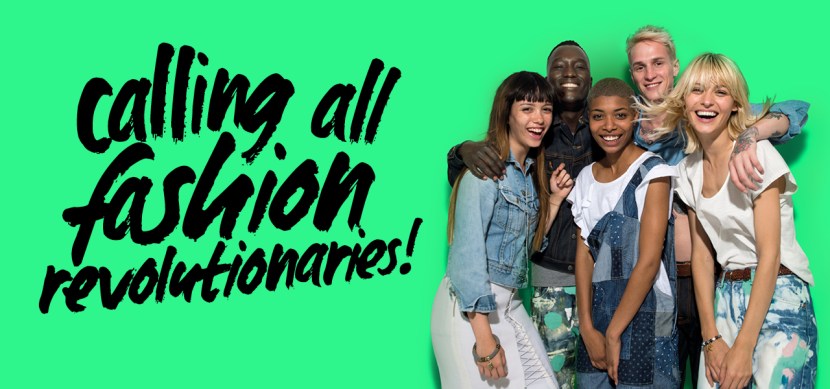
We’ve organised three sessions on ‘Scholar Activism and the Fashion Revolution: who made my clothes?’ at the Royal Geographical Society (with the Institute of British Geographers) conference in London next week. We are excited to bring together scholars from many countries and disciplines and key members of Fashion Revolution’s Global Coordination Team. Everything takes place on Thursday 1st September. Here’s the line-up (click the session titles for the full details):
Session 1: ‘connecting producers and consumers’
Chair: Ian Cook, Geography, University of Exeter
Rebecca Collins, Geography and International Development, University of Chester: New-Old Jeans or Old-New Jeans? Unpicking perverse, provocative and paradoxical temporalities in young people’s clothing consumption.
Do ‘follow the thing’ documentaries affect their audiences?
This is one of the questions that drives our work at followthethings.com. We tend to find our answers – yes, no, maybe, depends, etc… – in the user-generated comments on video-sharing websites like YouTube and in the comments on newspaper reviews. We’re currently wading through thousands of comments on a 2015 ‘follow the fashion’ film called The True Cost, and came across this powerful video response. We’re giving a paper about the True Cost and fashion activism at a conference next month. There’s an argument in the literature that work like this makes prescriptive arguments about responsibility that are so infinitely demanding they can generate a sense of powerlessness in consumer audiences. This doesn’t seem to be the case, at least for this viewer. Watching this film was a powerful experience. For us, this kind of response changes the question that’s asked. Now it’s ‘how do ‘follow the things’ documentaries affect their audiences? What vocabulary can we develop to describe this? That’s what we’re working on.
followthethings.com as digital geography
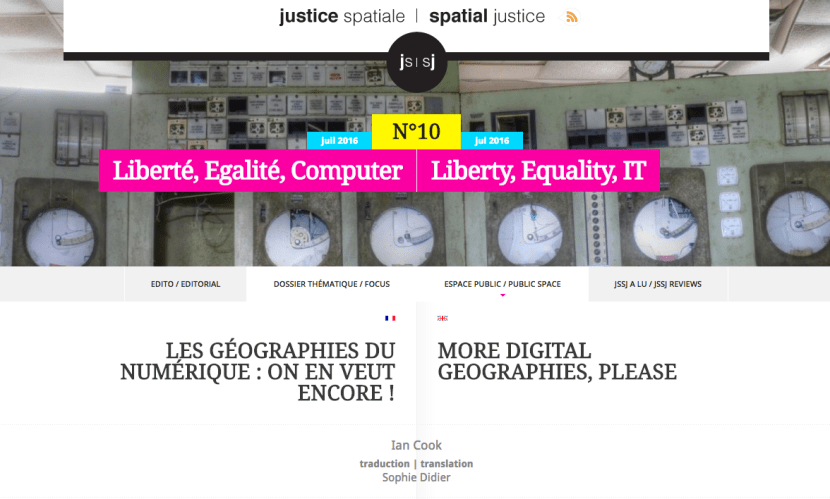
Ian was asked recently to write a short article about the subversive possibilities of digital geographic practice for the journal Justice Spatiale | Spatial Justice and to place followthethings.com in this emerging, absent, who knows what, tradition. It’s just been published.
We noticed that followthethings.com, or anything that seems (to us) to be anything like it, was not being discussed in reviews of digital geographies. So, we imagined the kind of review in which it would be a central example. A review that’s based on already-published literature that’s informed and helped us to make sense of what we’ve made and what we can do with it. A review whose plea for ‘more digital geographies’ is a plea both for more experiments in digital geography, and for experiments that are themselves more digital.
This kind of work more fully lives in and works through the new media ecology of web2.0. followthethings is an example of what this can look like, how it can operate, the kinds of arguments it can make, how it can make those arguments, how it could be assessed, what we could and should write about ‘it’ in academic journals.
Other examples are, of course, available. For us, the Museum of Contemporary Commodities (MoCC) project also fits this bill, in its own unique ways.
See what you think. Click the image to read the full argument.
Thanks to our friends at Paris 7 University for this opportunity to express ourselves.
On the making of followthethings.com

Here’s Ian et al’s first paper about the making of followthethings.com. It was published in French in 2014 and has recently been made available on open access. You can now download the paper as it was originally written in English. If you want the French version, click here.
followthethings.com was not designed and then made, but emerged from an iterative, creative, collaborative, conversation-infused, open-ended, making project. The paper is written to reflect this. Here’s the abstract: Continue reading
New on followthethings.com: the 2 Euro T-shirt: a social experiment
It’s Fashion Revolution Week this week. Last year’s headline, viral #whomademyclothes smash came from Germany. A vending machine apparently dispensing t-shirts for only 2 Euros in a Berlin square. If you put your money in, you had to watch a video showing the sweatshop conditions in which they were made. Twenty seconds in, you were presented with an option to buy the t-shirt or donate your 2 Euros. You were also filmed. With your permission, your reactions were included in a short film that was posted on YouTube on 23 April 2015. To date, over 7 million people will have seen your reactions, the expressions on your face, and joined the often heated, occasionally funny and carefully reasoned conversation in the comments below, and elsewhere online.
At followthethings.com, we turn the thousands of comments all over the internet into a digested read, a single conversation. Reading this you might get a sense of how successful this experiment was, and what made the video go viral. You might also think what you might have added to the conversation. What is the experiment showing? What’s it not showing? See what you think. Here.
Highlights from the conversation: Continue reading
Possibly the most coherent explanation for ‘follow the thing’ research Ian has ever offered!
Our CEO Ian Cook gave a talk about followthethings.com at an ‘Interdisciplinary Perspectives in Consumption Ethics’ seminar at the University of Leicester in June 2015. Afterwards, the speakers were asked to sit down and explain to camera how they had become interested in ‘ethical consumption’ as researchers. This is what he said…
Ian thanks Dierdre Shaw, Helen Gorowek and Andreas Chatzidakis for inviting him to present, Juliet Schor, Marylyn Carrigan and Caroline Moraes for their great talks, and Andreas for his at-ease interviewing skills.
Fashion Revolution call for papers at RGS(IBG) annual conference
We’re involved in running a session at the Royal Geographical Society (Institute of British Geography) annual conference this summer whose aim is to bring academic fashion experts into dialogue with the Fashion Revolution movement. We’re asking how fashion research can contribute to what is becoming a worldwide movement for a more ethical / sustainable fashion industry in the wake of the Rana Plaza factory collapse in April 2013. We’re looking for academic research from any discipline that can contribute to Fashion Revolution’s five year planning. Here’s what we’re doing. Please get in touch with Ian, Lousie and/or Alex to discuss any ideas. The deadline for abstracts is Friday 12th February.
– Call for papers –
Scholar activism and the Fashion Revolution: ‘who made my clothes?’

Abstract
The collapse of the Rana Plaza factory complex on April 24th 2013, which crushed to death over 1,000 people making clothes for Western brands, was a final straw, a call to arms, for significant change in the fashion industry. Since then, tens of thousands of people have taken to social media, to the streets, to their schools and halls of government to uncover the lives hidden in the clothes we wear. Businesses, consumers, governments, academics, NGOS and others working towards a safer, cleaner and more just future for the fashion industry have been galvanised.
Where does Isis get its money and weapons from?
In the UK’s discussions this week about appropriate responses to Isis/Daesh questions have been asked not only about bombing and ground troops, but also about supply lines of weapons, money and people. A brief examination of news reporting on these issues suggest that a ‘follow the things’ approach to understanding and combatting Isis/Daesh has been emerging over the past year. We’re using this post to begin to piece its elements together. Follow the links to flesh out the stories.
Corbyn’s questions
“[UK Labour Party leader] Jeremy Corbyn posed a series of rhetorical questions when asked whether bombing Isis following the Paris terror attacks would make a significant difference to the situation. In an interview with Lorraine Kelly on ITV, [he] answered “probably not”, adding: “Who is funding Isis? Who is arming Turkey? Who is providing safe havens for ISIS? You have to ask questions about the arms everyone has sold in the region. … So where does Isis get its money, guns and bombs, both in Europe and in the Middle East?” (Brooks-Pollock 2015 np link). Continue reading
 the back office