
Category: art
Talk: keeping conversations going with Political LEGO
At the end of 2015, followthethings.com CEO Ian Cook gave a talk explaining why we re-create scenes described on our website it LEGO, what our shoppers like about them, and what they add to our scholar-activist work. That talk was filmed and you can watch it below. He talked through a series of re-creations made in response to the controversy provoked by a TV documentary film called ‘Primark on the rack’ that was first broadcast 2008, and re-energised by Primark’s response to the Rana Plaza collapse in 2013. It draws upon the work of Political LEGO artists like legofesto, whose conversation with Julia Zielke we published a few months ago. Ian’s talk outlines the argument being made in an academic paper he’s currently writing. Think of this talk as its Trailer….
Why David Cameron isn’t the only person to (allegedly) be intimate with pigs…
One of our favourite examples of the followthethings genre is a book by artist Christien Meindertsma called PIG 05049. She finds pig parts in 185 products and describes pigs as ‘absolute kings and queens’. How did she do this? As she describes her work in this TED talk, “I followed this one pig…”
Meindertsma isn’t the only artist to follow a pig. In 2011, musician Matthew Herbert made an album called ‘One Pig’. He fed sounds from a pig’s life into music. Here’s his explanation, track by track…
Bideford Black: exhibition trailer and press release
followthethings.com has been a project partner for The Bideford Black (2nd generation) Arts Council-funded project in North Devon. There are 8 commissions, including one involving CEO Ian making things from this raw pigment with artists Joan and Neville Gabie. A film has been made to document the project and the production of its work. The trailer was released today:
The Press release describes what Neville, Joan and Ian have been doing as follows:
Prompted by Bideford Black, and using a shared sketchbook, artists Neville Gabie and Joan Gabie are holding a ‘dialogue of ideas’ with Cultural Geographer Ian Cook (University of Exeter). Together, the three explore the physicality, social and geological significance of Bideford Black, presenting films of studio drawings and artifacts discovered and created along the way.
The exhibition opens from 3rd October to 13 November, at the Burton Art Gallery & Museum, Bideford, Devon EX39 2QQ. For more details about the Bideford Black project, please see the project blog.
How to run a subvertisement workshop
One of our former interns, Eeva Kemppainen, now works in Helsinki for the pro-Fair Trade NGO Eettisen kaupan puolesta (Pro Ethical Trade Finland). In 2014, she published a paper in the Finnish journal Natura about ways in which she tries to engage students in humorous critiques of consumption and advertising. They examine, then cut up, rearrange and/or scribble on magazine adverts. They try to subvert their messages so that the information that they hide is made visible. What they produce are what’s called subvertisments. Here Eeva describes how she organises subvertisement workshops, and showcases some of the work that students have produced.

Figure 1: An example of a student-produced subvertisment: rearranging kids in an H&M advert to show connections between who makes and wears their clothes
Political LEGO: an interview with Legofesto
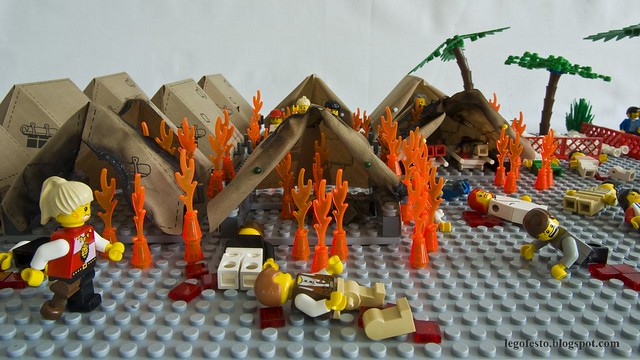
Sri Lanka: Bombing a refugee camp 4 (Legofesto 2009).
We re-create scenes from the trade justice documentaries, art and activist work in LEGO. We photograph them, put them online and embed them on our site’s pages. You can see what we’ve done here. This work was inspired by LEGO scenes from the ‘War on Terror’ produced by a person calling herself Legofesto. We read interviews with and articles about her that were published in 2009, but hadn’t found anything since. This year, after teaching Political LEGO on the MRes Critical Human Geographies at Exeter University, one student – Julia Zielke – emailed Legofesto to interview her for an essay. What questions hadn’t been asked in those 2009 pieces? What had Legofesto been doing since then? Can we expect any new Legofesto work? This is what she said… Continue reading
New in Lego: A Global Positioning System

Here’s the latest of our Lego re-creations, made today to add to one of our first published pages: on Melanie Jackson’s (2006) digitally generated animation (and catalogue) A Global Positioning System. Continue reading
Why Eeva Legoed the kidnapping of Ronald McDonald
#followtheteachers blog post No.5
‘Kidnapping Ronald McDonald’ (Jani Leinonen, Finland) made in #lego by @EevaKemppainen @ #gaconf14 #ideazone pic.twitter.com/h1FGNk4g7P
— followthethings.com (@followthethings) April 16, 2014
Our 4th #followtheteachers post: on subvertisement workshops

“What the §^*! are we doing here?”
A couple of weeks ago, we published a guest post from Eeva Kemppainen describing the ways in which her work for followthething.com and her masters thesis on trade justice pedagogy in the UK and Finland, had led to her work on a ‘Closing the Gap’ project with Finnish pro-ethical trade NGO Eetti . This is Eeva’s second post, in which she describes how she works with diverse groups of students (using followthethings.com as a resource) and shows the kinds of subverts that her students create.
Happy ‘shopping’: making & using followthethings.com bags
This post began as a contribution to a special issue of the journal ACME on the new ‘impact’ agenda in British Higher Education. Our shopping bags and ‘ladybugging’ activities seemed to fit this bill, although their ‘impact’ wasn’t measurable (and that was the point). In the end, another short piece on impact was written for the journal. We have revised that original paper to post here, and hope it may be interesting for readers who are keen to use our site and/or bags in their teaching and wider ‘shopping’ activities.
Update September 2016: sorry, we have no bags left to give away. They’ve all gone. If you have one, it’s a priceless collector’s item. If you see someone carrying one, please say hi.
——————————————————-
“We need to develop forms of critique that inspire hauntings, feed feelings, come alive, leap out and grab us, … that are not just about vital materiality but are themselves vitally material” (Cook & Woodyer 2012 p.238).
Our #followtheteachers blogging begins
We’ve been working with a group of trainee high school teachers at the University of Nottingham this year. We’ve talked in detail with them about how followthethings.com could help them engage their students in a variety of complex and sometimes controversial geographical issues.
We enjoyed working together so much that, after hosting together a ‘Teaching with followthethings.com’ workshop at the 2013 Geographical Association conference, we decided to continue our work as they begin their careers as Geography teachers.

We decided to call what we were doing the ‘follow the teachers’ project. This would a) follow the use, adaptation and creation of followthethings.com resources to teach geography and related subjects, and b) share these experiences and resources online for others to use. Over the next few months, we’ll be hearing from seven teachers involved in this project.
We begin with Oprah Whipp’s use of our page on a Simpson’s couch gag to teach her students about globalisation and geographical thought.
I had a class of 30 year 7 pupils, mixed ability who had never studied the concept of globalisation, however this is a topic covered in detail in year 9, and again at GCSE and A Level. What could I do to put a spin on this topic, that wouldn’t become repetitive?
I began looking through the followthethings.com web page, which I was introduced to during my PGCE course at the University of Nottingham and came across the video clip directed by Banksy, and the opening sequence he created for an episode of the cartoon series ‘The Simpsons’. This was something I felt that my class would relate to, and capture their imagination.

Get a bag from followthethings@yahoo.com
In the lessons prior to this, I had introduced key terms, and completed followthethings.com shopping bag missions 1-3 on the Mission:Explore website. I adapted mission 3 – ‘Who made it?’ – by splitting the class into two groups, and asking one what they would say to a person who had made their bags, and the other what they thought those workers would say to them. This allowed pupils to gain a brief understanding of the concept of globalisation, focusing on worker’s rights.
This lesson began with me recapping the term globalisation, and then introducing Banksy by showing the pupils a picture of one of his guerrilla artworks (download my powerpoint slides). I asked them to think geographically, and about the topic we had been looking at over the past two weeks to help them do so. The class coped really well with this, and a couple of the higher levelled pupils even knew the artist and were able to inform their peers on his background.

From pupil to factory worker.
The detailed walk through of the clip provided on its followthethings.com page enabled the gifted and talented pupils to read out loud to the rest of the group, which ensured the initial material (the video clip) was accessible to each member of the class and they understood Banksy’s reasoning behind it.
My main task was for the pupils to create their own piece of guerrilla art. Here is where differentiation became apparent. The lower levelled pupils interpreted Banksy’s work, and wrote a vague description and reasoning behind their work, whereas the higher achieving pupils really came to life, incorporating ideas from the previous lessons (the postcards and the meaning of the word globalisation).
I really enjoyed this lesson, teaching it was a highlight of my teaching practice, especially because of the positive feedback I received from my pupils.
Update: twitter feedback
@JarradNorthover thank you for taking the time to read it! Me and my colleagues have more blogs to come over the summer #followtheteachers
— Oprah Jade (@OprahJade) July 22, 2013
@OprahJade Write for us next!!:)
— Protocol Education (@ProtocolEd) July 22, 2013
 the back office