
Category: University of Exeter
followthethings.com CEO wins Royal Geographical Society teaching award

Photo credit: Nicola Thomas
Good news. On Monday, CEO Ian was awarded the Royal Geographical Society (with the Institute of British Geographers) ‘Taylor and Francis Award for Excellence in the Promotion and Practice of Teaching and Learning of Geography in Higher Education’. He was nominated for the whole ‘follow the thing’ appreciation of the the social relations of trade and its application across school, university and wider public pedagogies. The ‘et al’ in his name signifies his permanent, heartfelt appreciation of everyone involved in the project over the years, and those who may join it in the future. As he explains:
“I am very happy and humbled to be given this award. My research began in the classroom where I miserably failed to encourage students to be interested in what was happening in other parts of the world. I was desperate to find a way to show how their lives were connected to those of the people and places we were studying. Finding out how some of our things are made, in some of those places, was the answer and that’s how the ‘follow the thing’ idea originated in Kentucky in the late 1980s. Since then, I’ve really enjoyed developing ways to help students follow their own things, to think empathetically about their relations and responsibilities to others in the process, and to play, have fun, make mischief, be activist with their findings. I’ve learned as much as I have taught as we have done this together. I’ve been constantly surprised by what I have learned from the students who have taken my modules and worked as interns on the followthethings.com project. Being ourselves is a massively collaborative effort. I truly appreciate everyone’s contributions.”
This work continues -> next we’re working on our ‘follow the things’ Subvertisement project in Finland with Eeva Kempainnen – researching and adding 10 new pages to our website – running our free Fashion Revolution ‘Who Made My Clothes?’ course that starts on 26th July, and opening the Museum of Contemporary Commodities at the RGS(IBG)’s Pavilion Gallery on London’s Exhibition Road from 24th – 27th August. Please join us.
Ever wondered ‘Who made my clothes?’ Find out by taking this free online course
Fashion Revolution week finished yesterday. It’s call to arms is the question ‘Who made my clothes?’ Here’s how you get involved, do this yourself.
On June 26th, there will be another way to find out ‘Who made my clothes?’: that’s when a free 3 week online course led by our CEO Ian begins. Here’s the trailer. You can sign up here.
Guest blog: what is the thing with palm oil?
This year we have been working with Dr Carolin Schurr in Switzerland. Her new ‘Follow the Thing: Studying Transcultural Markets’ course at the University of St Gallen ran in parallel to our ‘Geographies of Material Culture’ course at the University of Exeter. To showcase the awesomely critical, creative scholar-activist work that our students produce, this year we’ve published student guest blogs about gun sights, iPhones and paint. This post contains two pieces of work on palm oil by Carolin’s students Gianmarco Zorloni, Harpreet Perhar, Julian Krauth, Leonardo Ehnimb and Milan Kuzmanovic. We start with a short animated information film (expertly put together using Videoscribe software), followed by a script showing how ‘the thing with palm oil’ can enter conversation and affect behaviour, and finishing with the research report upon which this work is based. How can you respond to ‘follow the thing’ research that finds that thing in, more or less, everything?!
The information film
The script
Guest blog: Dear iPhone Girl
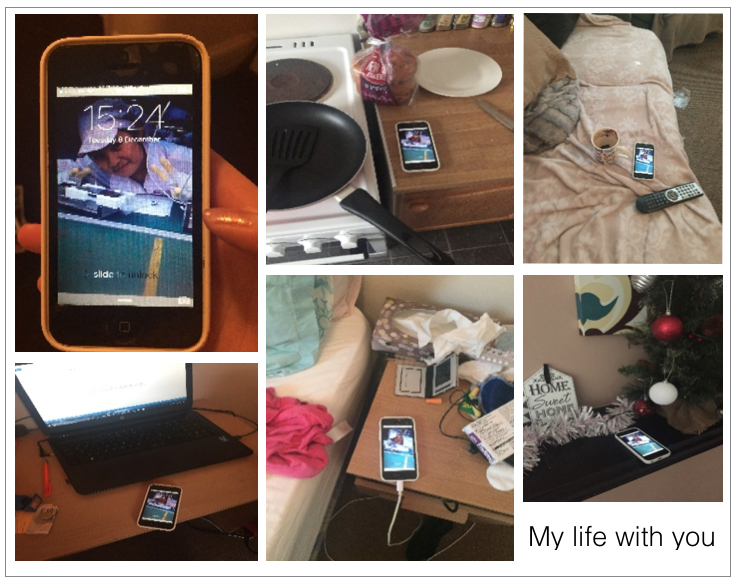
Here’s another excellent example of journal writing from the Exeter Geography module behind our website. At the start of the module, we ask the students to add to their phone homescreens this photo of an Apple factory worker which, it seems, was accidentally left on an iPhone bought in 2009. The person who found this and four other photos posted them online and the quest to find out who she was, why photos of her were on that phone, and what would happen to her after they went pubic went viral (as documented on our followthethings.com page). We ask our students to keep her photo on their homescreens until the end of the module, for almost 4 months. What can happen to you when she looks at you every time you look at your phone, wherever you go? Sophie Woolf explains… to the person who became known as ‘iPhone Girl’.
Guest blog: step away from the weapon
This post is by Ginny Childs, a student who took the Exeter University Geography module that is behind our website last term. It’s a piece of (slightly edited) coursework that she wrote in response to reading behind Sofia Ashraf’s ‘Dow vs. Bhopal: a toxic rap battle’. Ginny wasn’t even born when the Bhopal factory exploded in 1984, but it affected her here and now. Here’s how…

I joined Exeter University Officer Training Corps this year. Last weekend was my first weapons training session; on the SA80 assault rifle. The first lesson I received was a ‘Normal Safety Procedure’ on what to do if I drop it and the sighting system cracks. The system uses tritium (a radioactive hydrogen isotope) in gas form, to create visible light. If it escapes, and I were to inhale it, radioactive damage could occur in my body.
Sat in my weapons training lesson, whilst thinking about tritium, my mind drifted to methyl isocyanate (MIC). The Bhopal disaster was the topic my group were researching for this module. I’d been researching the thousands of deaths and deformities this gas leak caused. Now, here I was being cautioned on tritium. It seemed silly. The rifle contains only a minute amount, and it’s deemed to be one of the least hazardous radionuclides. Yet, I was laboriously taken through a step-by-step routine to memorise the safety procedure: STEP AWAY FROM THE WEAPON… HOLD YOUR BREATH…GET ANY SMOKERS TO PUT OUT CIGARETTES…INFORM ARMOURY OF INCIDENT etc.
Shopping and subversion
This week, for the module behind our website, we held an arts and activism symposium at the University of Exeter. One of our speakers was artist Louise Ashcroft, who worked with us on our sister project the Museum of Contemporary Commodities earlier this year (what she made is here). Never have we heard students laugh so hard and be so inspired in an academic classroom. Watch Louise’s TED talk and you’ll see what we mean.
Our Arts & Activism Symposium @exetergeography today
Today is an exciting day in the university module that powers our website. It’s our annual Arts and Activism Symposium, funded and hosted by the Department of Geography at the University of Exeter. Here’s the line-up and some background info on the projects our speakers will be talking about. After this, our students develop their own commodity activist work.
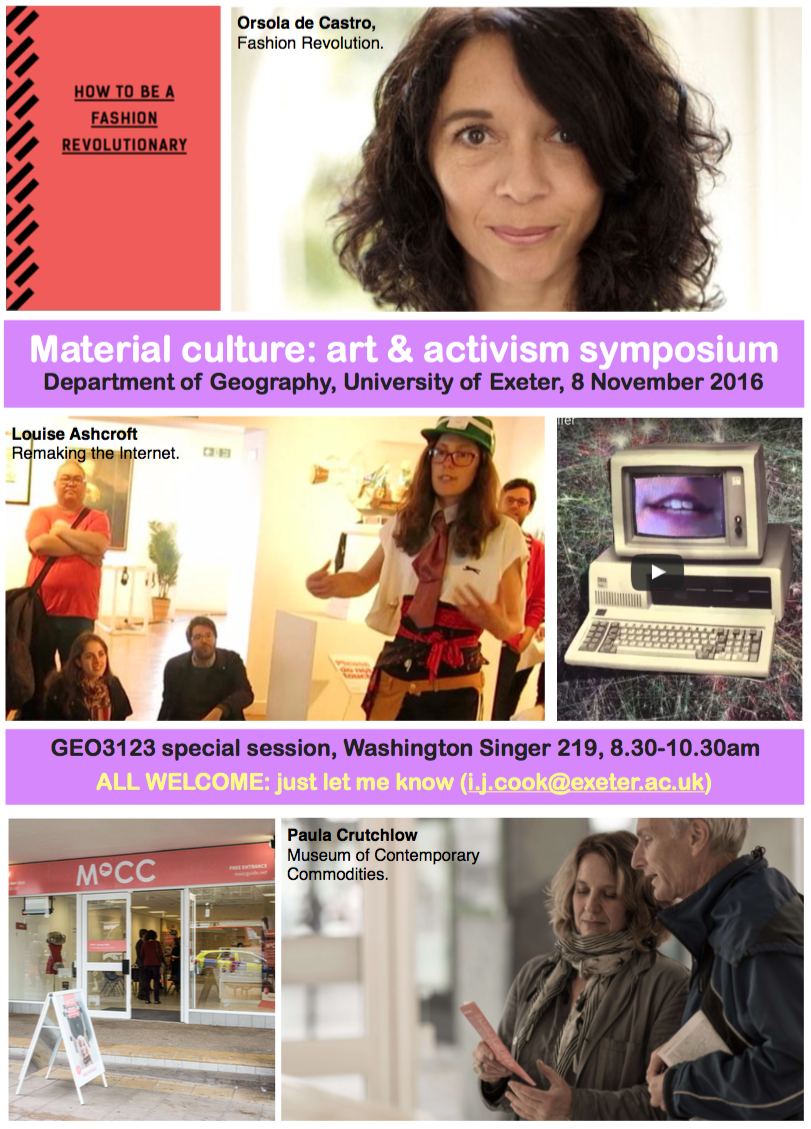 1) Orsola de Castro: watch this
On the making of followthethings.com

Here’s Ian et al’s first paper about the making of followthethings.com. It was published in French in 2014 and has recently been made available on open access. You can now download the paper as it was originally written in English. If you want the French version, click here.
followthethings.com was not designed and then made, but emerged from an iterative, creative, collaborative, conversation-infused, open-ended, making project. The paper is written to reflect this. Here’s the abstract: Continue reading
Political LEGO: an interview with Legofesto
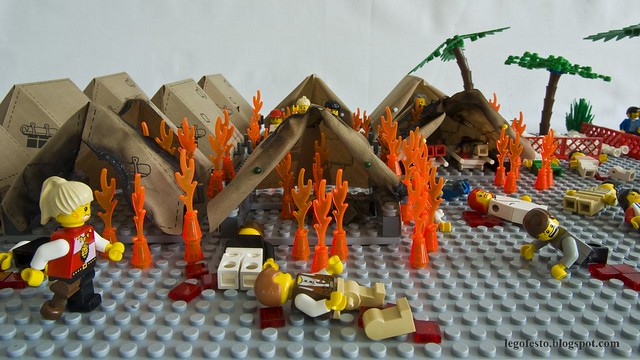
Sri Lanka: Bombing a refugee camp 4 (Legofesto 2009).
We re-create scenes from the trade justice documentaries, art and activist work in LEGO. We photograph them, put them online and embed them on our site’s pages. You can see what we’ve done here. This work was inspired by LEGO scenes from the ‘War on Terror’ produced by a person calling herself Legofesto. We read interviews with and articles about her that were published in 2009, but hadn’t found anything since. This year, after teaching Political LEGO on the MRes Critical Human Geographies at Exeter University, one student – Julia Zielke – emailed Legofesto to interview her for an essay. What questions hadn’t been asked in those 2009 pieces? What had Legofesto been doing since then? Can we expect any new Legofesto work? This is what she said… Continue reading
Fashion Revolution Day 2015 in Schools & Universities: a roundup
Here are some of the many ways in which young people around the world were curious, found out and did something for Fashion Revolution Day this year. We’re now collecting and sharing ideas for 2015-6. Please get in touch with education@fashionrevolution.org with actions and advice that we’ve missed. #whomademyclothes
 the back office
