
Category: catchy
On the making of followthethings.com

Here’s Ian et al’s first paper about the making of followthethings.com. It was published in French in 2014 and has recently been made available on open access. You can now download the paper as it was originally written in English. If you want the French version, click here.
followthethings.com was not designed and then made, but emerged from an iterative, creative, collaborative, conversation-infused, open-ended, making project. The paper is written to reflect this. Here’s the abstract: Continue reading
Guest blog | Hannah asks her students ‘Who are you wearing?’
A couple of weeks ago, we attended the Geographical Association (GA) conference in Manchester. This is a conference for geography teachers, student geography teachers and the people who train them. We talked to many who taught their students the geographies of trade through researching their own clothes. We went to a talk where Hannah Campion, a newly qualified teacher, explained how she sparked her students’ curiosity about these geographies using some of our teaching resources. With the second anniversary of the Rana Plaza collapse only a few days away, we are publishing what she said…
A £4 t-shirt

A cheap white tee (click for image source)
My name is Hannah Campion. I am an NQT at The National Church of England Academy, Nottinghamshire. My fascination around the Geography of my ‘stuff’ developed from undergraduate study of commodity chains, commodity fetishism and Cook’s (2004) ‘follow the thing’ approach at the University of Nottingham. An assignment during my teacher training course on ‘Fantastic Geographies’ gave me the opportunity to bring this controversial issue into the classroom, to enable pupils to investigate and to develop a curiosity around the lives of our everyday commodities. The initial scheme is a 5 lesson sequence unveiling and unpicking the life of a plain white £4 t-shirt from production through to consumption. In 2014, I was asked to display my work at the Geographical Association conference in Guildford as part of the Ideas Zone exhibition. Since then, I have written an article for Teaching Geography (Campion 2015) and presented a Teacher-to-Teacher session at this year’s GA conference entitled ‘Behind the seams: global connections in the classroom (KS3)’.
Everything is (not) awesome: Greenpeace, Shell & Lego activism.
Greenpeace & Lego
Greenpeace want Lego to end its links with Shell, and are currently campaigning through the medium of imaginative Lego re-creation. This video is one of a number of examples, whose aim is to encourage people to sign this petition. In the wake of the hugely successful Lego Movie (whose stars make a cameo appearance) this campaign is becoming perhaps the most lavish and high-profile example of Lego activism to date.
followthethings.com & Lego
On a much smaller budget, we’ve been making, photographing and posting online re-creations in Lego of (imagined) scenes from trade justice films, art and activism for a while now. See, for example, our recreations from and around the BBC Panorama documentary ‘Primark on the rack’. Continue reading
Next week: we’re in a shopping centre talking clothes
We’ve been working on one of 12 ‘Grand Challenges’ that the University of Exeter runs each year for first year students. The idea is that academic staff introduce first year students from across the university to the Grand Challenges of the 21st Century, through some hands-on learning and with the help of visiting experts (who students refer to as ‘real people’, in my experience).
Challenges this year include Climate Change, Global Security and Mental Health, and the one that we’re running is on Fashion ethics after the Rana Plaza collapse.
There are four ways to find out more, to get involved, and to follow us next week:
1) Our blog
All the background information we’ve put together to prepare for this challenge. The Rana Plaza collapse and its ripple effects, and how we’re trying to appreciate and work with these ripples in the space of Exeter’s Guildhall Shopping centre, where we’re be occupying 2 disused shops and its main square for 4 days next week.
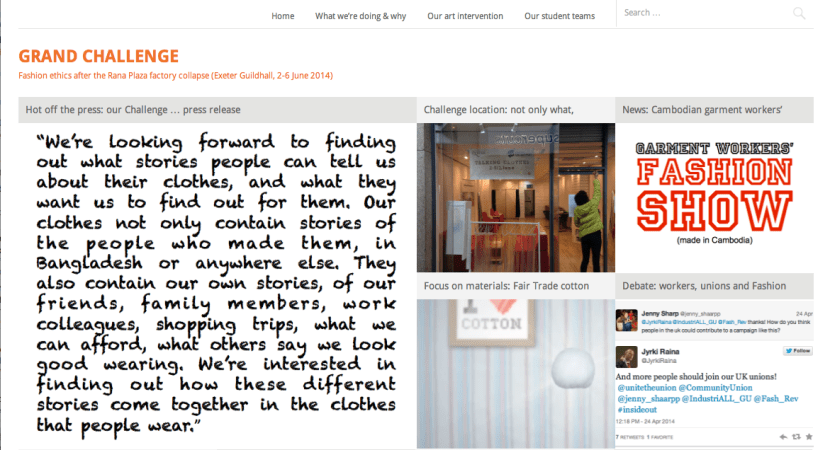
Click image for blog
Our 4th #followtheteachers post: on subvertisement workshops

“What the §^*! are we doing here?”
A couple of weeks ago, we published a guest post from Eeva Kemppainen describing the ways in which her work for followthething.com and her masters thesis on trade justice pedagogy in the UK and Finland, had led to her work on a ‘Closing the Gap’ project with Finnish pro-ethical trade NGO Eetti . This is Eeva’s second post, in which she describes how she works with diverse groups of students (using followthethings.com as a resource) and shows the kinds of subverts that her students create.
Show us your @fash_rev trump cards!
Today, we started to play with the Fashion Ethics Trump card game we’ve made for, and with, Fashion Revolution Day.
We ended up tweeting some #fashtrumps selfies and a step by step guide for anyone who wants to join the #fashtrumps conversation.
We present to you here: some examples of #fashtrumps selfies, those guiding tweets and a twitter box that will show the ones that you have made…
Give this a go!
Some examples
Sodastream studies…
Overnight, [Scarlett Johansson] has become the Marie Antoinette of the Israeli-Palestinian conflict, smiling regally and offering: “Let them sip soda.” (source)
We’ve been following carefully how actor Scarlett Johansson (a.k.a Scarjo) was forced last week to choose between her role as an Oxfam Global Ambassador and as the face of soft-drink machine maker Sodastream.
This is the banned TV advert that was due to be shown at half time during Superbowl 2014, the ‘most watched’ TV show in the US. What values are expressed here?
How to make & play Fashion Revolution’s Fashion Ethics Trump card game
In November last year, we made and played a Ethical Fashion Trump Card game that we were developing for the Fashion Revolution Day Education Pack.
Its aim is to encourage its players to think about their clothes and fashion ethics, a topic that’s more important than ever after the Rana Plaza factory collapse in Dhaka, Bangladesh on 24 April last year.
It’s a playful way of encouraging some serious discussion about who and what we are wearing.
Here, we want to showcase the new FRD pack – which was published yesterday – and to provide a match report that will give you an idea of how the game can be made and played in your classroom, home, shed … wherever you play cards!
Making music in trade justice education: listen up!
Creative academic expression
There’s an undergraduate module at the University of Exeter called ‘Geographies of Material Culture’. It’s one of two University modules whose student coursework form the basis of almost every followthethings.com page. The module is assessed through students’ critical self-reflections on whatever comes to mind through reading the academic literature and working together to research and publish draft ‘compilation’ pages and new work for the site. They are encouraged to be creative, to express themselves in ways that rework the traditional essay formal that everyone is used to. The work is diverse and fascinating. You never read the same thing twice.
‘How am I gonna be an activist about this?’
One type of work that’s started to emerge in 2013 are original songs, written, recorded and published online by students and written about on paper. There have been two so far. The first is by Jenny Hart, who submitted her song at the start of the module this year (in October). She’s trying to get her head around the key theoretical baselines of the module. The second is by Tommy Sadler, who submitted his song at the end of the module last year (in January). He’s expressing what the module was about, for him. Both shared their songs via Soundcloud, and you can listen to them here:
 the back office