
Category: Where does our stuff come from?
A pig in a hundred pieces: Christien Meindertsma
If you have been looking for a go-to explanation of the ‘follow the thing’ approach to material culture studies, this is your lucky post. Here artist and designer Christien Meindertsma – author of PIG05049 – explains it beautifully.
If you’re curious about PIG05049, we posted her TED talk on it here. She explains more in this video, too.
Guest blog | Hannah asks her students ‘Who are you wearing?’
A couple of weeks ago, we attended the Geographical Association (GA) conference in Manchester. This is a conference for geography teachers, student geography teachers and the people who train them. We talked to many who taught their students the geographies of trade through researching their own clothes. We went to a talk where Hannah Campion, a newly qualified teacher, explained how she sparked her students’ curiosity about these geographies using some of our teaching resources. With the second anniversary of the Rana Plaza collapse only a few days away, we are publishing what she said…
A £4 t-shirt

A cheap white tee (click for image source)
My name is Hannah Campion. I am an NQT at The National Church of England Academy, Nottinghamshire. My fascination around the Geography of my ‘stuff’ developed from undergraduate study of commodity chains, commodity fetishism and Cook’s (2004) ‘follow the thing’ approach at the University of Nottingham. An assignment during my teacher training course on ‘Fantastic Geographies’ gave me the opportunity to bring this controversial issue into the classroom, to enable pupils to investigate and to develop a curiosity around the lives of our everyday commodities. The initial scheme is a 5 lesson sequence unveiling and unpicking the life of a plain white £4 t-shirt from production through to consumption. In 2014, I was asked to display my work at the Geographical Association conference in Guildford as part of the Ideas Zone exhibition. Since then, I have written an article for Teaching Geography (Campion 2015) and presented a Teacher-to-Teacher session at this year’s GA conference entitled ‘Behind the seams: global connections in the classroom (KS3)’.
Guest blog: follow the poppies
Our latest guest blog is by Joe Thorogood, a former student in the ‘Geographies of material culture’ module at Exeter University who is in the early stages of a ‘follow the things’ PhD in the Department of Geography at University College London. His research is on poppies. In the post below, he outlines what he’s found out so far about the Remembrance Day variety. As usual with following research, you may be surprised by what he finds.

Royal British Legion poppy: click for source
The Remembrance poppy is a symbol of memorial. In the couple of weeks before November 11th – Remembrance Day – these poppies are available in exchange for a charitable donation to the Royal British Legion, a UK charity that provides services for ex-military personnel and their dependents. It is worn in the UK in memory of service personnel who died in the First World War and in wars since then. It’s a symbol for personal grief and reflection, but also of national loss. Many countries have poppies shipped out to expatriates and families who have relatives who fought on behalf of the British Empire and British army in campaigns abroad.
I’m researching Remembrance poppies for my PhD, using a methodology that studies the lives and issues that are connected through their travels and transformations as things.
It wasn’t hard to find out about how and where Remembrance poppies are made. You could do it yourself by simply visiting the Poppy Factory in Richmond, Surrey, where they make about 500,000 of the poppies the public wear. Ex-service personnel and their dependents are crucial to this effort, as they often work in the factory or are supported by factory to find employment after leaving the armed forces. Continue reading
Next week: we’re in a shopping centre talking clothes
We’ve been working on one of 12 ‘Grand Challenges’ that the University of Exeter runs each year for first year students. The idea is that academic staff introduce first year students from across the university to the Grand Challenges of the 21st Century, through some hands-on learning and with the help of visiting experts (who students refer to as ‘real people’, in my experience).
Challenges this year include Climate Change, Global Security and Mental Health, and the one that we’re running is on Fashion ethics after the Rana Plaza collapse.
There are four ways to find out more, to get involved, and to follow us next week:
1) Our blog
All the background information we’ve put together to prepare for this challenge. The Rana Plaza collapse and its ripple effects, and how we’re trying to appreciate and work with these ripples in the space of Exeter’s Guildhall Shopping centre, where we’re be occupying 2 disused shops and its main square for 4 days next week.
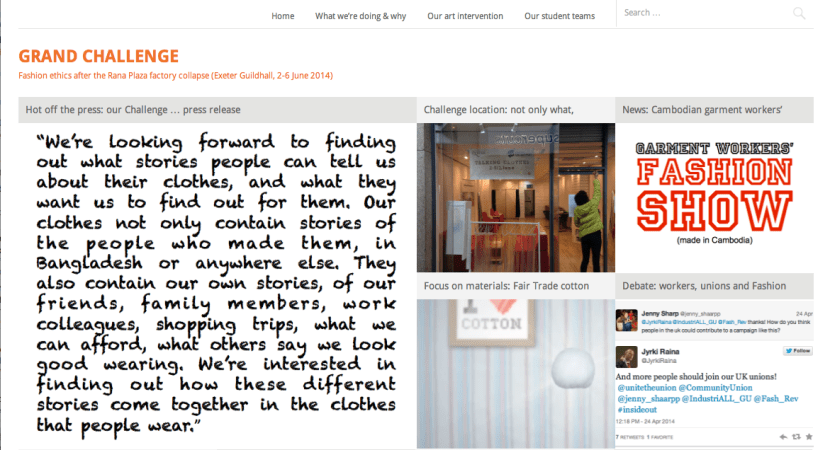
Click image for blog
Watch this: BBC Breakfast on Rana Plaza
Great 6 minutes on #ranaplaza & fashion ethics on @BBCBreakfast last week with @LaHamnett & @TansyHoskins
http://t.co/7wyLjFeGev #insideout
— followthethings.com (@followthethings) March 24, 2014
For International Women’s Day: Maquilapolis – city of factories
It’s International Women’s Day tomorrow, so we’ve picked out a documentary that’s soon to be featured on our site: Maquilapolis – city of factories. This is a preview of its page in our Electrical Department. It’s unique in the ‘follow the things’ genre because its both about, and made with and by, factory working women.
Maquilapolis – city of factories

Year: 2006
Type: Documentary film (68 mins, in Spanish with Spanish or English subtitles)
Directors: Vicky Funari and Sergio de la Torre, in collaboration with the factory workers.
Production Company: Independent Television Service (ITVS).
Availability: DVD (California newsreel $24.99 for home use), transcript (English & Spanish, free), online (sections & whole film, search).
.
Show us your @fash_rev trump cards!
Today, we started to play with the Fashion Ethics Trump card game we’ve made for, and with, Fashion Revolution Day.
We ended up tweeting some #fashtrumps selfies and a step by step guide for anyone who wants to join the #fashtrumps conversation.
We present to you here: some examples of #fashtrumps selfies, those guiding tweets and a twitter box that will show the ones that you have made…
Give this a go!
Some examples
Sodastream studies…
Overnight, [Scarlett Johansson] has become the Marie Antoinette of the Israeli-Palestinian conflict, smiling regally and offering: “Let them sip soda.” (source)
We’ve been following carefully how actor Scarlett Johansson (a.k.a Scarjo) was forced last week to choose between her role as an Oxfam Global Ambassador and as the face of soft-drink machine maker Sodastream.
This is the banned TV advert that was due to be shown at half time during Superbowl 2014, the ‘most watched’ TV show in the US. What values are expressed here?
How to make & play Fashion Revolution’s Fashion Ethics Trump card game
In November last year, we made and played a Ethical Fashion Trump Card game that we were developing for the Fashion Revolution Day Education Pack.
Its aim is to encourage its players to think about their clothes and fashion ethics, a topic that’s more important than ever after the Rana Plaza factory collapse in Dhaka, Bangladesh on 24 April last year.
It’s a playful way of encouraging some serious discussion about who and what we are wearing.
Here, we want to showcase the new FRD pack – which was published yesterday – and to provide a match report that will give you an idea of how the game can be made and played in your classroom, home, shed … wherever you play cards!
Foxconn factory work: 2 perspectives
In response to a student query today about the pride that factory workers can have in making consumer goods for others, I recommended that the two short films below were watched one after the other.
Both are about the notorious manufacturer of Apple and other electronic goods: Foxconn.
Dreamwork China
This is an extract from a documentary film in which young factory workers are interviewed in a photo studio across the road from the factory.
iProtest
This is an episode of from the Al Jazeera TV series Activate, about the investigation into worker rights, health and safety in Foxconn factories by Hong Kong based NGO Students and Scholars Against Corporate Misbehaviour.
 the back office