
Category: responsibility
How shop-dropping can contribute to the Fashion Revolution: the Craftivist Collective’s Mini Fashion Statements
It’s Fashion Revolution Week this week. To mark this, we’re showcasing our favourite examples of cultural activism which have supported its #whomademyclothes call to action. Yesterday, we highlighted the 2014 ‘guerilla projection’ work of documentary photographer Ismael Ferdous. His photos of people dead and injured by the Rana Plaza collapse were projected on the High Street stores of companies which were refusing to acknowledge that their clothes were being made there.
Today, we turn to the gentle activism of shop-dropping. It’s the opposite of shop-lifting, where activists leave things in store – in garments’ pockets, for example – to highlight to people who find them, and brands and retailers challenged by them, inequities in their supply chains. For Fashion Revolution Week why not make and leave behind in store a ‘Mini Fashion Statement’? He’s the Craftivist Collective‘s 2016 ‘how to’ video.
Further information
Sarah Corbett (2017) Mini Fashion Statements. Craftivist Collective 19 April [includes a MFS kit to purchase and a ‘Why To’ video with Sarah]
Further reading
Randall Bezanson & Andrew Finkelman (2009) Trespassory art. University of Michigan Journal of Law Reform 43(2), 245-322 [download here]
Ian Cook et al (2015) The 13 best examples of shop-dropping… ever. followtheblog.org November
YesMenLab (2011) Shop Dropping Product Labels – by the Yes Lab. Destructibles 7 July
How Guerrilla Projection can contribute to the Fashion Revolution: TED talk from Ismael Ferdous
It’s Fashion Revolution week this week. Today is the fourth anniversary of the deadly Rana Plaza collapse in Savar, Bangladesh. We’ve been working closely with Fashion Revolution almost from the start, our CEO Ian being a member of its Global Coordination Team. followthethings.com brings to Fashion Revolution a keen interest in cultural activism, its creation, discussion and impacts, This week we will be sharing each day a form of cultural activism that has made significant contributions to the movement.
Today’s post shows how photographs from the Rana Plaza site in the hours and days after the collapse were used to engage consumers and shame brands and retailers who refused to acknowledge that their clothes were being made there at the time. In this 2014 TED talk, Bangladeshi documentary photographer Ismael Ferdous talks about those he took on the day and what he did with them when he took them to New York. Guerrilla Projection is the activist tactic. This is moving, inspiring, troubling work.
Further reading
Samantha Corbin & Mark Read (2012) Tactic: Guerilla Projection. in Andrew Boyd (comp.) Beutiful trouble: a toolbox for revolution. New York: O/R, 52-53
Hannah Harris Green (2014) Photographer Ismail Ferdous On Documenting the Rana Plaza Factory Collapse. The Aerogram 15 May
New garment factory doc: Machines
Watch out for this new film coming to UK cinemas in 2017.
Moving through the corridors and bowels of an enormous and disorientating structure, the camera takes the viewer on a descent down to a dehumanized place of physical labor and intense hardship. This gigantic textile factory in Gujarat, India might just as well be the decorum for a 21st century Dante’s Inferno. In his mind-provoking yet intimate portrayal, director Rahul Jain observes the life of the workers, the suffering and the environment they can hardly escape from. With strong visual language, memorable images and carefully selected interviews of the workers themselves, Jain tells a story of inequality, oppression and the huge divide between rich, poor and the perspectives of both (source).
Reviews and interviews
Trade is not a thing…
The main point…
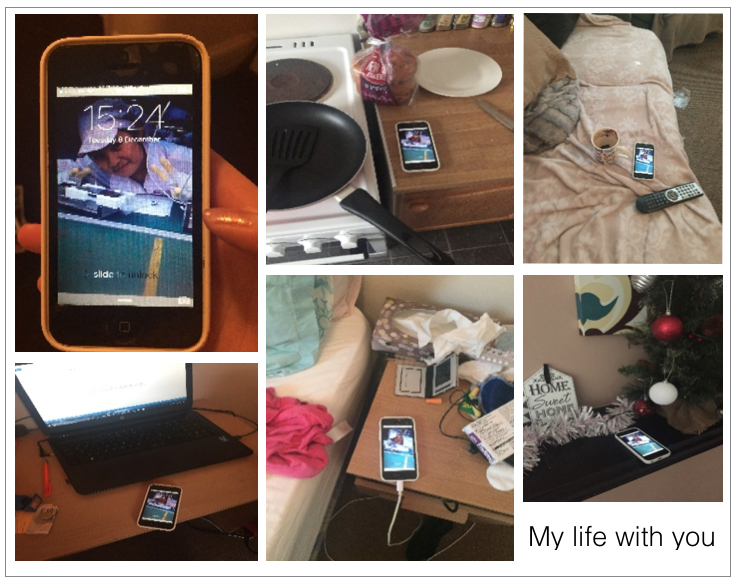
Guest blog: Dear iPhone Girl
Here’s another excellent example of journal writing from the Exeter Geography module behind our website. At the start of the module, we ask the students to add to their phone homescreens this photo of an Apple factory worker which, it seems, was accidentally left on an iPhone bought in 2009. The person who found this and four other photos posted them online and the quest to find out who she was, why photos of her were on that phone, and what would happen to her after they went pubic went viral (as documented on our followthethings.com page). We ask our students to keep her photo on their homescreens until the end of the module, for almost 4 months. What can happen to you when she looks at you every time you look at your phone, wherever you go? Sophie Woolf explains… to the person who became known as ‘iPhone Girl’.
Guest blog: step away from the weapon
This post is by Ginny Childs, a student who took the Exeter University Geography module that is behind our website last term. It’s a piece of (slightly edited) coursework that she wrote in response to reading behind Sofia Ashraf’s ‘Dow vs. Bhopal: a toxic rap battle’. Ginny wasn’t even born when the Bhopal factory exploded in 1984, but it affected her here and now. Here’s how…

I joined Exeter University Officer Training Corps this year. Last weekend was my first weapons training session; on the SA80 assault rifle. The first lesson I received was a ‘Normal Safety Procedure’ on what to do if I drop it and the sighting system cracks. The system uses tritium (a radioactive hydrogen isotope) in gas form, to create visible light. If it escapes, and I were to inhale it, radioactive damage could occur in my body.
Sat in my weapons training lesson, whilst thinking about tritium, my mind drifted to methyl isocyanate (MIC). The Bhopal disaster was the topic my group were researching for this module. I’d been researching the thousands of deaths and deformities this gas leak caused. Now, here I was being cautioned on tritium. It seemed silly. The rifle contains only a minute amount, and it’s deemed to be one of the least hazardous radionuclides. Yet, I was laboriously taken through a step-by-step routine to memorise the safety procedure: STEP AWAY FROM THE WEAPON… HOLD YOUR BREATH…GET ANY SMOKERS TO PUT OUT CIGARETTES…INFORM ARMOURY OF INCIDENT etc.
Buy this shirt… #worldfactory
We’ve been following this project on social media for a while now. Today we bought the shirt…
Part research method, part art object, The Shirt is a specifically designed consumer item, manufactured in a Chinese factory, which uses bespoke digital technology to make visible all the people and processes behind its production. The Shirt has barcodes on it, and when you put your smartphone over the barcode, using a bespoke app, it will trigger digital content that reveals the very people and processes involved in making the actual shirt in your hands.
Buy your shirt here. £35 plus shipping… Find out more here. Continue reading
Brandjamming the John Lewis Christmas ad to #stopfundinghate
We’re brandjamming the John Lewis Christmas ad! Please share & urge @JohnLewisretail & @Waitrose to #StopFundingHate #bustertheboxer pic.twitter.com/drYlgKNt6j
— Stop Funding Hate (@StopFundingHate) November 10, 2016
Do ‘follow the thing’ documentaries affect their audiences?
This is one of the questions that drives our work at followthethings.com. We tend to find our answers – yes, no, maybe, depends, etc… – in the user-generated comments on video-sharing websites like YouTube and in the comments on newspaper reviews. We’re currently wading through thousands of comments on a 2015 ‘follow the fashion’ film called The True Cost, and came across this powerful video response. We’re giving a paper about the True Cost and fashion activism at a conference next month. There’s an argument in the literature that work like this makes prescriptive arguments about responsibility that are so infinitely demanding they can generate a sense of powerlessness in consumer audiences. This doesn’t seem to be the case, at least for this viewer. Watching this film was a powerful experience. For us, this kind of response changes the question that’s asked. Now it’s ‘how do ‘follow the things’ documentaries affect their audiences? What vocabulary can we develop to describe this? That’s what we’re working on.
On the making of followthethings.com

Here’s Ian et al’s first paper about the making of followthethings.com. It was published in French in 2014 and has recently been made available on open access. You can now download the paper as it was originally written in English. If you want the French version, click here.
followthethings.com was not designed and then made, but emerged from an iterative, creative, collaborative, conversation-infused, open-ended, making project. The paper is written to reflect this. Here’s the abstract: Continue reading
 the back office
