
Category: followthethings.com
Bideford Black: exhibition trailer and press release
followthethings.com has been a project partner for The Bideford Black (2nd generation) Arts Council-funded project in North Devon. There are 8 commissions, including one involving CEO Ian making things from this raw pigment with artists Joan and Neville Gabie. A film has been made to document the project and the production of its work. The trailer was released today:
The Press release describes what Neville, Joan and Ian have been doing as follows:
Prompted by Bideford Black, and using a shared sketchbook, artists Neville Gabie and Joan Gabie are holding a ‘dialogue of ideas’ with Cultural Geographer Ian Cook (University of Exeter). Together, the three explore the physicality, social and geological significance of Bideford Black, presenting films of studio drawings and artifacts discovered and created along the way.
The exhibition opens from 3rd October to 13 November, at the Burton Art Gallery & Museum, Bideford, Devon EX39 2QQ. For more details about the Bideford Black project, please see the project blog.
How to run a subvertisement workshop
One of our former interns, Eeva Kemppainen, now works in Helsinki for the pro-Fair Trade NGO Eettisen kaupan puolesta (Pro Ethical Trade Finland). In 2014, she published a paper in the Finnish journal Natura about ways in which she tries to engage students in humorous critiques of consumption and advertising. They examine, then cut up, rearrange and/or scribble on magazine adverts. They try to subvert their messages so that the information that they hide is made visible. What they produce are what’s called subvertisments. Here Eeva describes how she organises subvertisement workshops, and showcases some of the work that students have produced.

Figure 1: An example of a student-produced subvertisment: rearranging kids in an H&M advert to show connections between who makes and wears their clothes
Political LEGO: an interview with Legofesto
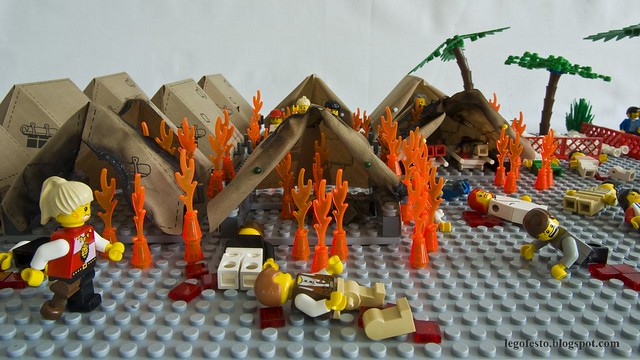
Sri Lanka: Bombing a refugee camp 4 (Legofesto 2009).
We re-create scenes from the trade justice documentaries, art and activist work in LEGO. We photograph them, put them online and embed them on our site’s pages. You can see what we’ve done here. This work was inspired by LEGO scenes from the ‘War on Terror’ produced by a person calling herself Legofesto. We read interviews with and articles about her that were published in 2009, but hadn’t found anything since. This year, after teaching Political LEGO on the MRes Critical Human Geographies at Exeter University, one student – Julia Zielke – emailed Legofesto to interview her for an essay. What questions hadn’t been asked in those 2009 pieces? What had Legofesto been doing since then? Can we expect any new Legofesto work? This is what she said… Continue reading
Guest blog | Hannah asks her students ‘Who are you wearing?’
A couple of weeks ago, we attended the Geographical Association (GA) conference in Manchester. This is a conference for geography teachers, student geography teachers and the people who train them. We talked to many who taught their students the geographies of trade through researching their own clothes. We went to a talk where Hannah Campion, a newly qualified teacher, explained how she sparked her students’ curiosity about these geographies using some of our teaching resources. With the second anniversary of the Rana Plaza collapse only a few days away, we are publishing what she said…
A £4 t-shirt

A cheap white tee (click for image source)
My name is Hannah Campion. I am an NQT at The National Church of England Academy, Nottinghamshire. My fascination around the Geography of my ‘stuff’ developed from undergraduate study of commodity chains, commodity fetishism and Cook’s (2004) ‘follow the thing’ approach at the University of Nottingham. An assignment during my teacher training course on ‘Fantastic Geographies’ gave me the opportunity to bring this controversial issue into the classroom, to enable pupils to investigate and to develop a curiosity around the lives of our everyday commodities. The initial scheme is a 5 lesson sequence unveiling and unpicking the life of a plain white £4 t-shirt from production through to consumption. In 2014, I was asked to display my work at the Geographical Association conference in Guildford as part of the Ideas Zone exhibition. Since then, I have written an article for Teaching Geography (Campion 2015) and presented a Teacher-to-Teacher session at this year’s GA conference entitled ‘Behind the seams: global connections in the classroom (KS3)’.
‘Behind the seams’: from Idea Zone to journal article
Last year we co-ran the Idea Zone at the Geographical Association conference in Guildford. We filled a table with Lego for delegates to recreate scenes described on our website. We set up a card table to make a play our Ethical Trade trump card game. And a Nottingham PGCE student called Hannah Campion brought along some lesson plans, teaching materials and student work showing how she’d used our site and classroom resources to develop a lesson series about ‘The Geographies of my Stuff’. She was asked if she’d be interested in writing a short paper about all of this in the GA’s Teaching Geography journal. It’s just been published, and here’s an extract.
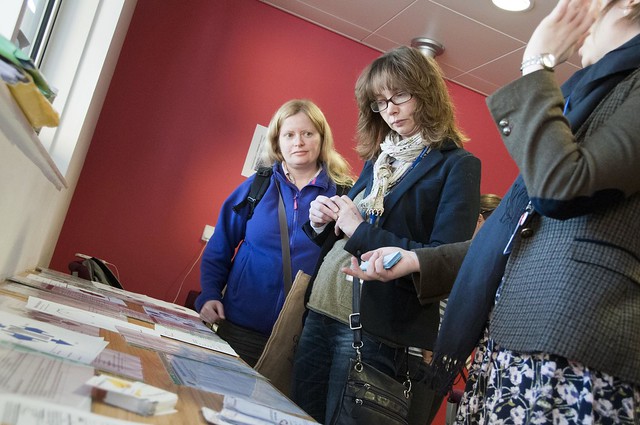
Hannah talks to delegates about her lesson plans, materials and student work.
“… My five-lesson sequence was developed for year 8 and followed on from a year 7 unit, ‘The Geography of my Stuff’. I wanted to develop students’ ability to investigate and critically reflect on the hidden connections which link them to often distant global communities, and to empathise with the people who live and work there. To do this, I chose a familiar but often untraceable commodity which students could easily identify with – a plain white T-shirt. … In the first lesson we used a ‘who, what, why’ starter, with images of horses, clothes and the Rana Plaza factory collapse to stimulate students’ curiosity. … Lesson 2 introduced the £4 T-shirt as the commodity to be investigated. After we had covered the role of the first link in the chain, the cotton farmer, the main activity required students to explore, in groups, ‘How much of the £4 should x get paid?’ … Lesson 3 focused on manufacturing and worker conditions. The enquiry question was: ‘Who was to blame for the Rana Plaza collapse?’ … Having helped students to step into the shoes of ‘others’ and investigate the structures and processes of the clothing industry, in lesson 4 we focused on the ethical standards of global retailers. The class was divided into two groups, representing H&M and Primark … [and] students played the Top Trumps game to compare multiple retailers. … [Finally] The assessment activity was to produce a newspaper article … entitled ‘Behind the seams… the story of a £4 T-shirt’.”
Source
Hannah Campion (2015) Behind the seams… the story of a £4 t-shirt. Teaching Geography Spring, 26-28 (Click to access)
Guest blog: developing global perspectives on sustainability with followthethings.com
In February this year, Ian, Charlotte Brunton and Jenny Hart contributed to a Pedagogy Cafe seminar at Plymouth University’s Centre for Sustainable Futures. They talked about Geographies of Material Culture coursework (a university lifestyle catalogue and a singing heart pacemaker) now published on our site. What happened next was surprising. Plymouth lecturer Helen Bowstead talked about her use of ‘follow the things’ research to teach English as a Foreign Language. Here’s what she said.

International students discuss complex and overlooked understandings of things.
The benefits of group work have been well-documented: Gibbs claims working as a group “has the potential measurably to improve student engagement, performance, marks and retention and usually succeeds in achieving this potential” (Gibbs 2010:1). However, successfully implementing and assessing a piece of group work is also often fraught with challenges, particularly when the students do not share a common language and/or cultural background. In groups where some or all students are non-native English speakers, there may be an ‘imbalance’ in power relations, as the ideas and views of the students with ‘stronger’ language skills often end up dominating. In many instances, non-native speakers find themselves side-lined within the group, sometimes because their language skills are weaker than other members, but also because, due to cultural and educational differences, their knowledge base is perceived as having less ‘value’.
Guest blog: follow the poppies
Our latest guest blog is by Joe Thorogood, a former student in the ‘Geographies of material culture’ module at Exeter University who is in the early stages of a ‘follow the things’ PhD in the Department of Geography at University College London. His research is on poppies. In the post below, he outlines what he’s found out so far about the Remembrance Day variety. As usual with following research, you may be surprised by what he finds.

Royal British Legion poppy: click for source
The Remembrance poppy is a symbol of memorial. In the couple of weeks before November 11th – Remembrance Day – these poppies are available in exchange for a charitable donation to the Royal British Legion, a UK charity that provides services for ex-military personnel and their dependents. It is worn in the UK in memory of service personnel who died in the First World War and in wars since then. It’s a symbol for personal grief and reflection, but also of national loss. Many countries have poppies shipped out to expatriates and families who have relatives who fought on behalf of the British Empire and British army in campaigns abroad.
I’m researching Remembrance poppies for my PhD, using a methodology that studies the lives and issues that are connected through their travels and transformations as things.
It wasn’t hard to find out about how and where Remembrance poppies are made. You could do it yourself by simply visiting the Poppy Factory in Richmond, Surrey, where they make about 500,000 of the poppies the public wear. Ex-service personnel and their dependents are crucial to this effort, as they often work in the factory or are supported by factory to find employment after leaving the armed forces. Continue reading
New in Lego: A Global Positioning System

Here’s the latest of our Lego re-creations, made today to add to one of our first published pages: on Melanie Jackson’s (2006) digitally generated animation (and catalogue) A Global Positioning System. Continue reading
Everything is (not) awesome: Greenpeace, Shell & Lego activism.
Greenpeace & Lego
Greenpeace want Lego to end its links with Shell, and are currently campaigning through the medium of imaginative Lego re-creation. This video is one of a number of examples, whose aim is to encourage people to sign this petition. In the wake of the hugely successful Lego Movie (whose stars make a cameo appearance) this campaign is becoming perhaps the most lavish and high-profile example of Lego activism to date.
followthethings.com & Lego
On a much smaller budget, we’ve been making, photographing and posting online re-creations in Lego of (imagined) scenes from trade justice films, art and activism for a while now. See, for example, our recreations from and around the BBC Panorama documentary ‘Primark on the rack’. Continue reading
Who made my stuff? Look for the letters!
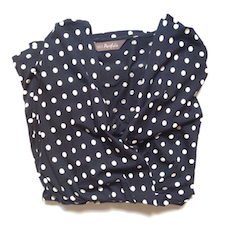
2014 labels & letter in clothes

2013 letter in decorations

2012 letter in Saks bag
2014 shop-dropping post
 the back office