
Category: Education
Why Eeva Legoed the kidnapping of Ronald McDonald
#followtheteachers blog post No.5
‘Kidnapping Ronald McDonald’ (Jani Leinonen, Finland) made in #lego by @EevaKemppainen @ #gaconf14 #ideazone pic.twitter.com/h1FGNk4g7P
— followthethings.com (@followthethings) April 16, 2014
Our 4th #followtheteachers post: on subvertisement workshops

“What the §^*! are we doing here?”
A couple of weeks ago, we published a guest post from Eeva Kemppainen describing the ways in which her work for followthething.com and her masters thesis on trade justice pedagogy in the UK and Finland, had led to her work on a ‘Closing the Gap’ project with Finnish pro-ethical trade NGO Eetti . This is Eeva’s second post, in which she describes how she works with diverse groups of students (using followthethings.com as a resource) and shows the kinds of subverts that her students create.
Show us your @fash_rev trump cards!
Today, we started to play with the Fashion Ethics Trump card game we’ve made for, and with, Fashion Revolution Day.
We ended up tweeting some #fashtrumps selfies and a step by step guide for anyone who wants to join the #fashtrumps conversation.
We present to you here: some examples of #fashtrumps selfies, those guiding tweets and a twitter box that will show the ones that you have made…
Give this a go!
Some examples

This Valentine’s Day, let’s show some love to everyone in its supply chains
Buying gifts to give to loved ones presents unique dilemmas to those who are concerned about who made them, under what conditions. Can you express your love for another person by buying them conflict jewelry, or child labour chocolate? What are the alternatives? And how have these dilemmas changed as a result of decades of actvisism highlighting trade injustice in these supply chains?
Teaching and learning resources
If you’re looking for resources to help creatively discuss the controversial issues in Valentine’s Day supply chains, here’s a selection.
Continue readingHow to make & play Fashion Revolution’s Fashion Ethics Trump card game
In November last year, we made and played a Ethical Fashion Trump Card game that we were developing for the Fashion Revolution Day Education Pack.
Its aim is to encourage its players to think about their clothes and fashion ethics, a topic that’s more important than ever after the Rana Plaza factory collapse in Dhaka, Bangladesh on 24 April last year.
It’s a playful way of encouraging some serious discussion about who and what we are wearing.
Here, we want to showcase the new FRD pack – which was published yesterday – and to provide a match report that will give you an idea of how the game can be made and played in your classroom, home, shed … wherever you play cards!
New for 2014: our Fashion Ethics ‘Grand Challenge’ at Exeter University
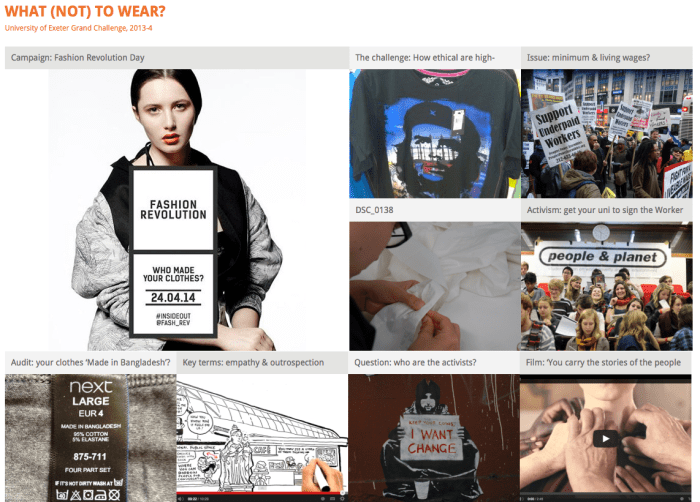
Things have been a bit quiet on the blog since the ftt Awards Ceremony in December. We have been busy on another project, at the University where we’re based, introducing First Year Students to the challenge of to how to help develop a more ethical fashion industry, in the wake of the Rana Plaza factory collapse in April last year.
We’ve been putting together a website for the Challenge, but it’s open to everyone to use, comment on, and get involved in.
Please do so via the website (click the screen grab below) or get in touch with us via followthethings@yahoo.com, @followthethings or our Grand Challenges Facebook page.
Fashion Revolution Day: the first Trump card game
Yesterday at the Department of Geography at the University of Exeter, we heard Carry Somers talking about Fashion Revolution Day at our ‘What (not) to wear?’ conference. There was mention of an Ethical Trade Trump card game invented by students taking ‘Geographies of Material Culture’ in 2012 – using data from free2work.org – being adapted as followthethings.com’s contribution to this campaign.
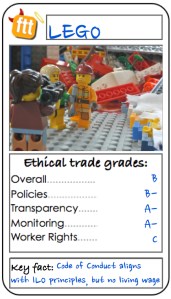
A new Fashion pack will soon be designed, but today we tested out the idea in class. Students each made a card based on something they were wearing, sketched it, added the grades from free2work and – for extra information at the bottom of each card – added whether that company / brand had signed the Accord on Fire & Building Safety in Bangladesh.
The match report
6 teams of 8 students each made one or more cards in the first 15 minutes. One student was elected from each group as their player, and we staged a 6 player tournament at the front of the classroom. The cards were shuffled and dealt. The game began with player one calling out a brand (Cheap Monday!), a category (policies!), a grade (A+!), and then slamming the card on the table (drama!). The other players then took the card at the top of their pack, one after the other, called out its brand (Calvin Klein! or Adidas!), and its policy grade (C-! or A+), and slammed their cards on the table. The audience gathered round, watching their cards being played, helping their players to win and lose each round.
In each round, the player who called out the highest grade took all of the cards, and started the next round. If there was a draw – like between Cheap Monday and Adidas, both with A+ grades for their policies – the ‘key fact’ could be played: had the brand / company signed the Accord? In this case, only Adidas had (only very recently, the referee had to say), so that was the winning card.
The game went on with rounds in which, for example, only ‘worker rights’ scores could be played. It ended with a ‘winner takes all’ round, with the 3 remaining contestants. This was dramatic: a draw that was resolved by the key fact. The Accord-signatory won. Well done Adidas! Good job you signed the accord. Nobody wants a losing card. Whoops all around.
After the game ended, we discussed what had happened, why some cards were worse to play that others, why – with one exception – the policy grades were higher than the ‘workers’ rights’ grades, and how to find out why by looking at brands’ detailed free2work ‘score cards’. So, 40 minutes into class, we were talking about, asking informed questions about, and having a good idea how to find out more about the relations between ethical trade policies, transparency, monitoring, workers’ rights and the Accord.
This game can be made and played by any group of people trying to learn the basics and/or intricacies of Ethical Trade and Corporate Social Responsibility.
This is our 46 card pack, scanned after the game. What would your pack be like?


If you want to have a go:
- download the pack template, research and playing instructions here
- find the grades for your cards here www.free2work.org
- find out who has signed the Accord here www.bangladeshaccord.org/signatories/
Let us know about your game, send us your packs and match reports!
Thanks
Ian
Credits
This game was devised in 2012 as coursework ‘Geographies of Material Culture’ at the University of Exeter by Joe Thorogood, Michael Franklin, Sophie Angell, Florence Flint, Bryony Board, Toby Swadling, Jack Saxton, Jake Pincock, Emma Hargreaves & Joe Harrison. This pack was re–designed by Ian Cook, in consultation with the #followtheteachers ‘user crew’ Alan Parkinson, Oprah Whipp, Victoria Salt, Charlotte Wild, Jenny Thomas, Natalie Batten, Heather Taylor & Mary Biddulph for use in schools and universities.
Update
This pack was revised in 2014 as followthethings.com’s contribution to Fashion Revolution Day, an Ethical Fashion Trump Card Game is part of its Education Pack (download link to be added when this this is live).
Playing cards: ftt’s Ethical Trade Trump game
It’s a game
Students at the University of Exeter designed an Ethical Trade Trumps card game in November last year using data from free2work.org. This summer, we worked this up into a ftt-‘branded’ game, complete with rules, and templates so that groups of people could make and play cards with their stuff. You can download its templates here. This was designed with advice from the secondary school teachers involved in our #followtheteachers project. Natalie is using them with her A-level class to help with Globalisation revision: look!
The idea
When you make cards for your stuff and play them with others, you learn about the companies who make your stuff, their labour policies, transparency, monitoring and worker rights. In one sense, it’s a simple game of trumping – ‘Ha! My shoes’ worker rights score beats your Kitkat’s!’ – but making and playing the cards also raises questions about what you can find out about your stuff, what ‘monitoring’, ‘worker rights’ and a ‘living wage’ mean, how they are measured, and what to think about this.
Playing cards
Yesterday, we ran our first Top Trump workshop, at Bath Spa University, with Ranji Devadason and her students (a big thanks to them for giving this such a good go). Here we share the cards that were played at this first ever Ethical Trade Trump tournament!
The experience
The atmosphere was tense but fun. Poker faces were everywhere. Imagine being dealt some of these cards! How would you play them? What was it like for them to play with their stuff like this? We’re inviting them to say so, in comments on this post…
PS if you are unfamiliar Trump card games, check this Wikipedia page.
Credits
This game was devised in 2012 as coursework ‘Geographies of Material Culture’ at the University of Exeter by Joe Thorogood, Michael Franklin, Sophie Angell, Florence Flint, Bryony Board, Toby Swadling, Jack Saxton, Jake Pincock, Emma Hargreaves & Joe Harrison. This pack was re–designed by Ian Cook, in consultation with the #followtheteachers ‘user crew’ Alan Parkinson, Oprah Whipp, Victoria Salt, Charlotte Wild, Jenny Thomas, Natalie Batten, Heather Taylor & Mary Biddulph for use in schools and universities.
Update
This pack was revised in 2014 as followthethings.com’s contribution to Fashion Revolution Day, an Ethical Fashion Trump Card Game is part of its Education Pack (download link to be added when this this is live).
Happy ‘shopping’: making & using followthethings.com bags
This post began as a contribution to a special issue of the journal ACME on the new ‘impact’ agenda in British Higher Education. Our shopping bags and ‘ladybugging’ activities seemed to fit this bill, although their ‘impact’ wasn’t measurable (and that was the point). In the end, another short piece on impact was written for the journal. We have revised that original paper to post here, and hope it may be interesting for readers who are keen to use our site and/or bags in their teaching and wider ‘shopping’ activities.
Update September 2016: sorry, we have no bags left to give away. They’ve all gone. If you have one, it’s a priceless collector’s item. If you see someone carrying one, please say hi.
——————————————————-
“We need to develop forms of critique that inspire hauntings, feed feelings, come alive, leap out and grab us, … that are not just about vital materiality but are themselves vitally material” (Cook & Woodyer 2012 p.238).
Our 2nd #followtheteachers blog post
Over the course of the 2013-4 academic year, we’re following seven school teachers and they use and adapt followthething.com in their classrooms in England. Our second post is by Natalie Batten. She reflects on how she encouraged her students to use our site last year to help compare and contrast multinational corporations. This year, she will be using one of our new game-based teaching resources to encourage her students to better appreciate corporations’ diverse policies regarding workers’ rights and monitoring.

I covered a similar topic to the one discussed in Oprah’s #followtheteachers blog post – that of globalisation and multinational companies. This scheme, however, was implemented for AS Level Geography students (studying the OCR exam syllabus). This highlights the versatility of followthethings.com site as a resource for a variety of student ages, even when covering the same topic area. For example, while Oprah used the site to introduce globalisation at Year 7, I used it at A level to consolidate pupils’ prior learning and provide them with examples and case studies for their exams.
Click the seat!
The pupils were not familiar with the site, so time was incorporated into the scheme of work for them to explore it. They really liked the layout and navigation of the site and its recognisable format – like other online stores such as Amazon – which made the site personal to them and their interests.
Click to play!
The different forms of data presentation on the site (eg. film reviews, travel journals, newspaper articles and Lego re-creations) provided opportunities for differentiation with more able pupils challenging themselves through interpretation of more abstract research sources. In particular, some used the Ford Car Seat page – based on a 2006 film called ‘Made in Dagenham’ – to explore social and historical geographical topics such as feminism and women’s rights. This was important as it allowed pupils to ‘find the geography’ and make synoptic links to other geographical topics during their MNC research task.
An extension to a task like this could be to incorporate followthethings.com’s new teaching resource – Ethical Trade Trump Cards as a way to compare and contrast global MNCs on categories such as worker’s rights, policies and monitoring in an exciting and familiar game for pupils.
Both they and myself as a trainee teacher took a lot of positives away from this activity and I will certainly be using followthethings.com in my future teaching for this and other topics.
 the back office