Who made my clothes? New Fashion Revolution education worksheets published

followthethings,com has been working closely with the Fashion Revolution Day movement which has been encouraging people all over the world, since the Rana Plaza collapse in 2013, to ask brands and retailers ‘who made my clothes?’. This week saw the release of Fashion Revolution’s latest set of Education Resources.

FRD_free_educationalresources

Click to get to Fashion Revolution’s Education webpage.

Here’s how you can get to them. I) go to fashionrevolution.org/education; 2) register for the resources; 3) go to the URL that you’re sent; and 4) browse and download.

Each resource is a 2 page pdf with instructions to teachers on one page, and a resource for students on the other. Tasks for students of different ages are suggested. What are the tasks? Here’s a preview:

Screen Shot 2015-10-31 at 17.05.41 Continue reading

Coming soon to followthethings.com

Most followthethings.com’s pages begin their lives as group research work in a University of Exeter module called Geographies of material culture. We show the students a selection of followthethings,com ‘compilation’ pages, and ask them to produce pages just like these for a new set of provocative sources.

They’re called ‘compilation’ pages because they are compilations of quotations taken from online discussions of a film, art work, etc. that are arranged on the page to resemble a lively conversation about that film, art work, etc.: how it’s been described, how and why it was made, what discussion it provoked and what impacts it had. There are eight groups of students working on eight new pages, right now. Their draft followthethings.com pages will be published as wordpress blogs. Here’s what you have to look forward to…

A: 2 Euro T-shirt Vending Machine.

Hits:  457,000 (Google), 6.8m (YouTube), 4 (Nexis) & 0 (Google Scholar). Continue reading

Talk: keeping conversations going with Political LEGO

At the end of 2015, followthethings.com CEO Ian Cook gave a talk explaining why we re-create scenes described on our website it LEGO, what our shoppers like about them, and what they add to our scholar-activist work. That talk was filmed and you can watch it below. He talked through a series of re-creations made in response to the controversy provoked by a TV documentary film called ‘Primark on the rack’ that was first broadcast 2008, and re-energised by Primark’s response to the Rana Plaza collapse in 2013. It draws upon the work of Political LEGO artists like legofesto, whose conversation with Julia Zielke we published a few months ago. Ian’s talk outlines the argument being made in an academic paper he’s currently writing. Think of this talk as its Trailer….

Continue reading

This costs more than 5p: the life story of a plastic bag.

On the day that shoppers in England start to pay for plastic bags, let’s watch this film which “traces the epic, existential journey of a plastic bag (voiced by Werner Herzog) searching for its lost maker, the woman who took it home from the store and eventually discarded it. Along the way, it encounters strange creatures, experiences love in the sky, grieves the loss of its beloved maker, and tries to grasp its purpose in the world.”

https://www.youtube.com/watch?v=YuJ31bu01mM

Why David Cameron isn’t the only person to (allegedly) be intimate with pigs…

One of our favourite examples of the followthethings genre is a book by artist Christien Meindertsma called PIG 05049. She finds pig parts in 185 products and describes pigs as ‘absolute kings and queens’.  How did she do this? As she describes her work in this TED talk, “I followed this one pig…”

Meindertsma isn’t the only artist to follow a pig. In 2011, musician Matthew Herbert made an album called ‘One Pig’. He fed sounds from a pig’s life into music. Here’s his explanation, track by track…

Bideford Black: exhibition trailer and press release

followthethings.com has been a project partner for The Bideford Black (2nd generation) Arts Council-funded project in North Devon. There are 8 commissions, including one involving CEO Ian making things from this raw pigment with artists Joan and Neville Gabie. A film has been made to document the project and the production of its work. The trailer was released today:

The Press release describes what Neville, Joan and Ian have been doing as follows:

Prompted by Bideford Black, and using a shared sketchbook, artists Neville Gabie and Joan Gabie are holding a ‘dialogue of ideas’ with Cultural Geographer Ian Cook (University of Exeter). Together, the three explore the physicality, social and geological significance of Bideford Black, presenting films of studio drawings and artifacts discovered and created along the way.

The exhibition opens from 3rd October to 13 November, at the Burton Art Gallery & Museum, Bideford, Devon EX39 2QQ. For more details about the Bideford Black project, please see the project blog.

How to run a subvertisement workshop

One of our former interns, Eeva Kemppainen, now works in Helsinki for the pro-Fair Trade NGO Eettisen kaupan puolesta (Pro Ethical Trade Finland). In 2014, she published a paper in the Finnish journal Natura about ways in which she tries to engage students in humorous critiques of consumption and advertising. They examine, then cut up, rearrange and/or scribble on magazine adverts. They try to subvert their messages so that the information that they hide is made visible. What they produce are what’s called subvertisments. Here Eeva describes how she organises subvertisement workshops, and showcases some of the work that students have produced.

HM vastamainos, Vaskivuoren lukio

Figure 1: An example of a student-produced subvertisment: rearranging kids in an H&M advert to show connections between who makes and wears their clothes

Continue reading

Creando Conciencia en las Aulas (Raising Awareness in the Classroom)

As part of our education work with Fashion Revolution Day, we’re looking to source and share blog posts and films showing how students and teachers commemorated the second anniversary of the Rana Plaza factory collapse earlier this year. The Fashion Revolution mantra is Be Curious, Find Out, Do Something and its 2015 question was #whomademyclothes? Groups were active in 75 countries. This post and video were produced by Alicia Carrasco Rozas, a teacher at the International School in Pensicola, Spain. It’s just been posted on the Fashion Revolution Day website. If you read Spanish, you’ll love the whole post. But if you don’t, just watch the video.
.
.
En el International School Peniscola (www.colegiosisp.com) hemos querido unirnos a la celebración del Fashion Revolution desde el ámbito educativo con nuestros alumnos. Ellos son el futuro y, hoy más que nunca, necesitamos personas que estén concienciadas y que entiendan el mundo desde una perspectiva global en la que cada acto cuenta y tiene una consecuencia directa en otro lugar del planeta.

.

Click for more

New project goes public: Museum of Contemporary Commodities

This is the project that Ian founded with Exeter-based artist and PhD student Paula Crutchlow in 2013. It  involves a whole host of collaborators now. It is going public this weekend in London’s Finsbury Park. And its website is now live. Please check out what it’s about and take part in person and/or online. Here’s what it’s about. Click the logo to get to the webpage. 

Screen Shot 2015-06-11 at 12.57.49The Museum of Contemporary Commodities (MoCC) is neither a building nor a permanent collection of stuff – it’s an invitation. To consider every shop, online store and warehouse full of stuff as if it were a museum, and all the things in it part of our collective future heritage.

Imagine yourself as this museum’s curator with the power to choose what is displayed and how. To trace and interpret the provenance and value of these things and how they arrived here. To consider the effects this stuff has on people and places close by or far away, and how and why it connects them.

What do we mean by things or stuff? Everything that you can buy in today’s society. The full range of contemporary commodities available to consume.

Please join us on our journey by browsing and adding to our collection, attending an event, becoming a researcher. We are currently curating connections between trade-place-data-values in Finsbury Park, London, and here online. Welcome to MoCC!

Political LEGO: an interview with Legofesto

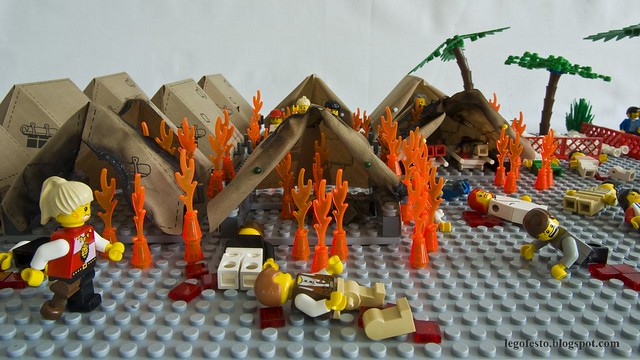
Sri Lanka: Bombing a refugee camp 4

Sri Lanka: Bombing a refugee camp 4 (Legofesto 2009).

We re-create scenes from the trade justice documentaries, art and activist work in LEGO. We photograph them, put them online and embed them on our site’s pages. You can see what we’ve done here. This work was inspired by LEGO scenes from the ‘War on Terror’ produced by a person calling herself Legofesto. We read interviews with and articles about her that were published in 2009, but hadn’t found anything since. This year, after teaching Political LEGO on the MRes Critical Human Geographies at Exeter University, one student – Julia Zielke – emailed Legofesto to interview her for an essay. What questions hadn’t been asked in those 2009 pieces? What had Legofesto been doing since then? Can we expect any new Legofesto work? This is what she said… Continue reading