
Category: responsibility
New on followthethings.com: the 2 Euro T-shirt: a social experiment
It’s Fashion Revolution Week this week. Last year’s headline, viral #whomademyclothes smash came from Germany. A vending machine apparently dispensing t-shirts for only 2 Euros in a Berlin square. If you put your money in, you had to watch a video showing the sweatshop conditions in which they were made. Twenty seconds in, you were presented with an option to buy the t-shirt or donate your 2 Euros. You were also filmed. With your permission, your reactions were included in a short film that was posted on YouTube on 23 April 2015. To date, over 7 million people will have seen your reactions, the expressions on your face, and joined the often heated, occasionally funny and carefully reasoned conversation in the comments below, and elsewhere online.
At followthethings.com, we turn the thousands of comments all over the internet into a digested read, a single conversation. Reading this you might get a sense of how successful this experiment was, and what made the video go viral. You might also think what you might have added to the conversation. What is the experiment showing? What’s it not showing? See what you think. Here.
Highlights from the conversation: Continue reading
Fashion Revolution call for papers at RGS(IBG) annual conference
We’re involved in running a session at the Royal Geographical Society (Institute of British Geography) annual conference this summer whose aim is to bring academic fashion experts into dialogue with the Fashion Revolution movement. We’re asking how fashion research can contribute to what is becoming a worldwide movement for a more ethical / sustainable fashion industry in the wake of the Rana Plaza factory collapse in April 2013. We’re looking for academic research from any discipline that can contribute to Fashion Revolution’s five year planning. Here’s what we’re doing. Please get in touch with Ian, Lousie and/or Alex to discuss any ideas. The deadline for abstracts is Friday 12th February.
– Call for papers –
Scholar activism and the Fashion Revolution: ‘who made my clothes?’

Abstract
The collapse of the Rana Plaza factory complex on April 24th 2013, which crushed to death over 1,000 people making clothes for Western brands, was a final straw, a call to arms, for significant change in the fashion industry. Since then, tens of thousands of people have taken to social media, to the streets, to their schools and halls of government to uncover the lives hidden in the clothes we wear. Businesses, consumers, governments, academics, NGOS and others working towards a safer, cleaner and more just future for the fashion industry have been galvanised.
‘Behind the seams’: from Idea Zone to journal article
Last year we co-ran the Idea Zone at the Geographical Association conference in Guildford. We filled a table with Lego for delegates to recreate scenes described on our website. We set up a card table to make a play our Ethical Trade trump card game. And a Nottingham PGCE student called Hannah Campion brought along some lesson plans, teaching materials and student work showing how she’d used our site and classroom resources to develop a lesson series about ‘The Geographies of my Stuff’. She was asked if she’d be interested in writing a short paper about all of this in the GA’s Teaching Geography journal. It’s just been published, and here’s an extract.
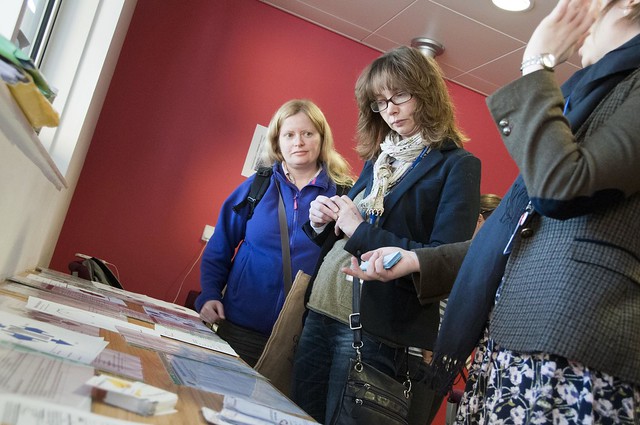
Hannah talks to delegates about her lesson plans, materials and student work.
“… My five-lesson sequence was developed for year 8 and followed on from a year 7 unit, ‘The Geography of my Stuff’. I wanted to develop students’ ability to investigate and critically reflect on the hidden connections which link them to often distant global communities, and to empathise with the people who live and work there. To do this, I chose a familiar but often untraceable commodity which students could easily identify with – a plain white T-shirt. … In the first lesson we used a ‘who, what, why’ starter, with images of horses, clothes and the Rana Plaza factory collapse to stimulate students’ curiosity. … Lesson 2 introduced the £4 T-shirt as the commodity to be investigated. After we had covered the role of the first link in the chain, the cotton farmer, the main activity required students to explore, in groups, ‘How much of the £4 should x get paid?’ … Lesson 3 focused on manufacturing and worker conditions. The enquiry question was: ‘Who was to blame for the Rana Plaza collapse?’ … Having helped students to step into the shoes of ‘others’ and investigate the structures and processes of the clothing industry, in lesson 4 we focused on the ethical standards of global retailers. The class was divided into two groups, representing H&M and Primark … [and] students played the Top Trumps game to compare multiple retailers. … [Finally] The assessment activity was to produce a newspaper article … entitled ‘Behind the seams… the story of a £4 T-shirt’.”
Source
Hannah Campion (2015) Behind the seams… the story of a £4 t-shirt. Teaching Geography Spring, 26-28 (Click to access)
Guest blog: gagged student reporter publishes story!

Original photo: copyright Ben Doherty / Fairfax Media Australia (used with permission)
Student and followthethings.com intern Will Kelleher has an exclusive story.
The last two weeks before I handed in my dissertation were a bit frantic. I was trying to publish an article about the rugby ball I had followed in my University’s student newspaper Exeposé.
Because of the damning information I had found, it was right and proper to contact the company who made that ball for a response. They demanded to see the article and, having read it, went on the attack:
“You carry the stories of the people who make your clothes”
Because of our involvement in the commemoration of the Rana Plaza factory collapse through ‘Fashion Revolution Day’ (and its ‘Who made your clothes?’ theme), and the University of Exeter’s ‘What (not) to wear?’ ethical fashion Grand Challenge, we’ve been collecting films and other resources designed to engage consumers with the hidden social relations in their clothes, the lives in their things.
This short film, just published on YouTube, and it’s ‘behind the scenes’ sequel are fascinating, we think.
‘Handprint’: the film.
Behind the scenes: the making of ‘Handprint’.
‘What (not) to wear’ event: an introduction

Click for the facebook event page
Date: 11 November 2013, 4-6pm
Venue: University of Exeter, Streatham Campus, Streatham Court, Lecture Room C.
.
Our sponsor

A taster event for 1st year University of Exeter students: click for details
.
Setting the scene: journalism, activism & ‘Primark on the rack’
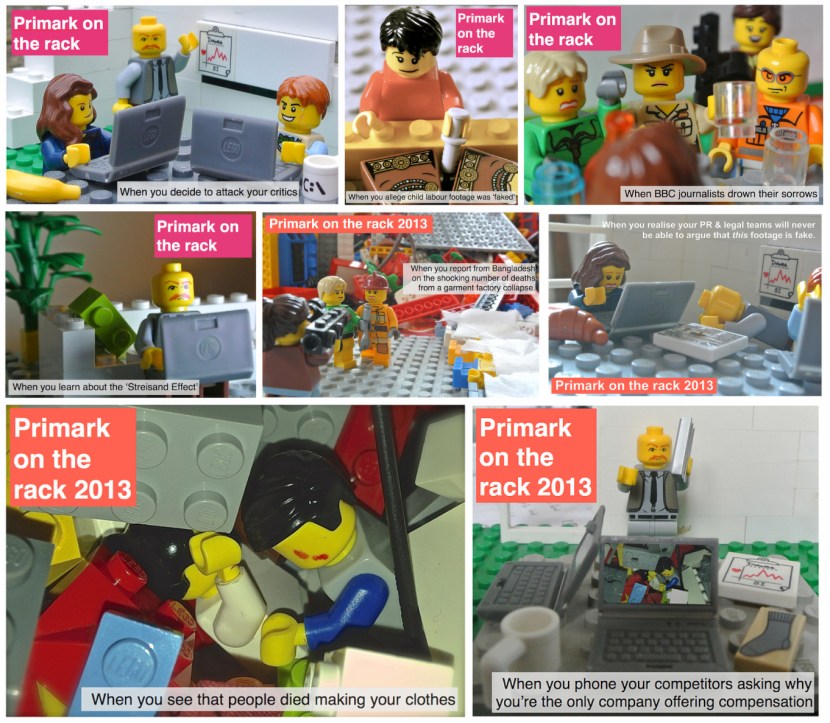
Click for the flickr set with explanations
.
Our audience: curious & expert students

Click to read more about this module

A draft followthethings.com page published last week: click to read
A draft followthethings.com page, published last week: click to read
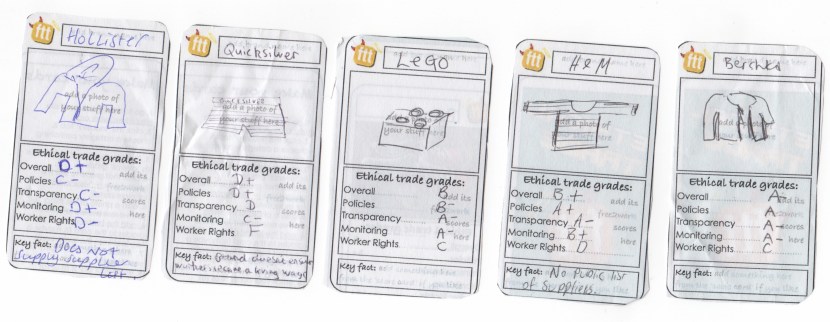
New student work: e.g. Ethical Trade Trumps game
.
Our hashtag

Tweet photos of your ‘Made in…’ labels & ask questions with this.
.
Our speakers
James Christie-Miller
Click for our Grand Challenge Events page
& Carry Somers

Click here for our Grand Challenge events page
Why Lego ‘Primark on the rack 2013’?
We researched a 2009 BBC Panorama documentary ‘Primark on the rack’ for followthethings.com. This was a documentary exposing Primark for producing its notoriously cheap clothes in Indian sweatshops. It contained a 45 second scene in which child labourers were filmed checking that sequins were firmly attached to its sequined tops. Primark claimed that this scene had been ‘faked’ and made a concerted effort to discredit the whole film, with mixed success (detailed on our site here).
As with many of our pages, we made a few scenes in Lego, uploaded them to a flickr set, and embedded them. Today, we added a couple of new scenes to our ‘Primark on the rack’ set, to bring the story up to date.
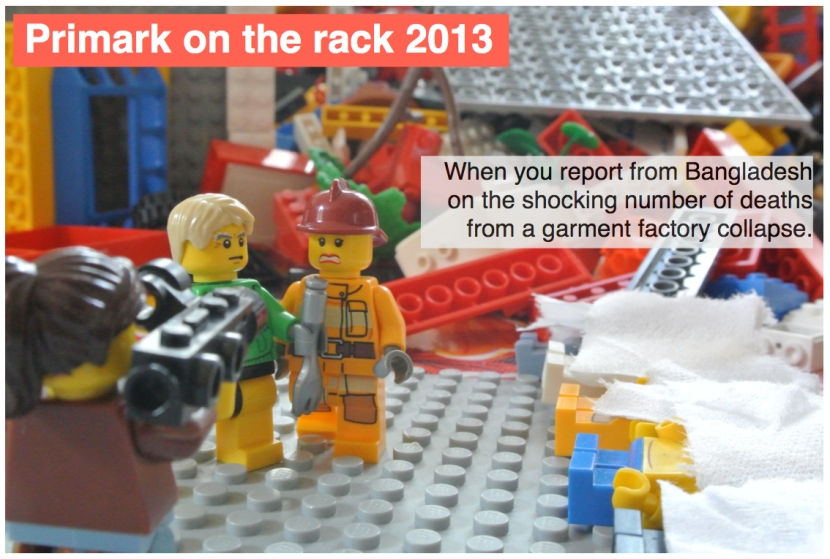
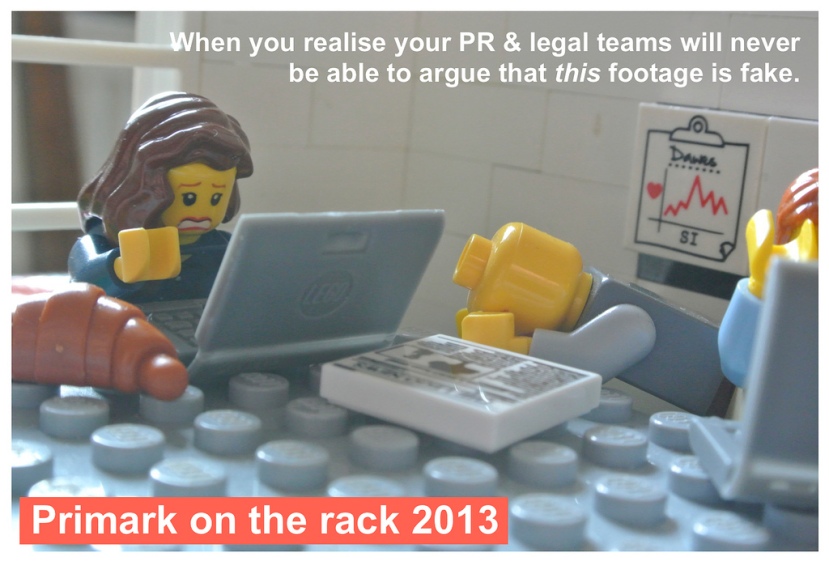
These scenes are intended to highlight a theme that cuts across a number of examples of followthethings filmmaking on our site: corporations responding to sweatshop, worker health and environmental destruction exposures by employing public relations and/or legal teams to ‘prove’ that key scenes – and, by implication, whole films – are ‘faked’. This is, for example, how Primark responded to the BBC documentary in 2009, how Dole responded to Fredrik Gertten’s documentary ‘Bananas!*’ in 2009 (link), and how Chevron responded to Joe Berlinger’s documentary ‘Crude: the real price of oil’ in 2009 (link).
This past week has seen relentless TV news footage and newspaper column inches devoted to the Savar Rana garment factory collapse. Journalists have told unfolding stories of dramatic rescue efforts and the shocking numbers of people who made Primark, Joe Fresh, Matalan, Mango, Benneton, Bon Marche and other branded clothes being found dead in the wreckage of their workplace or missing, presumed dead.
NGOs and others are putting pressure on these clothing brands to respond appropriately to this disaster by properly compensating its victims and their families, by signing agreements that they’d been reluctant to sign before, and by putting into place more comprehensive auditing practices so that what they agree to is more likely to be done in the future.
This pressure continues to be applied, and companies are responding. On Monday, for example, the BBC reported that Primark had released a statement saying that it ‘accepts all its responsibilities in this disaster’ (Source: BBC 2013 link). ALL of them. We shall see.
This is not a single documentary with a named director, whose work can be ‘discredited’ with the right PR and legal teams in place. This is ‘Primark on the rack 2013’. Click the photos to get to the whole 6 scene set.
Postscript: why Lego?
We’ve been inspired by Lego re-creations that we found online of hidden scenes from the ‘War on Terror’. They had been made and posted online in 2009 by an artist/blogger called Legofesto (see her flickr sets here). She argued that:
‘By using toys, I hope the viewer will linger longer over the image and think again about what is actually being depicted or described, in a visual language that is recognised by us all: LEGO. … The incongruity between the immoral and horrific acts and events depicted and the smiley-faced children’s toy create a tension’ (legofesto in Time Magazine 2009 link).
By photographing re-creations and publishing them online, she argues:
‘I want to keep the debate going. To keep it in people’s minds, to remind us of our atrocities because the media has moved on and they don’t want to dwell on the tactics [of the ‘War on Terror’]. … People are using Legofesto to talk about torture and state violence’ (legofesto in Carling 2009 link).
We want our Lego re-creations to help keep trade (in)justice debates going, to keep them in people’s minds, etc. in a similar way.
 the back office