
Category: Manufacture
Sodastream studies…
Overnight, [Scarlett Johansson] has become the Marie Antoinette of the Israeli-Palestinian conflict, smiling regally and offering: “Let them sip soda.” (source)
We’ve been following carefully how actor Scarlett Johansson (a.k.a Scarjo) was forced last week to choose between her role as an Oxfam Global Ambassador and as the face of soft-drink machine maker Sodastream.
This is the banned TV advert that was due to be shown at half time during Superbowl 2014, the ‘most watched’ TV show in the US. What values are expressed here?
“You carry the stories of the people who make your clothes”
Because of our involvement in the commemoration of the Rana Plaza factory collapse through ‘Fashion Revolution Day’ (and its ‘Who made your clothes?’ theme), and the University of Exeter’s ‘What (not) to wear?’ ethical fashion Grand Challenge, we’ve been collecting films and other resources designed to engage consumers with the hidden social relations in their clothes, the lives in their things.
This short film, just published on YouTube, and it’s ‘behind the scenes’ sequel are fascinating, we think.
‘Handprint’: the film.
Behind the scenes: the making of ‘Handprint’.
Foxconn factory work: 2 perspectives
In response to a student query today about the pride that factory workers can have in making consumer goods for others, I recommended that the two short films below were watched one after the other.
Both are about the notorious manufacturer of Apple and other electronic goods: Foxconn.
Dreamwork China
This is an extract from a documentary film in which young factory workers are interviewed in a photo studio across the road from the factory.
iProtest
This is an episode of from the Al Jazeera TV series Activate, about the investigation into worker rights, health and safety in Foxconn factories by Hong Kong based NGO Students and Scholars Against Corporate Misbehaviour.
‘What (not) to wear’ event: an introduction

Click for the facebook event page
Date: 11 November 2013, 4-6pm
Venue: University of Exeter, Streatham Campus, Streatham Court, Lecture Room C.
.
Our sponsor

A taster event for 1st year University of Exeter students: click for details
.
Setting the scene: journalism, activism & ‘Primark on the rack’
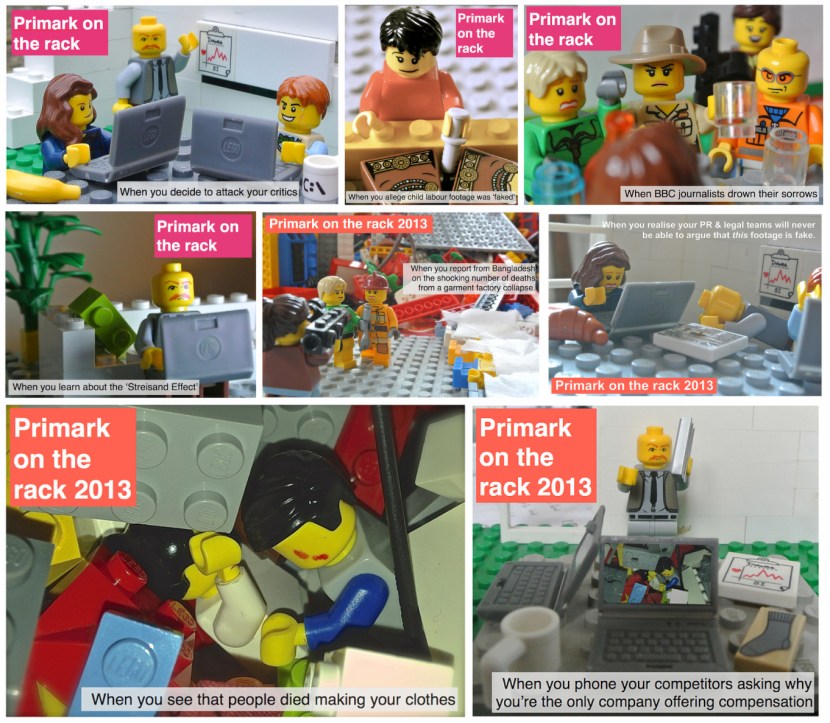
Click for the flickr set with explanations
.
Our audience: curious & expert students

Click to read more about this module

A draft followthethings.com page published last week: click to read
A draft followthethings.com page, published last week: click to read
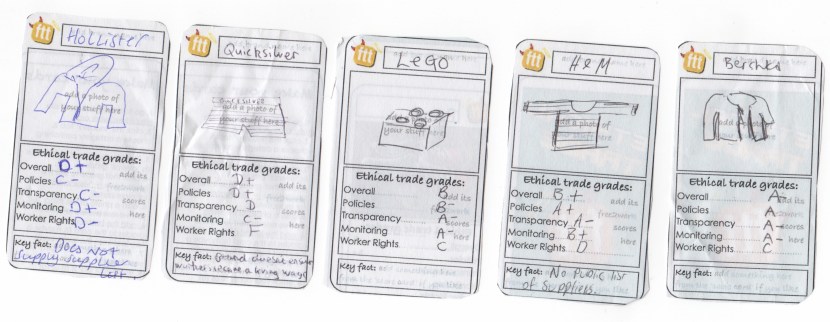
New student work: e.g. Ethical Trade Trumps game
.
Our hashtag

Tweet photos of your ‘Made in…’ labels & ask questions with this.
.
Our speakers
James Christie-Miller
Click for our Grand Challenge Events page
& Carry Somers

Click here for our Grand Challenge events page
Halloween specials
We have decorated our website’s header for the season. It’s all gone a bit Scooby Doo. Our site is a mystery machine full of pesky kids.
‘Tis the season to be haunted. So here are a couple of followthethings examples with a Halloween theme.
Letter from a labour camp worker found in Halloween decorations
[click here and you can read our page on this letter – who made it, how it was discussed, and the impacts it had]
Film of workers injured making Mickey Mouse’s ‘Haunted Halloween’ book
[click here and you can read our page on this film – who made it, how it was discussed and the impacts it had].
Fairphone: ‘an object to start conversations’.
Having become fascinated by the spoof ‘conflict free’ iPhone 4CF created by the Yes Men and students at the Parsons New School for Design in 2010, we have been following with fascination the creation of the Fairphone: a ‘real’ conflict free smartphone which will be out very soon.
Recently the Fairphone opened a ‘Pop-up Space’ in London, where they discussed this phone with people who dropped by. This short film about these pop-up discussions is well worth watching.
What was a ‘design fiction’ is now a reality… so what does that mean for the designers, makers, traders and users of smart phones?
Happy ‘shopping’: making & using followthethings.com bags
This post began as a contribution to a special issue of the journal ACME on the new ‘impact’ agenda in British Higher Education. Our shopping bags and ‘ladybugging’ activities seemed to fit this bill, although their ‘impact’ wasn’t measurable (and that was the point). In the end, another short piece on impact was written for the journal. We have revised that original paper to post here, and hope it may be interesting for readers who are keen to use our site and/or bags in their teaching and wider ‘shopping’ activities.
Update September 2016: sorry, we have no bags left to give away. They’ve all gone. If you have one, it’s a priceless collector’s item. If you see someone carrying one, please say hi.
——————————————————-
“We need to develop forms of critique that inspire hauntings, feed feelings, come alive, leap out and grab us, … that are not just about vital materiality but are themselves vitally material” (Cook & Woodyer 2012 p.238).
Commodity activism & making things: the Fairphone.
Earlier this year, journalist George Monbiot wrote about the next mobile phone he was going to buy. It was a difficult decision:
If you are too well connected, you stop thinking. The clamour, the immediacy, the tendency to absorb other people’s thoughts, interrupt the deep abstraction required to find your own way. This is one of the reasons why I have not yet bought a smartphone. But the technology is becoming ever harder to resist. Perhaps this year I will have to succumb. So I have asked a simple question: can I buy an ethical smartphone? … I haven’t yet made a decision. There are all the other issues to investigate, including the remarkably short life of these phones … Perhaps I will wait until FairPhone manufactures a handset. Or perhaps I won’t bother. I might resign myself to less immediacy, less accessibility and a little more space in which to think. George Monbiot 2013 [link]
This is the ad for the Fairphone he was talking about. It’s just been posted online. Please press play.
.
We love this project. It starts with the argument that we start with. But they’re not exposing exploitation (see here). They’re not making a banned smartphone game that shows how it’s made (see here). They’re not spoofing the existence of a conflict free phone (see here).
Like these other examples, however, they are putting pressure on manufacturers. By showing that conflict free phones can be made. By making and marketing one. That’s cool and affordable as other smartphones. €325. That you can buy and use (in Europe first). They need 5,000 orders. Here.
.
 the back office