
Category: 2017
Commodity activism in a transmedia world: our latest publication
There’s an academic publications page on our blog that gives a taste of, and provides access to, our research papers about the followthethings.com project. A book chapter has just been published in an open access e-book that brings together a series of lectures in Switzerland asking if and how social scientific research can transform society. Our answer is a qualified yes.
Cook et al, I. (2017) followthethings.com: analysing relations between the making, reception and impact of commodity activism in a transmedia world. in Ola Söderström, Laure Kloetzer & Hugues Jeannerat (eds) Innovations Sociales: Comment les Sciences Sociales contribuent à transformer la Société, MAPS: Université de Neuchâtel, 50-61 Full Text
What we are keen to find out are what filmmaking, artistic and activist tactics lead to what kinds of public and corporate responses, and with what kinds of impacts on whom. There is an established argument that, when this work is didactic and tries to enroll its audiences through blame, shame and guilt, it tends to fail. Audiences feel powerless, overwhelmed, apathetic, and angry at those making them feel this way rather that at the injustices exposed (Barnett 2010, Sandlin & Milam 2008, Cook & Woodyer 2012). Even the most cursory examination of our website suggests that the elements of, and relationships set out in, this argument are quite narrowly defined. To illustrate this, we offer below a taste of what’s to come from the analysis of the followthethings.com archive. We provisionally outline one engagement tactic, one kind of consumer response, one kind of corporate response, and one kind of impact.
Guest blog: what is the thing with palm oil?
This year we have been working with Dr Carolin Schurr in Switzerland. Her new ‘Follow the Thing: Studying Transcultural Markets’ course at the University of St Gallen ran in parallel to our ‘Geographies of Material Culture’ course at the University of Exeter. To showcase the awesomely critical, creative scholar-activist work that our students produce, this year we’ve published student guest blogs about gun sights, iPhones and paint. This post contains two pieces of work on palm oil by Carolin’s students Gianmarco Zorloni, Harpreet Perhar, Julian Krauth, Leonardo Ehnimb and Milan Kuzmanovic. We start with a short animated information film (expertly put together using Videoscribe software), followed by a script showing how ‘the thing with palm oil’ can enter conversation and affect behaviour, and finishing with the research report upon which this work is based. How can you respond to ‘follow the thing’ research that finds that thing in, more or less, everything?!
The information film
The script
Advice from Emma Watson: ‘always follow the thing’
We know from our research that the involvement of celebrities in activist campaigns raises their media profiles and impacts. We have been hoping that our ‘follow the things’ project would one day attract a celebrity to get behind what we’re doing, encourage others to do what we do. Yesterday we found what we were looking for. Emma Watson was exchanging advice for $2 in New York’s Grand Central Station. We’ve skipped to the part in the video when she’s responding to one young man’s question. If you take her advice entirely out of content, she’s giving us an endorsement. Her character Hermione Grainger has inspired activist members of the Harry Potter Alliance. Now she inspires us. The way she says our words is wonderful. Thank you Emma.
Guest comic – Painting the way for change
Here’s yet another strange and wonderful piece of work from the Exeter Geography module behind our website. It’s Rebecca Jones’ cartoon strip in which she tries to humanise paint and its commodity relations, health, safety and ethics. It starts like a talk by a young woman, but other speakers soon appear….

Click the image to download the rest.
#whomademyclothes? Fazlul Ashraf?
A week ago PhD student Thomas Dekeyser tweeted a photograph of a note found in someone’s Zara jeans. We circulated it at work, and loads of people discussed what language it might be written in and what it could say. We’d found a note on a CD player and found help to translate it before.
There’s a genre of shop-dropping in which factory workers leave notes for consumers in the things they make. Sometimes they’re genuine. Sometimes they’re hoaxes. Sometimes they’re part of activist campaigns. See our post The 13 best examples of shop-dropping … ever for more.
This one was particularly relevant for the Fashion Revolution movement, whose core question is ‘Who made my clothes?’ This note could simply be a direct answer. According to Reddit. Or is there more to it?
Thanks to Thomas and to Brad Garrett for the tipoff.
Unstoppable, incredible … #IWD2017
How the ‘follow the thing’ approach has become part of International Women’s Day campaigning. In 1907, the University of Chicago says:
‘A common version of the beginning of International Women’s Day starts … with a march of textile women workers in New York. Amidst public discussion about the conditions of textile workers and women’s campaign for suffrage, about 15,000 women working in needle and textile industries marched through New York City. The demonstrators sought to commemorate police brutality encountered in a women workers demonstration in 1857, as well as demanded shorter work hours, better pay and voting rights’ (source).
In 2016 REMAKE published online their film Celebrating the Women Behind Our Fashion. This year, OXFAM GB published online its films about Florina the Unstoppable Tomato Tree Farmer and Theresie and the Incredible Pineapple Harvest.
Read and watch!
Follow the… Fairtrade Fortnight 2017
‘Would people still love a bargain if we bought these issues closer to home?’
‘Money is the journey we send it on.’
It’s fairtrade fortnight, the time of year when companies and NGOs make the relations and responsibilities between the producers and consumers of everyday things mainstream news. In this post we highlight two contrasting videos in which these relations are a) brought close to home through the delivery of food and b) stretched out through investing money (perhaps the most fascinating commodity) in an ethical ISA. Watch and discuss…
Follow the produce: the home delivery service they weren’t expecting
Follow the money: the most rewarding cash ISA in the world
Trade is not a thing…
The main point…
Guest blog: Dear iPhone Girl
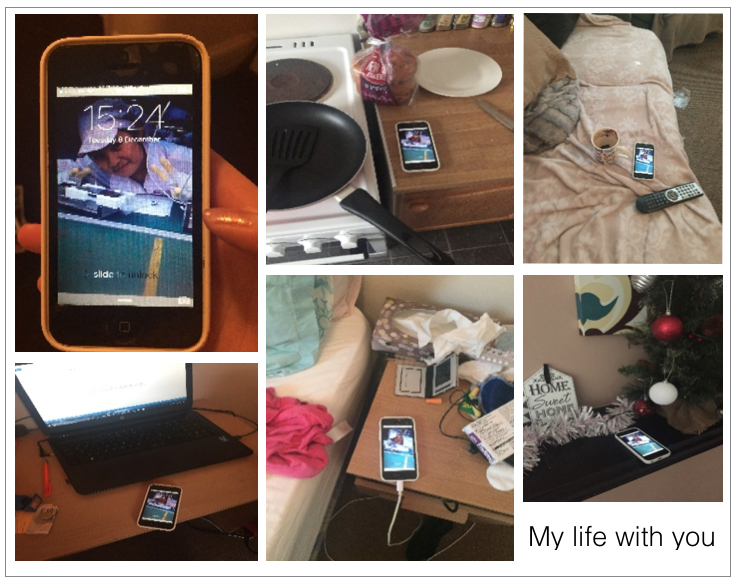
Here’s another excellent example of journal writing from the Exeter Geography module behind our website. At the start of the module, we ask the students to add to their phone homescreens this photo of an Apple factory worker which, it seems, was accidentally left on an iPhone bought in 2009. The person who found this and four other photos posted them online and the quest to find out who she was, why photos of her were on that phone, and what would happen to her after they went pubic went viral (as documented on our followthethings.com page). We ask our students to keep her photo on their homescreens until the end of the module, for almost 4 months. What can happen to you when she looks at you every time you look at your phone, wherever you go? Sophie Woolf explains… to the person who became known as ‘iPhone Girl’.
Guest blog: step away from the weapon
This post is by Ginny Childs, a student who took the Exeter University Geography module that is behind our website last term. It’s a piece of (slightly edited) coursework that she wrote in response to reading behind Sofia Ashraf’s ‘Dow vs. Bhopal: a toxic rap battle’. Ginny wasn’t even born when the Bhopal factory exploded in 1984, but it affected her here and now. Here’s how…

I joined Exeter University Officer Training Corps this year. Last weekend was my first weapons training session; on the SA80 assault rifle. The first lesson I received was a ‘Normal Safety Procedure’ on what to do if I drop it and the sighting system cracks. The system uses tritium (a radioactive hydrogen isotope) in gas form, to create visible light. If it escapes, and I were to inhale it, radioactive damage could occur in my body.
Sat in my weapons training lesson, whilst thinking about tritium, my mind drifted to methyl isocyanate (MIC). The Bhopal disaster was the topic my group were researching for this module. I’d been researching the thousands of deaths and deformities this gas leak caused. Now, here I was being cautioned on tritium. It seemed silly. The rifle contains only a minute amount, and it’s deemed to be one of the least hazardous radionuclides. Yet, I was laboriously taken through a step-by-step routine to memorise the safety procedure: STEP AWAY FROM THE WEAPON… HOLD YOUR BREATH…GET ANY SMOKERS TO PUT OUT CIGARETTES…INFORM ARMOURY OF INCIDENT etc.
 the back office
