Guest blog | Milkybar buttons & child slavery: primary children write to Nestle

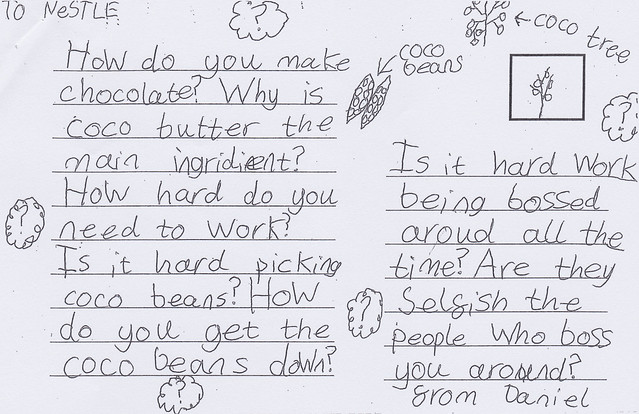
This is the latest in our #followtheteachers series. In December last year, Ian was contacted ‘out of the blue’ by Joe Lambert, a trainee teacher at Montgomery Primary School in Exeter who had been an undergraduate Geography student at Exeter University, where Ian works and where followthethings.com is based. Would Ian be interested in working with him and the school’s 7-9 year old (Year 3 and 4) students, who were following food the following month? Yes was the answer. Here’s what happened, as described by Joe. Montgomery Primary: Daniel's postcard to Nestle and a child slave picking cocoa in the Ivory Coast After hearing geography was the key focus of the first few weeks of the January term, my ears immediately pricked. A geography graduate rarely gets an opportunity to use his degree but when he does you know he is going to relish it! My interests were further stoked when the topic was narrowed to identifying where does our food come from? This was the wonderful, crystallising moment when you realise maybe paying attention in the 1st year of your degree was worthwhile. Continue reading
Where presents come from…

Dear followthethings.com shopper

Christmas is the busiest time of year for global capitalism. It’s also the best time of year to ask ‘who made my stuff’? Or, better, ‘who made the stuff I’m going to buy for my friends and family’? And ‘who made the gifts they’re going to gove to me’? There’s lots to think about.

We have been putting together a Christmas ‘shopping’ list for over a decade and it’s full of fascinating information and thought-provoking stories with which to teach and learn about this time of year. Watch some classic Christmas movies. Read some shopping guides, supply chain news, and perspectives on the season from NGOs, artists and academics.

How to think critically about and with Christmas? We have some ideas

Festive feelings

Ian et al.

[last updated December 2025]

Our Christmas movies

A short to warm up your audience:

Tesco pulls Christmas cards reportedly made by ‘Chinese prison slaves’ (2019)

or

Xmas Unwrapped (2014)

Where’s this from? See our page in this film here.

Continue reading

followthethings.com awards for 2014 (part 1)

Yes, it’s that time of the year. Our annual awards ceremony. Lego Daniel Radcliffe hosted the awards last year. This year he refused, so we’re doing it on the cheap. A huge thanks to everyone who contributed to our project this year, and to those who asked us to take part in their projects. 

Watch out for more awards over the next week. We start with the…

Most liked followthethings.com page

Pacemaker 1

1. The first ever pacemaker to speak for itself (student coursework, 51 facebook likes: new in 2014)

2=.  Cries for help found in Primark clothes (a.k.a. ‘labelgate’) (activist stunt, 29 likes: new in 2014)

2=.  Bananas!* (documentary film, 29 likes: added 2011)

4. Mardi Gras: Made in China (documentary film, 19 likes: added 2013)

5. McLibel (documentary film, 18 likes: added 2013)

Follow the make-shift tear-gas mask instructions…

Earlier this year, one of followthethings.com’s activities was to take a group of Exeter Geography undergraduates to the Victoria and Albert museum in London to compare its Disobedient Objects, Rapid Response Collecting and Fashion collections/exhibitions. We’d heard that some of the Disobedient Objects could not only be followed into and through the exhibition (lent by and returned to those who made them), but also out from it: as the exhibition’s DIY leaflets were being used elsewhere in the world to make the objects on display. We then found this article by Alice Bell which explains this brilliantly. 

Art historian Gavin Grindon first spotted DIY gas masks last year, looking through photos of the Gezi Park protests in Turkey. He was developing an exhibition on the art and design of protest, and was intrigued by a street-based response to tear gas: essentially a surgical mask stuffed inside a sliced plastic bottle, with some insulating foam and elastic added for good measure.

“As far as I can tell, it was playing around with what [protesters] had on hand,” Grindon told me. The trick of soaking cloth in lemon juice or vinegar has long been used by protesters to protect themselves against tear gas. But Grindon believes that as tear gas is being used more and more, people are looking for something more powerful. (For instance, Greek activists are experimenting with antacid medicine as more effective than vinegar.) For his part, Grindon imagined he could use a rough how-to guide for the bottle-based idea he found pinned to a wall in some photos to design something even better.

Click for more      

Guest blog: developing global perspectives on sustainability with followthethings.com

In February this year, Ian, Charlotte Brunton and Jenny Hart contributed to a Pedagogy Cafe seminar at Plymouth University’s Centre for Sustainable Futures. They talked about Geographies of Material Culture coursework (a university lifestyle catalogue and a singing heart pacemaker) now published on our site. What happened next was surprising. Plymouth lecturer Helen Bowstead  talked about her use of ‘follow the things’ research to teach English as a Foreign Language. Here’s what she said.

Screen Shot 2014-09-30 at 8.35.19 AM

International students discuss complex and overlooked understandings of things.

The benefits of group work have been well-documented: Gibbs claims working as a group “has the potential measurably to improve student engagement, performance, marks and retention and usually succeeds in achieving this potential” (Gibbs 2010:1). However, successfully implementing and assessing a piece of group work is also often fraught with challenges, particularly when the students do not share a common language and/or cultural background. In groups where some or all students are non-native English speakers, there may be an ‘imbalance’ in power relations, as the ideas and views of the students with ‘stronger’ language skills often end up dominating. In many instances, non-native speakers find themselves side-lined within the group, sometimes because their language skills are weaker than other members, but also because, due to cultural and educational differences, their knowledge base is perceived as having less ‘value’.

Continue reading

Guest blog: follow the poppies

Our latest guest blog is by Joe Thorogood, a former student in the ‘Geographies of material culture’ module at Exeter University who is in the early stages of a ‘follow the things’ PhD in the Department of Geography at University College London. His research is on poppies. In the post below, he outlines what he’s found out so far about the Remembrance Day variety. As usual with following research, you may be surprised by what he finds.

Royal British Legion poppy: click for source

The Remembrance poppy is a symbol of memorial. In the couple of weeks before November 11th – Remembrance Day – these poppies are available in exchange for a charitable donation to the Royal British Legion, a UK charity that provides services for ex-military personnel and their dependents. It is worn in the UK in memory of service personnel who died in the First World War and in wars since then. It’s a symbol for personal grief and reflection, but also of national loss. Many countries have poppies shipped out to expatriates and families who have relatives who fought on behalf of the British Empire and British army in campaigns abroad.

I’m researching Remembrance poppies for my PhD, using a methodology that studies the lives and issues that are connected through their travels and transformations as things.

It wasn’t hard to find out about how and where Remembrance poppies are made. You could do it yourself by simply visiting the Poppy Factory in Richmond, Surrey,  where they make about 500,000 of the poppies the public wear. Ex-service personnel and their dependents are crucial to this effort, as they often work in the factory or are supported by factory to find employment after leaving the armed forces. Continue reading

New in Lego: A Global Positioning System

A Global Positioning System

Here’s the latest of our Lego re-creations, made today to add to one of our first published pages: on Melanie Jackson’s (2006) digitally generated animation (and catalogue) A Global Positioning System.  Continue reading

Everything is (not) awesome: Greenpeace, Shell & Lego activism.

Greenpeace & Lego

Greenpeace want Lego to end its links with Shell, and are currently campaigning through the medium of imaginative Lego re-creation. This video is one of a number of examples, whose aim is to encourage people to sign this petition. In the wake of the hugely successful Lego Movie (whose stars make a cameo appearance) this campaign is becoming perhaps the most lavish and high-profile example of Lego activism to date.

followthethings.com & Lego

On a much smaller budget, we’ve been making, photographing and posting online re-creations in Lego of (imagined) scenes from trade justice films, art and activism for a while now. See, for example, our recreations from and around the BBC Panorama documentary ‘Primark on the rack’. Continue reading