
Category: followthethings.com
If your Geography Homework is on Nike…
It’s happening right now.
At least one class of Year 8 students at an Exeter high school are doing some Nike homework this weekend.
Natalie Batten, one of the newly qualified Geography teachers who has been using followthethings.com with her students as part of our #followtheteachers project, has already blogged about an assignment like this. Click this button to read about her experience and advice.

If you’re interested in what it life and work can be like for the people who make sports clothing, we have some other recommendations that aren’t on our sire. The first film is on Nike and could be a vivid and useful source. But other students in other schools may have been given Adidas to research. We have a couple of films for you too, if that’s what you’ve been asked to research. And, at the end, we bring things right up to date: with a way to compare these two companies / brands.
Nike: behind the Swoosh
A student at the US’s largest Catholic University feels disgusted with what he reads about Nike and ‘sweatshops’ and, when he refuses to wear his University’s Nike soccer kit, he’s fired. So he sets off to Indonesia with a friend to find out if the factory and living conditions he’s read about are as he imagines. People at University keep telling him that things are fine. What he sees, what he does, and the people he meets in Indonesia have a powerful effect on them and what they decide to do next.
Pester Power
If you’re studying Geography and your homework is about Adidas, you should find this next film interesting. It’s a 2001 episode of the Mark Thomas Comedy Product TV series that involves a class of Geography students in London finding out – with the comedian/activist’s help – about the company’s labour practices in a unique, face-to-face way, in their classroom. Fast forward to 6 minutes 13 seconds. That’s where it starts.
Not OK here, not OK anywhere
This short video was produced by the charity War on Want as part of its campaign to highlight the abuse of workers making Adidas sportswear for fans and athletes attending the 2012 Olympic Games in London. It was part of a wider campaign whose webpages are listed here.
Commitments to workers: 2013 update
If you have been studying the collapse of the Rana Plaza garment factory in Bangladesh in April this year, you may find it interesting to see which company has and which has not signed the Accord on Fire and Building Safety in Bangladesh. There’s a story about one signing and the other not signing in this newspaper story. But check the latest list that’s published here. The situation may possibly change…
“You carry the stories of the people who make your clothes”
Because of our involvement in the commemoration of the Rana Plaza factory collapse through ‘Fashion Revolution Day’ (and its ‘Who made your clothes?’ theme), and the University of Exeter’s ‘What (not) to wear?’ ethical fashion Grand Challenge, we’ve been collecting films and other resources designed to engage consumers with the hidden social relations in their clothes, the lives in their things.
This short film, just published on YouTube, and it’s ‘behind the scenes’ sequel are fascinating, we think.
‘Handprint’: the film.
Behind the scenes: the making of ‘Handprint’.
Making music in trade justice education: listen up!
Creative academic expression
There’s an undergraduate module at the University of Exeter called ‘Geographies of Material Culture’. It’s one of two University modules whose student coursework form the basis of almost every followthethings.com page. The module is assessed through students’ critical self-reflections on whatever comes to mind through reading the academic literature and working together to research and publish draft ‘compilation’ pages and new work for the site. They are encouraged to be creative, to express themselves in ways that rework the traditional essay formal that everyone is used to. The work is diverse and fascinating. You never read the same thing twice.
‘How am I gonna be an activist about this?’
One type of work that’s started to emerge in 2013 are original songs, written, recorded and published online by students and written about on paper. There have been two so far. The first is by Jenny Hart, who submitted her song at the start of the module this year (in October). She’s trying to get her head around the key theoretical baselines of the module. The second is by Tommy Sadler, who submitted his song at the end of the module last year (in January). He’s expressing what the module was about, for him. Both shared their songs via Soundcloud, and you can listen to them here:
.
followthethings & research impact
There’s a new special issue of the online, open access Geography journal ACME on the impact of academic research. This has become one of the ways in which the value of academic research is assessed in UK Higher Education, through the Research Excellence Framework.
One of the papers is by Ian Cook et al (that’s me/us), about the longstanding ‘follow the things’ research and public pedagogy that led to the creation and opening of followthethings.com in October 2008. To give a flavour of its approach to impact, here’s an extract from the paper:
When you publish academic work and make it freely available online, people read it and get in touch with you asking if you’d like to take part in work they’re (thinking of) doing. So you end up doing all kinds of unexpected things. This way of working is a core principle of ‘organic public geographies’ (Fuller and Askins, 2010; Hawkins et al., 2012). And it involves writing critical, radical, scholarly papers that are both publishable in academic journals and books, and accessible to more than academic audiences – like school teachers, journalists, filmmakers and artists: the people who make and use the work you’re researching. This is not the kind of “unidirectional knowledge” transfer that aims to make clear interventions in public debates (Pain et al., 2010, 185). It’s the kind that has critical pedagogy at its heart, that treats knowledge as “emerg[ing] only through invention and re-invention, through the restless, impatient, continuing, hopeful inquiry human beings pursue in the world, with the world, and with each other” (Freire, 1996, 52-3). Here, as Rich Heyman (2010) argues, academic writing should not be treated as the end point of research. Instead, it should aim to encourage research and conversation to continue beyond publication by offering its readers, for example, catchy and surprising narratives to engage with, unheard voices to listen to, unfamiliar concepts to use, tricky problems to think through, new skills to learn, and intriguing detective work to do (Cook and Woodyer, 2012).
Cook et al (2014, 48).
If you want to read the rest of the argument, download it here.
If you have any comments or questions, please submit them below.
Thanks
Ian
Fashion Revolution Day: the first Trump card game
Yesterday at the Department of Geography at the University of Exeter, we heard Carry Somers talking about Fashion Revolution Day at our ‘What (not) to wear?’ conference. There was mention of an Ethical Trade Trump card game invented by students taking ‘Geographies of Material Culture’ in 2012 – using data from free2work.org – being adapted as followthethings.com’s contribution to this campaign.
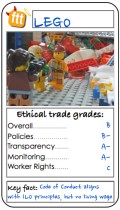
A new Fashion pack will soon be designed, but today we tested out the idea in class. Students each made a card based on something they were wearing, sketched it, added the grades from free2work and – for extra information at the bottom of each card – added whether that company / brand had signed the Accord on Fire & Building Safety in Bangladesh.
The match report
6 teams of 8 students each made one or more cards in the first 15 minutes. One student was elected from each group as their player, and we staged a 6 player tournament at the front of the classroom. The cards were shuffled and dealt. The game began with player one calling out a brand (Cheap Monday!), a category (policies!), a grade (A+!), and then slamming the card on the table (drama!). The other players then took the card at the top of their pack, one after the other, called out its brand (Calvin Klein! or Adidas!), and its policy grade (C-! or A+), and slammed their cards on the table. The audience gathered round, watching their cards being played, helping their players to win and lose each round.
In each round, the player who called out the highest grade took all of the cards, and started the next round. If there was a draw – like between Cheap Monday and Adidas, both with A+ grades for their policies – the ‘key fact’ could be played: had the brand / company signed the Accord? In this case, only Adidas had (only very recently, the referee had to say), so that was the winning card.
The game went on with rounds in which, for example, only ‘worker rights’ scores could be played. It ended with a ‘winner takes all’ round, with the 3 remaining contestants. This was dramatic: a draw that was resolved by the key fact. The Accord-signatory won. Well done Adidas! Good job you signed the accord. Nobody wants a losing card. Whoops all around.
After the game ended, we discussed what had happened, why some cards were worse to play that others, why – with one exception – the policy grades were higher than the ‘workers’ rights’ grades, and how to find out why by looking at brands’ detailed free2work ‘score cards’. So, 40 minutes into class, we were talking about, asking informed questions about, and having a good idea how to find out more about the relations between ethical trade policies, transparency, monitoring, workers’ rights and the Accord.
This game can be made and played by any group of people trying to learn the basics and/or intricacies of Ethical Trade and Corporate Social Responsibility.
This is our 46 card pack, scanned after the game. What would your pack be like?


If you want to have a go:
- download the pack template, research and playing instructions here
- find the grades for your cards here www.free2work.org
- find out who has signed the Accord here www.bangladeshaccord.org/signatories/
Let us know about your game, send us your packs and match reports!
Thanks
Ian
Credits
This game was devised in 2012 as coursework ‘Geographies of Material Culture’ at the University of Exeter by Joe Thorogood, Michael Franklin, Sophie Angell, Florence Flint, Bryony Board, Toby Swadling, Jack Saxton, Jake Pincock, Emma Hargreaves & Joe Harrison. This pack was re–designed by Ian Cook, in consultation with the #followtheteachers ‘user crew’ Alan Parkinson, Oprah Whipp, Victoria Salt, Charlotte Wild, Jenny Thomas, Natalie Batten, Heather Taylor & Mary Biddulph for use in schools and universities.
Update
This pack was revised in 2014 as followthethings.com’s contribution to Fashion Revolution Day, an Ethical Fashion Trump Card Game is part of its Education Pack (download link to be added when this this is live).
‘What (not) to wear’ event: an introduction

Click for the facebook event page
Date: 11 November 2013, 4-6pm
Venue: University of Exeter, Streatham Campus, Streatham Court, Lecture Room C.
.
Our sponsor

A taster event for 1st year University of Exeter students: click for details
.
Setting the scene: journalism, activism & ‘Primark on the rack’
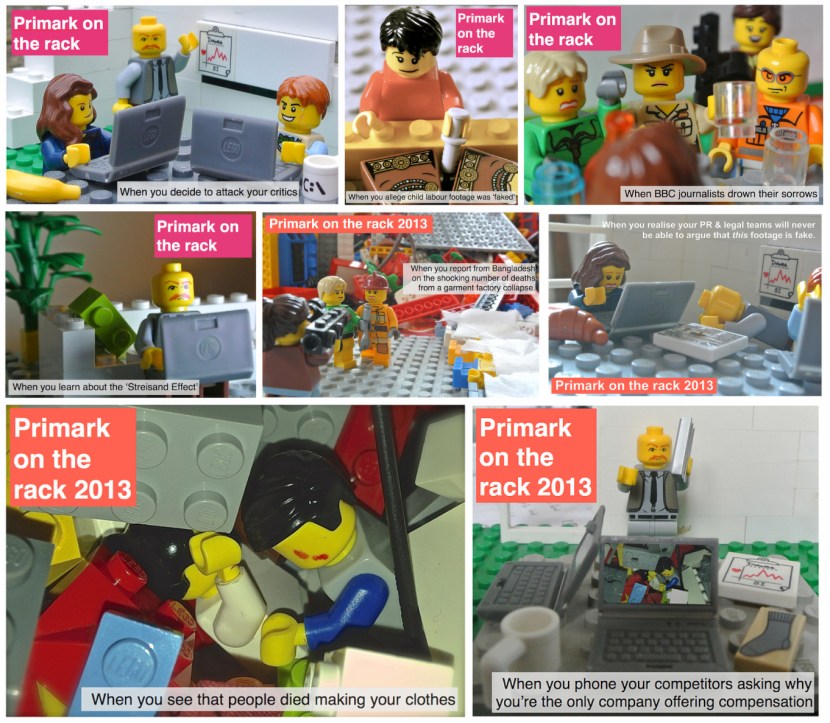
Click for the flickr set with explanations
.
Our audience: curious & expert students

Click to read more about this module

A draft followthethings.com page published last week: click to read
A draft followthethings.com page, published last week: click to read
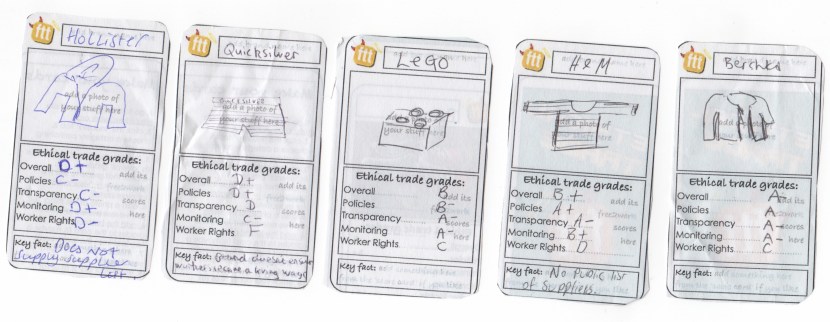
New student work: e.g. Ethical Trade Trumps game
.
Our hashtag

Tweet photos of your ‘Made in…’ labels & ask questions with this.
.
Our speakers
James Christie-Miller
Click for our Grand Challenge Events page
& Carry Somers

Click here for our Grand Challenge events page
Halloween specials
We have decorated our website’s header for the season. It’s all gone a bit Scooby Doo. Our site is a mystery machine full of pesky kids.
‘Tis the season to be haunted. So here are a couple of followthethings examples with a Halloween theme.
Letter from a labour camp worker found in Halloween decorations
[click here and you can read our page on this letter – who made it, how it was discussed, and the impacts it had]
Film of workers injured making Mickey Mouse’s ‘Haunted Halloween’ book
[click here and you can read our page on this film – who made it, how it was discussed and the impacts it had].
Flo the Cat: shopping & sharing
How can we use images to tell the stories we want to tell – an avoid repeating the ones we don’t? (Platform 2012).

We were very happy to see that Set 11 of Lego’s Minifigures included a new Grandma figure with a cat and shopping bag. We purchased our Grandma at the Thomas Moore store in Exeter, where staff can tell you what’s in each packet just by feeling it.

We know that photos of Cats and Lego are among the most shared on social media. We want more people to know about our site and what it’s all about. ‘Flo the Cat’ is helping us to do this.
These are the first ‘What the cat brought home’ photos that we added to Flo’s flickr set today. They point towards our page on Anna Chen’s 2010 Radio 4 investigation China, Britain and the Nunzilla Conundrum. Let us know what you think and, maybe, buy yourself a cat and bag and take some other ‘Flo the cat’ photos for us to publish.
If you haven’t seen Nunzilla wound up and in action, watch this short video:
And here’s what this radio show did with her:
“[The Nunzilla Conundrum] takes the example of British designed, Chinese-made ironic novelty gifts … and expands it into an illuminating discussion of the cultural differences between the two nations, with Chinese production line workers hard-pressed to describe what it is they’re making while British designers are oh-so keen to deconstruct the joke” (Naughton 2010, np).
See our page for more.
Happy ‘shopping’: making & using followthethings.com bags
This post began as a contribution to a special issue of the journal ACME on the new ‘impact’ agenda in British Higher Education. Our shopping bags and ‘ladybugging’ activities seemed to fit this bill, although their ‘impact’ wasn’t measurable (and that was the point). In the end, another short piece on impact was written for the journal. We have revised that original paper to post here, and hope it may be interesting for readers who are keen to use our site and/or bags in their teaching and wider ‘shopping’ activities.
Update September 2016: sorry, we have no bags left to give away. They’ve all gone. If you have one, it’s a priceless collector’s item. If you see someone carrying one, please say hi.
——————————————————-
“We need to develop forms of critique that inspire hauntings, feed feelings, come alive, leap out and grab us, … that are not just about vital materiality but are themselves vitally material” (Cook & Woodyer 2012 p.238).
Our 2nd #followtheteachers blog post

Over the course of the 2013-4 academic year, we’re following seven school teachers and they use and adapt followthething.com in their classrooms in England. Our second post is by Natalie Batten. She reflects on how she encouraged her students to use our site last year to help compare and contrast multinational corporations. This year, she will be using one of our new game-based teaching resources to encourage her students to better appreciate corporations’ diverse policies regarding workers’ rights and monitoring.

I covered a similar topic to the one discussed in Oprah’s #followtheteachers blog post – that of globalisation and multinational companies. This scheme, however, was implemented for AS Level Geography students (studying the OCR exam syllabus). This highlights the versatility of followthethings.com site as a resource for a variety of student ages, even when covering the same topic area. For example, while Oprah used the site to introduce globalisation at Year 7, I used it at A level to consolidate pupils’ prior learning and provide them with examples and case studies for their exams.
Click the seat!
The pupils were not familiar with the site, so time was incorporated into the scheme of work for them to explore it. They really liked the layout and navigation of the site and its recognisable format – like other online stores such as Amazon – which made the site personal to them and their interests.
Click to play!
The different forms of data presentation on the site (eg. film reviews, travel journals, newspaper articles and Lego re-creations) provided opportunities for differentiation with more able pupils challenging themselves through interpretation of more abstract research sources. In particular, some used the Ford Car Seat page – based on a 2006 film called ‘Made in Dagenham’ – to explore social and historical geographical topics such as feminism and women’s rights. This was important as it allowed pupils to ‘find the geography’ and make synoptic links to other geographical topics during their MNC research task.
An extension to a task like this could be to incorporate followthethings.com’s new teaching resource – Ethical Trade Trump Cards as a way to compare and contrast global MNCs on categories such as worker’s rights, policies and monitoring in an exciting and familiar game for pupils.
Both they and myself as a trainee teacher took a lot of positives away from this activity and I will certainly be using followthethings.com in my future teaching for this and other topics.
 the back office