
Category: Teaching resources
Foxconn factory work: 2 perspectives
In response to a student query today about the pride that factory workers can have in making consumer goods for others, I recommended that the two short films below were watched one after the other.
Both are about the notorious manufacturer of Apple and other electronic goods: Foxconn.
Dreamwork China
This is an extract from a documentary film in which young factory workers are interviewed in a photo studio across the road from the factory.
iProtest
This is an episode of from the Al Jazeera TV series Activate, about the investigation into worker rights, health and safety in Foxconn factories by Hong Kong based NGO Students and Scholars Against Corporate Misbehaviour.
Fashion Revolution Day: the first Trump card game
Yesterday at the Department of Geography at the University of Exeter, we heard Carry Somers talking about Fashion Revolution Day at our ‘What (not) to wear?’ conference. There was mention of an Ethical Trade Trump card game invented by students taking ‘Geographies of Material Culture’ in 2012 – using data from free2work.org – being adapted as followthethings.com’s contribution to this campaign.
A new Fashion pack will soon be designed, but today we tested out the idea in class. Students each made a card based on something they were wearing, sketched it, added the grades from free2work and – for extra information at the bottom of each card – added whether that company / brand had signed the Accord on Fire & Building Safety in Bangladesh.
The match report
6 teams of 8 students each made one or more cards in the first 15 minutes. One student was elected from each group as their player, and we staged a 6 player tournament at the front of the classroom. The cards were shuffled and dealt. The game began with player one calling out a brand (Cheap Monday!), a category (policies!), a grade (A+!), and then slamming the card on the table (drama!). The other players then took the card at the top of their pack, one after the other, called out its brand (Calvin Klein! or Adidas!), and its policy grade (C-! or A+), and slammed their cards on the table. The audience gathered round, watching their cards being played, helping their players to win and lose each round.
In each round, the player who called out the highest grade took all of the cards, and started the next round. If there was a draw – like between Cheap Monday and Adidas, both with A+ grades for their policies – the ‘key fact’ could be played: had the brand / company signed the Accord? In this case, only Adidas had (only very recently, the referee had to say), so that was the winning card.
The game went on with rounds in which, for example, only ‘worker rights’ scores could be played. It ended with a ‘winner takes all’ round, with the 3 remaining contestants. This was dramatic: a draw that was resolved by the key fact. The Accord-signatory won. Well done Adidas! Good job you signed the accord. Nobody wants a losing card. Whoops all around.
After the game ended, we discussed what had happened, why some cards were worse to play that others, why – with one exception – the policy grades were higher than the ‘workers’ rights’ grades, and how to find out why by looking at brands’ detailed free2work ‘score cards’. So, 40 minutes into class, we were talking about, asking informed questions about, and having a good idea how to find out more about the relations between ethical trade policies, transparency, monitoring, workers’ rights and the Accord.
This game can be made and played by any group of people trying to learn the basics and/or intricacies of Ethical Trade and Corporate Social Responsibility.
This is our 46 card pack, scanned after the game. What would your pack be like?


If you want to have a go:
- download the pack template, research and playing instructions here
- find the grades for your cards here www.free2work.org
- find out who has signed the Accord here www.bangladeshaccord.org/signatories/
Let us know about your game, send us your packs and match reports!
Thanks
Ian
Credits
This game was devised in 2012 as coursework ‘Geographies of Material Culture’ at the University of Exeter by Joe Thorogood, Michael Franklin, Sophie Angell, Florence Flint, Bryony Board, Toby Swadling, Jack Saxton, Jake Pincock, Emma Hargreaves & Joe Harrison. This pack was re–designed by Ian Cook, in consultation with the #followtheteachers ‘user crew’ Alan Parkinson, Oprah Whipp, Victoria Salt, Charlotte Wild, Jenny Thomas, Natalie Batten, Heather Taylor & Mary Biddulph for use in schools and universities.
Update
This pack was revised in 2014 as followthethings.com’s contribution to Fashion Revolution Day, an Ethical Fashion Trump Card Game is part of its Education Pack (download link to be added when this this is live).
‘What (not) to wear’ event: an introduction

Click for the facebook event page
Date: 11 November 2013, 4-6pm
Venue: University of Exeter, Streatham Campus, Streatham Court, Lecture Room C.
.
Our sponsor

A taster event for 1st year University of Exeter students: click for details
.
Setting the scene: journalism, activism & ‘Primark on the rack’
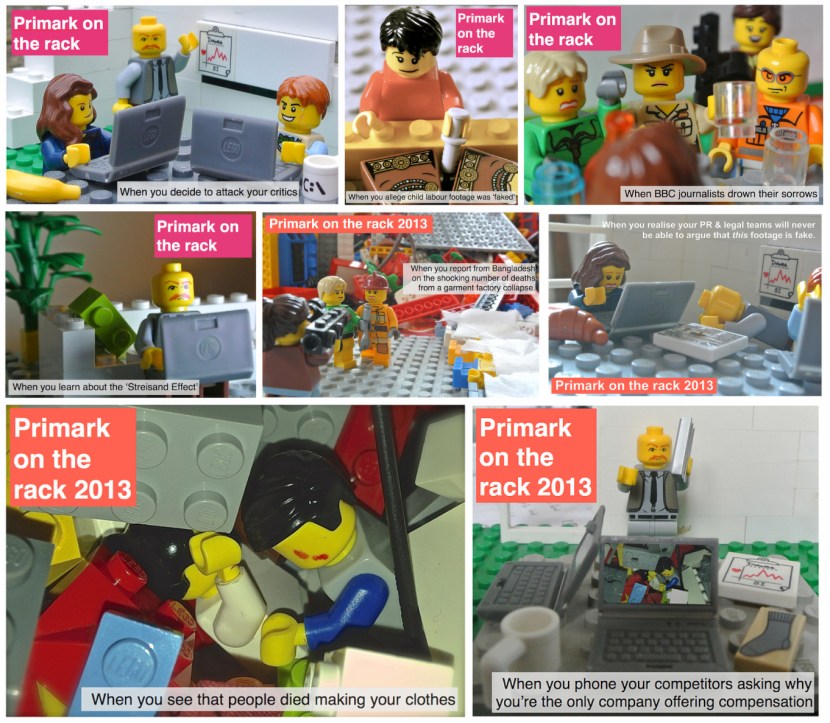
Click for the flickr set with explanations
.
Our audience: curious & expert students

Click to read more about this module

A draft followthethings.com page published last week: click to read
A draft followthethings.com page, published last week: click to read
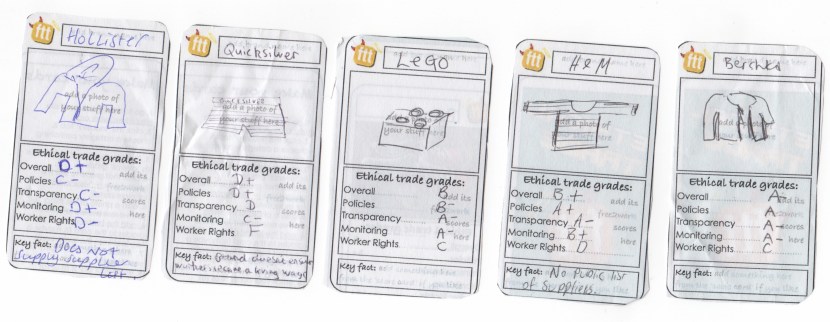
New student work: e.g. Ethical Trade Trumps game
.
Our hashtag

Tweet photos of your ‘Made in…’ labels & ask questions with this.
.
Our speakers
James Christie-Miller
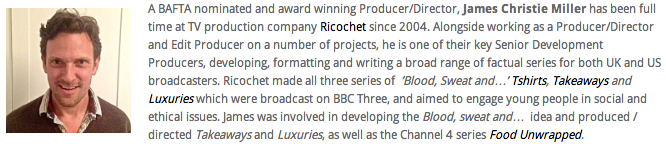
Click for our Grand Challenge Events page
& Carry Somers

Click here for our Grand Challenge events page
Happy ‘shopping’: making & using followthethings.com bags
This post began as a contribution to a special issue of the journal ACME on the new ‘impact’ agenda in British Higher Education. Our shopping bags and ‘ladybugging’ activities seemed to fit this bill, although their ‘impact’ wasn’t measurable (and that was the point). In the end, another short piece on impact was written for the journal. We have revised that original paper to post here, and hope it may be interesting for readers who are keen to use our site and/or bags in their teaching and wider ‘shopping’ activities.
Update September 2016: sorry, we have no bags left to give away. They’ve all gone. If you have one, it’s a priceless collector’s item. If you see someone carrying one, please say hi.
——————————————————-
“We need to develop forms of critique that inspire hauntings, feed feelings, come alive, leap out and grab us, … that are not just about vital materiality but are themselves vitally material” (Cook & Woodyer 2012 p.238).
Our 2nd #followtheteachers blog post

Over the course of the 2013-4 academic year, we’re following seven school teachers and they use and adapt followthething.com in their classrooms in England. Our second post is by Natalie Batten. She reflects on how she encouraged her students to use our site last year to help compare and contrast multinational corporations. This year, she will be using one of our new game-based teaching resources to encourage her students to better appreciate corporations’ diverse policies regarding workers’ rights and monitoring.

I covered a similar topic to the one discussed in Oprah’s #followtheteachers blog post – that of globalisation and multinational companies. This scheme, however, was implemented for AS Level Geography students (studying the OCR exam syllabus). This highlights the versatility of followthethings.com site as a resource for a variety of student ages, even when covering the same topic area. For example, while Oprah used the site to introduce globalisation at Year 7, I used it at A level to consolidate pupils’ prior learning and provide them with examples and case studies for their exams.
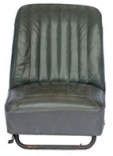
Click the seat!
The pupils were not familiar with the site, so time was incorporated into the scheme of work for them to explore it. They really liked the layout and navigation of the site and its recognisable format – like other online stores such as Amazon – which made the site personal to them and their interests.
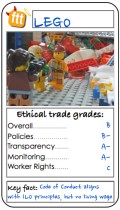
Click to play!
The different forms of data presentation on the site (eg. film reviews, travel journals, newspaper articles and Lego re-creations) provided opportunities for differentiation with more able pupils challenging themselves through interpretation of more abstract research sources. In particular, some used the Ford Car Seat page – based on a 2006 film called ‘Made in Dagenham’ – to explore social and historical geographical topics such as feminism and women’s rights. This was important as it allowed pupils to ‘find the geography’ and make synoptic links to other geographical topics during their MNC research task.
An extension to a task like this could be to incorporate followthethings.com’s new teaching resource – Ethical Trade Trump Cards as a way to compare and contrast global MNCs on categories such as worker’s rights, policies and monitoring in an exciting and familiar game for pupils.
Both they and myself as a trainee teacher took a lot of positives away from this activity and I will certainly be using followthethings.com in my future teaching for this and other topics.
More classroom resources to teach with followthethings.com

Today, we share two new classroom resources, developed with Alan Parkinson this summer. They have been developed primarily for school teachers in England and Wales (many of who share a new National Curriculum). BUT, they are also written for anyone, anywhere who is keen to teach and learn with followthething.com!
The first is a 9 page Teachers’ Guide to the Follow The Things Website. It’s a .pdf comic ‘guide to using the website in (& out of) the classroom’ with ‘lesson ideas and guidance for Key Stages 1-5’. It will also be of interest to anyone who hasn’t come across our website before and wants a quick tour. Click the button to download. We hope you enjoy it.

The second is a 4 page guide based on a wonderful set of Royal Geographic Society (with the Institute of British Geographers) teaching resources called Where does my stuff come from? These used some of the ‘follow the things’ work that we did before followthethings.com opened. This guide updates these resources, suggesting how our website and other resources can help to answer this question in vivid and up-to-date ways. It’s a Word file, too, for cut-&-pasting…

These resources are part of a larger Classroom Project which – by the end of the summer – will see two new pages for teachers added to our main website, and the documentation of a ‘follow the teachers’ project (see below). We look forward to hearing how these resources work in practice. We welcome comments (on this post), emails (to fttclassroom@yahoo.com) and tweets (@followthethings).
followthethings.com and the National Curriculum
This summer, we have been working with Alan Parkinson – legendary Geography teacher, ‘Living Geography‘ blogger and GeoBlogs tweeter – to develop some new pages and downloads for school teachers and their students. Our site has been open for almost two years, and we have found that these ‘shoppers’ are (among) our most enthusiastic. But we’ve also had feedback from some saying that it’s difficult to know where to start with our site: guidance and teacher-generated ideas were needed.
Today, we publish the first completed resource from our work together – a guide to how Geography teachers in England and Wales can use our site in the light of changing National Curriculum requirements. This document will, we are sure, be helpful for many other teachers across disciplines, in different kinds of schools, and in many countries.
This is where we’re publishing it first. You can download it by pressing the button below. We’ll update it as the Curriculum develops. [We made up the NC logo].
This, along with many other resources, will be published on followthethings.com later in the summer. As soon as each on is finished, however, we’ll publish it here!
Please send us any feedback and ideas by commenting on this post or emailing us on fttclassroom@yahoo.com And, if you have already been teaching with followthethings.com, we would love to see how! Please get in touch and join our ﹟followtheteachers project on twitter (see below).
Our #followtheteachers blogging begins
We’ve been working with a group of trainee high school teachers at the University of Nottingham this year. We’ve talked in detail with them about how followthethings.com could help them engage their students in a variety of complex and sometimes controversial geographical issues.
We enjoyed working together so much that, after hosting together a ‘Teaching with followthethings.com’ workshop at the 2013 Geographical Association conference, we decided to continue our work as they begin their careers as Geography teachers.
We decided to call what we were doing the ‘follow the teachers’ project. This would a) follow the use, adaptation and creation of followthethings.com resources to teach geography and related subjects, and b) share these experiences and resources online for others to use. Over the next few months, we’ll be hearing from seven teachers involved in this project.
We begin with Oprah Whipp’s use of our page on a Simpson’s couch gag to teach her students about globalisation and geographical thought.
I had a class of 30 year 7 pupils, mixed ability who had never studied the concept of globalisation, however this is a topic covered in detail in year 9, and again at GCSE and A Level. What could I do to put a spin on this topic, that wouldn’t become repetitive?
I began looking through the followthethings.com web page, which I was introduced to during my PGCE course at the University of Nottingham and came across the video clip directed by Banksy, and the opening sequence he created for an episode of the cartoon series ‘The Simpsons’. This was something I felt that my class would relate to, and capture their imagination.

Get a bag from followthethings@yahoo.com
In the lessons prior to this, I had introduced key terms, and completed followthethings.com shopping bag missions 1-3 on the Mission:Explore website. I adapted mission 3 – ‘Who made it?’ – by splitting the class into two groups, and asking one what they would say to a person who had made their bags, and the other what they thought those workers would say to them. This allowed pupils to gain a brief understanding of the concept of globalisation, focusing on worker’s rights.
This lesson began with me recapping the term globalisation, and then introducing Banksy by showing the pupils a picture of one of his guerrilla artworks (download my powerpoint slides). I asked them to think geographically, and about the topic we had been looking at over the past two weeks to help them do so. The class coped really well with this, and a couple of the higher levelled pupils even knew the artist and were able to inform their peers on his background.

From pupil to factory worker.
The detailed walk through of the clip provided on its followthethings.com page enabled the gifted and talented pupils to read out loud to the rest of the group, which ensured the initial material (the video clip) was accessible to each member of the class and they understood Banksy’s reasoning behind it.
My main task was for the pupils to create their own piece of guerrilla art. Here is where differentiation became apparent. The lower levelled pupils interpreted Banksy’s work, and wrote a vague description and reasoning behind their work, whereas the higher achieving pupils really came to life, incorporating ideas from the previous lessons (the postcards and the meaning of the word globalisation).
I really enjoyed this lesson, teaching it was a highlight of my teaching practice, especially because of the positive feedback I received from my pupils.
Update: twitter feedback
@JarradNorthover thank you for taking the time to read it! Me and my colleagues have more blogs to come over the summer #followtheteachers
— Oprah Jade (@OprahJade) July 22, 2013
@OprahJade Write for us next!!:)
— Protocol Education (@ProtocolEd) July 22, 2013
Preview: classroom page
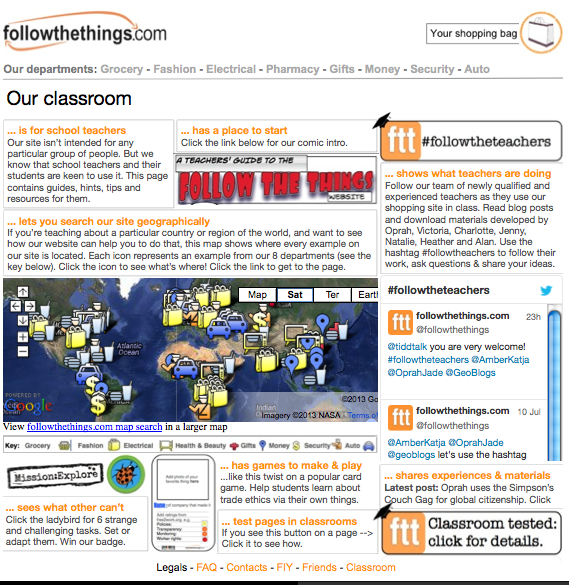
This is the week when the work that we’ve been doing this year with and for school teachers is brought together and made available on our site. We’re bringing together ideas and resources developed with student teachers, undergraduate students, followthethings interns, and educational consultant Alan Parkinson.
We’ll explain more about our longer-term project with teachers – #followtheteachers – in another post. Below, for those who like advance warning, is a screengrab showing roughly what our new classroom page will look like.
If you have any questions or suggestions, please post a comment, tweet us @followthethings or email us at followthethings@yahoo.com.
Thanks!
‘Changing habits for good’ with followthethings.com
We have recently started working with the Scottish Development Educational Council (SCOTDEC) who have invited us to run a followthethings.com workshop at a ‘development education’ conference in Krakow this week. This is the first teacher conference in the ‘Changing habits for good’ project which brings together school teachers from Scotland, Poland, Slovenia and Bulgaria (for more, see the project outline below). We’re taking part via a videolink, and this is the blog post that will hopefull organise what happens. We’ve been asked to introduce our website and the wider project, including our ongoing ‘classroom’ project, and then to talk through some of the shopping bag activities we’ve posted on the Guerrilla Geography education website Mission:Explore.
This is followthethings.com

What is followthethings.com?
- It’s an online shopping website, if you understand ‘shopping’ to involve betraying the origins of things, like you might ‘shop’ a person to the police.
- It’s designed to have the look, feel and architecture of familiar online stores.
- It’s stocked with examples of art work, documentary film, journalism, activism, academic, student and other work revealing the lives of everyday things, i.e. the relations between their producers and consumers hidden by commodity fetishism.
- It shows how their makers tried to make these relations apparent, visible, tangible in ways that might move their audiences to act by trying to make them feel guilty, shocked, appreciative, awkward and/or involved in other people’s lives and work.
- It researches what its makers and viewers have said online about each example: what it aimed to do, how it was made, what discussions it provoked, and what impacts it had.
- It’s full of quotations that are arranged so that they read like a conversation, a conversation that can move from the computer screen into the classroom as teachers create lesson plans and schemes of work with its contents.
- It aims to inform and inspire new ‘follow the things’ work (by teachers, their students, as well as artists, filmmakers, journalists and others), which we hope to publish on the site too. Some examples of new work have already been published.
- It has become a popular website for teachers looking to engage their students in North-South relations via the geographies of commodities. So, we’re working on a new ‘classroom page’ to bright together materials and ideas already developed for this purpose.
First: let’s browse!
Click the homepage image above and you’ll get to the store. Get a sense of what’s available by browsing its departments. Where do you want to look? I’ll talk about any page you choose!
Second: a preview of our classroom page
Our site isn’t intended for any particular group of people.But we know that school teachers and their students are keen to use it. This is a page whose contents we’ve been working on for the past couple of months, with a teacher trainer, student teachers, an educational consultant, and undergraduate students. It’s not published yet, but will be by the end of this month.
.
Third: workshop activities

To get a sense of the educational materials and activities on this page that could imaginatively engage students in ‘development’ issues, we were hoping to give out some of our shopping bags (they didn’t arrive on time, unfortunately). We had these made in a factory in China that makes them for UK supermarkets. They are made by the same people, in the same way, to the same specifications. And we have produced a series of missions based on their lives and travels on the Guerrilla Geography education site Mission:Explore.
To get a vivid sense of Guerrilla Geography and Mission:Explore are all about, this video is excellent ( you don’t have to be a geographer to find this interesting!)
.
There are six shopping bag missions, starting with ‘get the bag’, and ending with ‘go ladybugging’! You can complete the series to win the ‘followthethings.com champion shopper’ badge, and you can borrow and adapt these missions for classroom, fieldwork or homework activities for your students.
1. get the bag – 2.where was it made? – 3. who made it?
4. where has it been? – 5. go secret shopping – 6. go ladybugging.
We’ll go through the missions this afternoon, and then try one or two now (perhaps even setting one as homework). These aren’t impossible if you don’t have the bags. We will have to improvise! And feed back tomorrow morning…?
Finally: questions
If you want to find out more, please comment on this post or email us at followthethings@yahoo.com . Thanks!
You can also follow us on Twitter and Facebook. We’re happy to answer questions there too!
—–
PS: ‘Changing habits for good’
This is a 3 year project funded through the European Commission’s programme for ‘Raising public awareness of development issues and promoting development education in the European Union’ (details here). It brings together a organizations in Scotland (SCOTDEC), Poland (Polish Green Network), Bulgaria (Creative Effective Grassroots Alternatives) and Slovenia (Institute for African Studies).
 the back office