
Category: trade justice
Our 3rd #followtheteachers blog post: from Finland

The Geographies of Material Culture module that I took at Exeter University in my Erasmus year triggered a fascination about trade justice education and culture jamming. Quite an effect? Yes… and let me tell where this has led.
I’m one of the interns who helped to develop the followthethings.com website. I also worked with the site’s #followtheteachers group. My Masters thesis at the University of Helsinki focused on creative teaching of commodity geographies, young people’s geographies and culture jamming – a research field in which academics are narrowing school-university-NGO-gaps. My aim was to introduce these mindboggling ideas in Finland.

This Valentine’s Day, let’s show some love to everyone in its supply chains
Buying gifts to give to loved ones presents unique dilemmas to those who are concerned about who made them, under what conditions. Can you express your love for another person by buying them conflict jewelry, or child labour chocolate? What are the alternatives? And how have these dilemmas changed as a result of decades of actvisism highlighting trade injustice in these supply chains?
Teaching and learning resources
If you’re looking for resources to help creatively discuss the controversial issues in Valentine’s Day supply chains, here’s a selection.
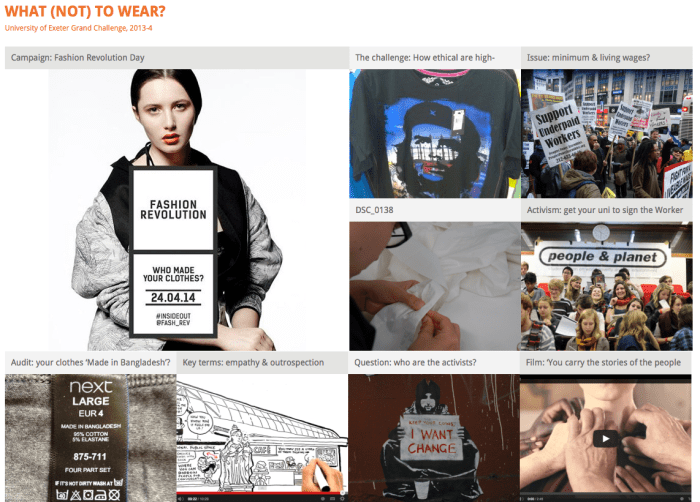
Continue readingNew for 2014: our Fashion Ethics ‘Grand Challenge’ at Exeter University
Things have been a bit quiet on the blog since the ftt Awards Ceremony in December. We have been busy on another project, at the University where we’re based, introducing First Year Students to the challenge of to how to help develop a more ethical fashion industry, in the wake of the Rana Plaza factory collapse in April last year.
We’ve been putting together a website for the Challenge, but it’s open to everyone to use, comment on, and get involved in.
Please do so via the website (click the screen grab below) or get in touch with us via followthethings@yahoo.com, @followthethings or our Grand Challenges Facebook page.
ftt review of 2013: part 2
At a packed followthethings.com 2013 award ceremony last night at the University of Exeter (entirely made from Lego), actor Daniel Radcliffe presented the awards.
“You carry the stories of the people who make your clothes”
Because of our involvement in the commemoration of the Rana Plaza factory collapse through ‘Fashion Revolution Day’ (and its ‘Who made your clothes?’ theme), and the University of Exeter’s ‘What (not) to wear?’ ethical fashion Grand Challenge, we’ve been collecting films and other resources designed to engage consumers with the hidden social relations in their clothes, the lives in their things.
This short film, just published on YouTube, and it’s ‘behind the scenes’ sequel are fascinating, we think.
‘Handprint’: the film.
Behind the scenes: the making of ‘Handprint’.
‘What (not) to wear’ event: an introduction
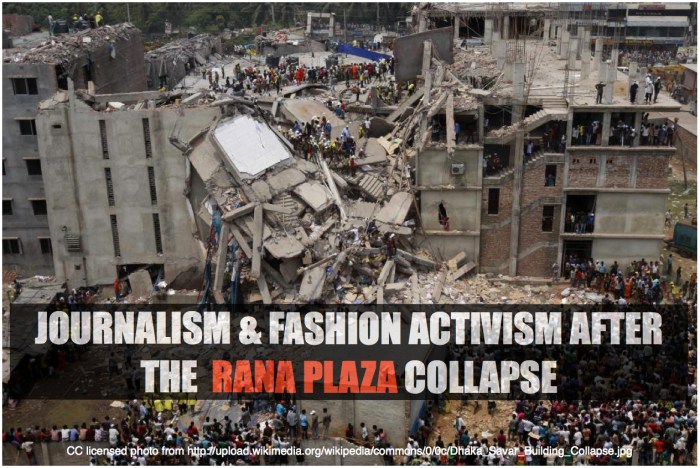
Click for the facebook event page
Date: 11 November 2013, 4-6pm
Venue: University of Exeter, Streatham Campus, Streatham Court, Lecture Room C.
.
Our sponsor
A taster event for 1st year University of Exeter students: click for details
.
Setting the scene: journalism, activism & ‘Primark on the rack’
Click for the flickr set with explanations
.
Our audience: curious & expert students

Click to read more about this module

A draft followthethings.com page published last week: click to read

A draft followthethings.com page, published last week: click to read

New student work: e.g. Ethical Trade Trumps game
.
Our hashtag

Tweet photos of your ‘Made in…’ labels & ask questions with this.
.
Our speakers
James Christie-Miller
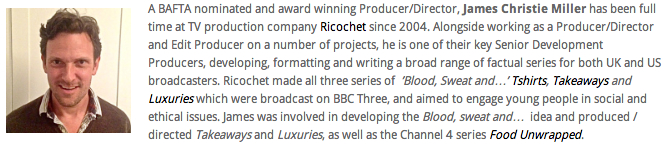
Click for our Grand Challenge Events page
& Carry Somers
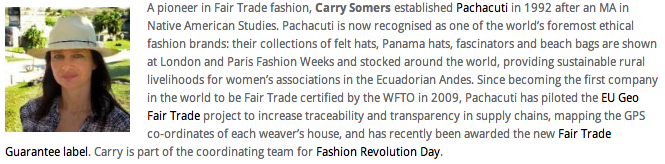
Click here for our Grand Challenge events page
Playing cards: ftt’s Ethical Trade Trump game
It’s a game
Students at the University of Exeter designed an Ethical Trade Trumps card game in November last year using data from free2work.org. This summer, we worked this up into a ftt-‘branded’ game, complete with rules, and templates so that groups of people could make and play cards with their stuff. You can download its templates here. This was designed with advice from the secondary school teachers involved in our #followtheteachers project. Natalie is using them with her A-level class to help with Globalisation revision: look!
The idea
When you make cards for your stuff and play them with others, you learn about the companies who make your stuff, their labour policies, transparency, monitoring and worker rights. In one sense, it’s a simple game of trumping – ‘Ha! My shoes’ worker rights score beats your Kitkat’s!’ – but making and playing the cards also raises questions about what you can find out about your stuff, what ‘monitoring’, ‘worker rights’ and a ‘living wage’ mean, how they are measured, and what to think about this.
Playing cards
Yesterday, we ran our first Top Trump workshop, at Bath Spa University, with Ranji Devadason and her students (a big thanks to them for giving this such a good go). Here we share the cards that were played at this first ever Ethical Trade Trump tournament!
The experience
The atmosphere was tense but fun. Poker faces were everywhere. Imagine being dealt some of these cards! How would you play them? What was it like for them to play with their stuff like this? We’re inviting them to say so, in comments on this post…
PS if you are unfamiliar Trump card games, check this Wikipedia page.
Credits
This game was devised in 2012 as coursework ‘Geographies of Material Culture’ at the University of Exeter by Joe Thorogood, Michael Franklin, Sophie Angell, Florence Flint, Bryony Board, Toby Swadling, Jack Saxton, Jake Pincock, Emma Hargreaves & Joe Harrison. This pack was re–designed by Ian Cook, in consultation with the #followtheteachers ‘user crew’ Alan Parkinson, Oprah Whipp, Victoria Salt, Charlotte Wild, Jenny Thomas, Natalie Batten, Heather Taylor & Mary Biddulph for use in schools and universities.
Update
This pack was revised in 2014 as followthethings.com’s contribution to Fashion Revolution Day, an Ethical Fashion Trump Card Game is part of its Education Pack (download link to be added when this this is live).
‘Behind the screen’: now on demand
There are a lot of follow the thing films that we’re looking forward to watching. We’ve seen the trailers, checked the websites, read the facebook posts, and we wait…
We found out today that this one is now available on demand, although not (we then found out) in the UK. So we’re watching the trailer again, and asking anyone who can watch the whole film on demand, or who has seen it at a festival, to tell us about it! We’re looking forward to the DVD release. This looks awesome!
‘Changing habits for good’ with followthethings.com
We have recently started working with the Scottish Development Educational Council (SCOTDEC) who have invited us to run a followthethings.com workshop at a ‘development education’ conference in Krakow this week. This is the first teacher conference in the ‘Changing habits for good’ project which brings together school teachers from Scotland, Poland, Slovenia and Bulgaria (for more, see the project outline below). We’re taking part via a videolink, and this is the blog post that will hopefull organise what happens. We’ve been asked to introduce our website and the wider project, including our ongoing ‘classroom’ project, and then to talk through some of the shopping bag activities we’ve posted on the Guerrilla Geography education website Mission:Explore.
This is followthethings.com

What is followthethings.com?
- It’s an online shopping website, if you understand ‘shopping’ to involve betraying the origins of things, like you might ‘shop’ a person to the police.
- It’s designed to have the look, feel and architecture of familiar online stores.
- It’s stocked with examples of art work, documentary film, journalism, activism, academic, student and other work revealing the lives of everyday things, i.e. the relations between their producers and consumers hidden by commodity fetishism.
- It shows how their makers tried to make these relations apparent, visible, tangible in ways that might move their audiences to act by trying to make them feel guilty, shocked, appreciative, awkward and/or involved in other people’s lives and work.
- It researches what its makers and viewers have said online about each example: what it aimed to do, how it was made, what discussions it provoked, and what impacts it had.
- It’s full of quotations that are arranged so that they read like a conversation, a conversation that can move from the computer screen into the classroom as teachers create lesson plans and schemes of work with its contents.
- It aims to inform and inspire new ‘follow the things’ work (by teachers, their students, as well as artists, filmmakers, journalists and others), which we hope to publish on the site too. Some examples of new work have already been published.
- It has become a popular website for teachers looking to engage their students in North-South relations via the geographies of commodities. So, we’re working on a new ‘classroom page’ to bright together materials and ideas already developed for this purpose.
First: let’s browse!
Click the homepage image above and you’ll get to the store. Get a sense of what’s available by browsing its departments. Where do you want to look? I’ll talk about any page you choose!
Second: a preview of our classroom page
Our site isn’t intended for any particular group of people.But we know that school teachers and their students are keen to use it. This is a page whose contents we’ve been working on for the past couple of months, with a teacher trainer, student teachers, an educational consultant, and undergraduate students. It’s not published yet, but will be by the end of this month.
.
Third: workshop activities

To get a sense of the educational materials and activities on this page that could imaginatively engage students in ‘development’ issues, we were hoping to give out some of our shopping bags (they didn’t arrive on time, unfortunately). We had these made in a factory in China that makes them for UK supermarkets. They are made by the same people, in the same way, to the same specifications. And we have produced a series of missions based on their lives and travels on the Guerrilla Geography education site Mission:Explore.
To get a vivid sense of Guerrilla Geography and Mission:Explore are all about, this video is excellent ( you don’t have to be a geographer to find this interesting!)
.
There are six shopping bag missions, starting with ‘get the bag’, and ending with ‘go ladybugging’! You can complete the series to win the ‘followthethings.com champion shopper’ badge, and you can borrow and adapt these missions for classroom, fieldwork or homework activities for your students.
1. get the bag – 2.where was it made? – 3. who made it?
4. where has it been? – 5. go secret shopping – 6. go ladybugging.
We’ll go through the missions this afternoon, and then try one or two now (perhaps even setting one as homework). These aren’t impossible if you don’t have the bags. We will have to improvise! And feed back tomorrow morning…?
Finally: questions
If you want to find out more, please comment on this post or email us at followthethings@yahoo.com . Thanks!
You can also follow us on Twitter and Facebook. We’re happy to answer questions there too!
—–
PS: ‘Changing habits for good’
This is a 3 year project funded through the European Commission’s programme for ‘Raising public awareness of development issues and promoting development education in the European Union’ (details here). It brings together a organizations in Scotland (SCOTDEC), Poland (Polish Green Network), Bulgaria (Creative Effective Grassroots Alternatives) and Slovenia (Institute for African Studies).
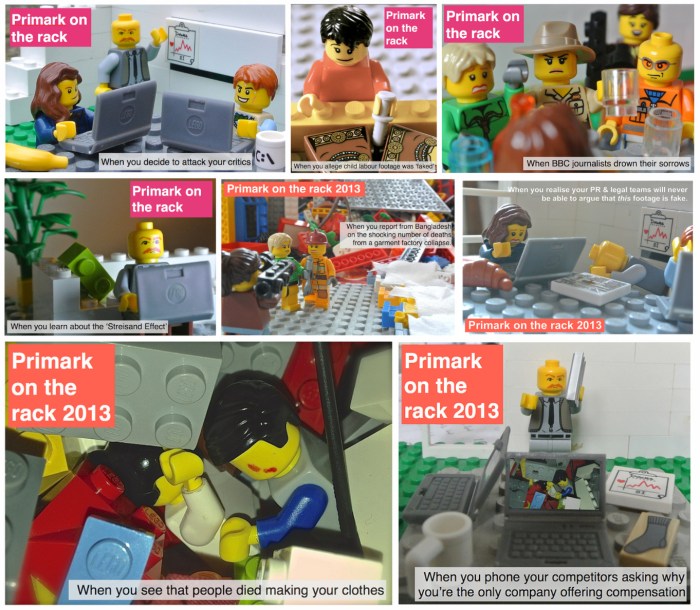
Why Lego ‘Primark on the rack 2013’?
We researched a 2009 BBC Panorama documentary ‘Primark on the rack’ for followthethings.com. This was a documentary exposing Primark for producing its notoriously cheap clothes in Indian sweatshops. It contained a 45 second scene in which child labourers were filmed checking that sequins were firmly attached to its sequined tops. Primark claimed that this scene had been ‘faked’ and made a concerted effort to discredit the whole film, with mixed success (detailed on our site here).
As with many of our pages, we made a few scenes in Lego, uploaded them to a flickr set, and embedded them. Today, we added a couple of new scenes to our ‘Primark on the rack’ set, to bring the story up to date.
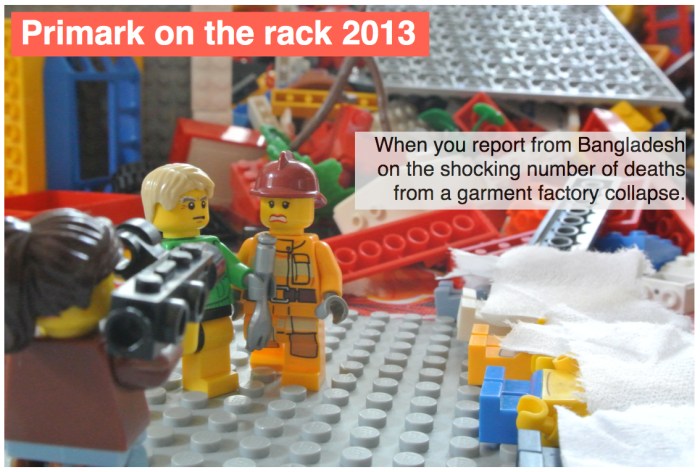
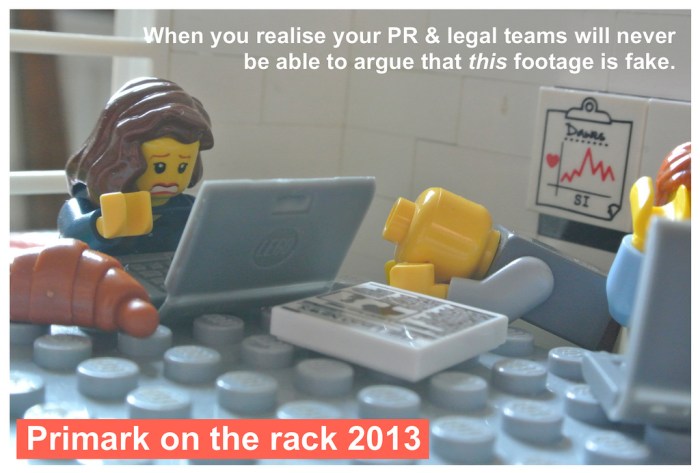
These scenes are intended to highlight a theme that cuts across a number of examples of followthethings filmmaking on our site: corporations responding to sweatshop, worker health and environmental destruction exposures by employing public relations and/or legal teams to ‘prove’ that key scenes – and, by implication, whole films – are ‘faked’. This is, for example, how Primark responded to the BBC documentary in 2009, how Dole responded to Fredrik Gertten’s documentary ‘Bananas!*’ in 2009 (link), and how Chevron responded to Joe Berlinger’s documentary ‘Crude: the real price of oil’ in 2009 (link).
This past week has seen relentless TV news footage and newspaper column inches devoted to the Savar Rana garment factory collapse. Journalists have told unfolding stories of dramatic rescue efforts and the shocking numbers of people who made Primark, Joe Fresh, Matalan, Mango, Benneton, Bon Marche and other branded clothes being found dead in the wreckage of their workplace or missing, presumed dead.
NGOs and others are putting pressure on these clothing brands to respond appropriately to this disaster by properly compensating its victims and their families, by signing agreements that they’d been reluctant to sign before, and by putting into place more comprehensive auditing practices so that what they agree to is more likely to be done in the future.
This pressure continues to be applied, and companies are responding. On Monday, for example, the BBC reported that Primark had released a statement saying that it ‘accepts all its responsibilities in this disaster’ (Source: BBC 2013 link). ALL of them. We shall see.
This is not a single documentary with a named director, whose work can be ‘discredited’ with the right PR and legal teams in place. This is ‘Primark on the rack 2013’. Click the photos to get to the whole 6 scene set.
Postscript: why Lego?
We’ve been inspired by Lego re-creations that we found online of hidden scenes from the ‘War on Terror’. They had been made and posted online in 2009 by an artist/blogger called Legofesto (see her flickr sets here). She argued that:
‘By using toys, I hope the viewer will linger longer over the image and think again about what is actually being depicted or described, in a visual language that is recognised by us all: LEGO. … The incongruity between the immoral and horrific acts and events depicted and the smiley-faced children’s toy create a tension’ (legofesto in Time Magazine 2009 link).
By photographing re-creations and publishing them online, she argues:
‘I want to keep the debate going. To keep it in people’s minds, to remind us of our atrocities because the media has moved on and they don’t want to dwell on the tactics [of the ‘War on Terror’]. … People are using Legofesto to talk about torture and state violence’ (legofesto in Carling 2009 link).
We want our Lego re-creations to help keep trade (in)justice debates going, to keep them in people’s minds, etc. in a similar way.
 the back office