
Category: inspiration
Shopping and subversion
This week, for the module behind our website, we held an arts and activism symposium at the University of Exeter. One of our speakers was artist Louise Ashcroft, who worked with us on our sister project the Museum of Contemporary Commodities earlier this year (what she made is here). Never have we heard students laugh so hard and be so inspired in an academic classroom. Watch Louise’s TED talk and you’ll see what we mean.
Our Arts & Activism Symposium @exetergeography today
Today is an exciting day in the university module that powers our website. It’s our annual Arts and Activism Symposium, funded and hosted by the Department of Geography at the University of Exeter. Here’s the line-up and some background info on the projects our speakers will be talking about. After this, our students develop their own commodity activist work.
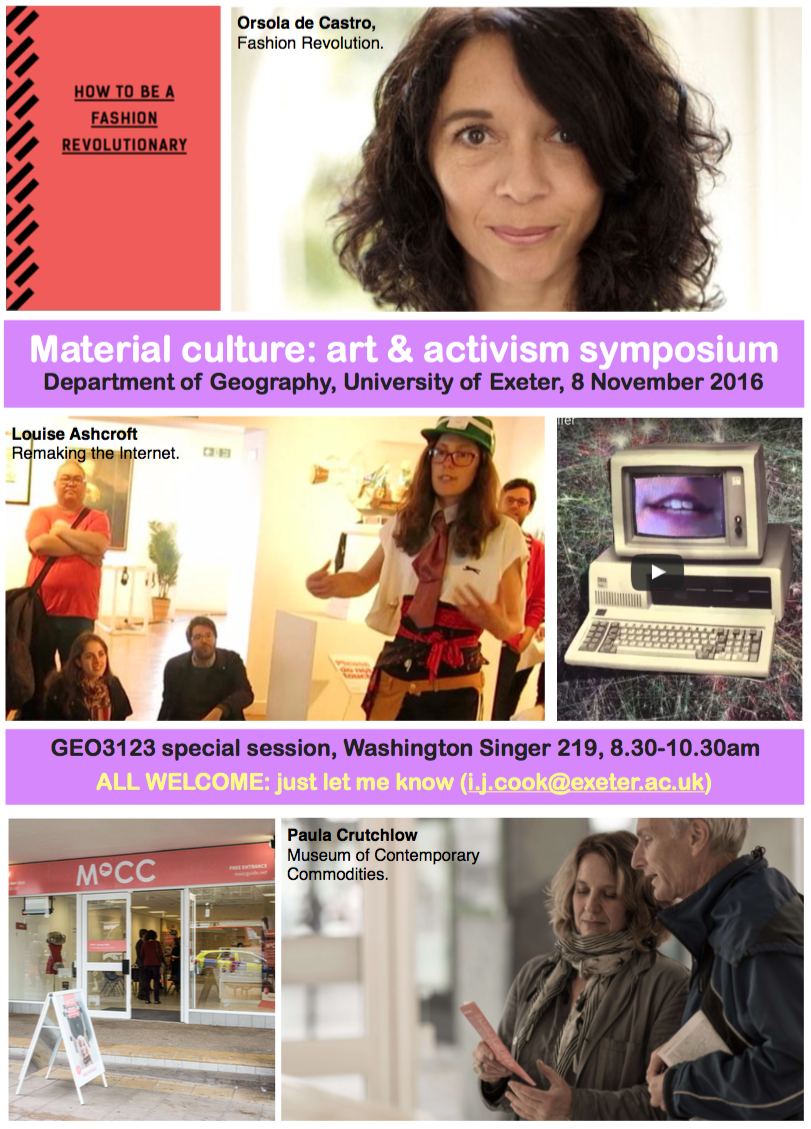 1) Orsola de Castro: watch this
Key concepts: Æfficacy / Æffect
The followthethings.com project is slowly moving from a curatorial to an analytical phase. We’re getting our heads around ways in which we can analyse the online commentaries we’ve researched and remixed for over 60 films, art works, activist stunts and pieces of journalism.
All of the work showcased on our website sets out to make tangible to its audiences the relationships between the people who make and consume things.
But who made them, why, with what resources and how were they hoping they would make a difference to their audiences and participants?
How did members of their audiences (consumers, citizens, corporations, governments, etc.) make sense of and react to them?
And what impacts do they seem to have had?
We want to assemble a vocabulary (see Massey 2013) which will enable these intentions, relations, reactions and connections to be named, discussed, critiqued and developed.
We’re actively looking to name what we find in our data.
Æfficacy / Æffect
Effect (v.) “To bring about (an event, a result); to accomplish (an intention, a desire).”
Affect (v.) “To have an effect on the mind or feelings of (a person); to impress or influence emotionally; to move, touch.” (Oxford English Dictionary)When it comes to bringing about social change, effect and affect are intertwined. Artistic activism aims to bring about demonstrable change through moving people viscerally and emotionally. We might think of this as: Affective Effect. Or, if you prefer: Effective Affect. Or, as we’ve come to call it: Æffect.
At the C4AA we are very, very interested in æffect. Artistic activism might be fun, creative and cutting edge but if it doesn’t deliver the goods in helping to transform the world, then what good is it?
Since we began the C4AA we’ve been asking the questions: Does it work? How do we know? And what does “working” even mean when we combine the arts and activism?
The Streisand Effect
… the phenomenon whereby an attempt to hide, remove, or censor a piece of information has the unintended consequence of publicizing the information more widely, usually facilitated by the Internet. It is an example of psychological reactance, wherein once people are aware something is being kept from them, their motivation to access and spread the information is increased.[1]
It is named after American entertainer Barbra Streisand, whose 2003 attempt to suppress photographs of her residence in Malibu, California, inadvertently drew further public attention to it. Similar attempts have been made, for example, in cease-and-desist letters to suppress numbers, files, and websites. Instead of being suppressed, the information receives extensive publicity and media extensions such as videos and spoof songs, often being widely mirrored across the Internet or distributed on file-sharing networks
We’ll post more when we find them. Watch this space.
Do ‘follow the thing’ documentaries affect their audiences?
This is one of the questions that drives our work at followthethings.com. We tend to find our answers – yes, no, maybe, depends, etc… – in the user-generated comments on video-sharing websites like YouTube and in the comments on newspaper reviews. We’re currently wading through thousands of comments on a 2015 ‘follow the fashion’ film called The True Cost, and came across this powerful video response. We’re giving a paper about the True Cost and fashion activism at a conference next month. There’s an argument in the literature that work like this makes prescriptive arguments about responsibility that are so infinitely demanding they can generate a sense of powerlessness in consumer audiences. This doesn’t seem to be the case, at least for this viewer. Watching this film was a powerful experience. For us, this kind of response changes the question that’s asked. Now it’s ‘how do ‘follow the things’ documentaries affect their audiences? What vocabulary can we develop to describe this? That’s what we’re working on.
On the making of followthethings.com

Here’s Ian et al’s first paper about the making of followthethings.com. It was published in French in 2014 and has recently been made available on open access. You can now download the paper as it was originally written in English. If you want the French version, click here.
followthethings.com was not designed and then made, but emerged from an iterative, creative, collaborative, conversation-infused, open-ended, making project. The paper is written to reflect this. Here’s the abstract: Continue reading
A pig in a hundred pieces: Christien Meindertsma
If you have been looking for a go-to explanation of the ‘follow the thing’ approach to material culture studies, this is your lucky post. Here artist and designer Christien Meindertsma – author of PIG05049 – explains it beautifully.
If you’re curious about PIG05049, we posted her TED talk on it here. She explains more in this video, too.
Creando Conciencia en las Aulas (Raising Awareness in the Classroom)
En el International School Peniscola (www.colegiosisp.com) hemos querido unirnos a la celebración del Fashion Revolution desde el ámbito educativo con nuestros alumnos. Ellos son el futuro y, hoy más que nunca, necesitamos personas que estén concienciadas y que entiendan el mundo desde una perspectiva global en la que cada acto cuenta y tiene una consecuencia directa en otro lugar del planeta.
.
 the back office