Fashion Revolution Day 2015 in Schools & Universities: a roundup

Here are some of the many ways in which young people around the world were curious, found out and did something for Fashion Revolution Day this year. We’re now collecting and sharing ideas for 2015-6. Please get in touch with education@fashionrevolution.org with actions and advice that we’ve missed. #whomademyclothes


“Who made my school uniform?’: how to engage primary students in Fashion Revolution Day

It was Fashion Revolution Day last Friday, the second anniversary of the collapse of the Rana Plaza factory complex in Dhaka, Bangladesh in which 1,129 people died making clothes for High Street brands. This year, we helped to create education packs for the global campaign, hoping to finds ways in which teachers and students of all ages could interrogate (un)ethical and (un)sustainable fashion by asking ‘who made my clothes?’ We have written about Fashion Revolution Day’s approach to teaching controversial issues here. Below, however, we showcase a blog post by Professor Becky Earley on the ‘Who made my uniform?’ project she worked on at her childrens’ primary school in London. We think this is fantastic. Here’s an extract. 

“… My son loves trainers. He’s a football fan and player, and the influence of the Arsenal team and their colorful attire – and what is donned by his group of friends at school and on his team at the local sports centre – is significant to him. He got the trainers he wanted for Christmas – bright orange. They looked amazing with his lime green away kit. Yet within days he starting asking for another pair, in a different colour. I took the opportunity to explain to him again about why ‘stuff’ is special. The materials, dyes, labour, shipping… all comes at a cost, and not just to the bank of mum and dad. At 8, he knows all this already. We talk about ‘stuff’ all the time. But he just can’t make the leap to applying this knowledge to his insatiable desire to be part of the team – to look the part. At his school the lost property area is a mess of unlabelled and unloved green, white and navy cotton and polyester. I decided to start here with my research, and look at the way in which primary school children relate to their uniform – their everyday clothes. The deputy head at St Mary’s Catholic Primary School in Chiswick and I hatched a plan to run a ‘Who Made My Uniform’ project, in response to the FRD provocation ‘Who Made My Clothes?’ Beginning with a carefully prepared school assembly on the actual day, the project consisted of a week-long residency by myself with the help of another mum, and a series of class projects run by the teachers. The photo story below documents the project. Over the summer term we asked:

  • Where was my uniform made?
  • Who made my uniform?
  • What is it made from?
  • How can I make my own clothes?

Click for more

More blog posts like this

How to explain Fashion Revolution Day to the kids

Encouraging children to ask ‘Who Made My Clothes?’

Fashion Revolution Day – raising awareness in the classroom (in Spanish)


Guest blog | Hannah asks her students ‘Who are you wearing?’

A couple of weeks ago, we attended the Geographical Association (GA) conference in Manchester. This is a conference for geography teachers, student geography teachers and the people who train them. We talked to many who taught their students the geographies of trade through researching their own clothes. We went to a talk where Hannah Campion, a newly qualified teacher, explained how she sparked her students’ curiosity about these geographies using some of our teaching resources. With the second anniversary of the Rana Plaza collapse only a few days away, we are publishing what she said…

A £4 t-shirt

A cheap white tee (click for image source)

A cheap white tee (click for image source)

My name is Hannah Campion. I am an NQT at The National Church of England Academy, Nottinghamshire. My fascination around the Geography of my ‘stuff’ developed from undergraduate study of commodity chains, commodity fetishism and Cook’s (2004) ‘follow the thing’ approach at the University of Nottingham. An assignment during my teacher training course on ‘Fantastic Geographies’ gave me the opportunity to bring this controversial issue into the classroom, to enable pupils to investigate and to develop a curiosity around the lives of our everyday commodities. The initial scheme is a 5 lesson sequence unveiling and unpicking the life of a plain white £4 t-shirt from production through to consumption. In 2014, I was asked to display my work at the Geographical Association conference in Guildford as part of the Ideas Zone exhibition. Since then, I have written an article for Teaching Geography (Campion 2015) and presented a Teacher-to-Teacher session at this year’s GA conference entitled ‘Behind the seams: global connections in the classroom (KS3)’.

Continue reading

Fashion Revolution Day Education Press Release

Fashion Revolution Day PRESS RELEASE TO EDUCATION PRESS

Fashion Revolution Day Offers Engaging Resources for Educators and Students of All Ages

Teaching controversial issues through students’ clothes

Fashrev legoland

The second Fashion Revolution Day will take place on 24 April 2015 to mark the anniversary of the collapse of the Rana Plaza clothing factory complex in Dhaka, Bangladesh.  This global campaign calls for more transparency in fashion supply chains and asks young people in particular to ask brands the question “who made my clothes?”

Following the success of the first Fashion Revolution Day in 2014 when schools, colleges and universities across the world took part, the Fashion Revolution Day Education Team has just launched 4 individual education packs for 2015: for Primary, Secondary, Sixth Form/College and University students. Continue reading

Wanted! Curious Shoppers and Local Traders (MoCC phase 2)

In January 2013, phase 1 of the ‘Museum of Contemporary Commodities’ (MoCC) art/social science project took place at the University of Exeter: a trade justice thinkering day. This month, phase 2 – in London’s Finsbury Park – began to take shape. Here’s what we’re doing and how you can get involved, as published on Furtherfield’s website.

Screen Shot 2015-03-17 at 15.11.41


Job Opportunity – MoCC Project Producer and Coordinator, Furtherfield, London
Initial contract 120 hours May – July 2015. £1,800 (VAT inclusive)
View details


Wanted! Curious Shoppers and Local Traders

Explore the rapidly changing economies of global capitalism, and help to create a radical new artwork in Finsbury Park.

In July 2015 the Museum of Contemporary Commodities will transform Furtherfield Gallery into an interactive shop-museum, filled with locally sold products that are ranked by different categories and preferences.

We are inviting Finsbury Park residents (and online participants) to join a team of volunteer researchers and art makers and get involved in the process through a series of walkshops, workshops and digital-arty-social events, running April-July in the park and online.

Share your experiences of shopping and trading, and help us create an engaging and entertaining experience with sensor technology, sound design, digital interactions and live action, that makes visible some of the complex relationships at play between data surveillance, trade justice, and global/local commodity culture.

How to get involved in Finsbury Park and online

Click for more

 

Out now! Fashion Revolution Day’s education packs & quiz

This year we’ve been involved in creating the content for Fashion Revolution Day’s education packs (including its quiz and trump card game). If you are teaching fashion ethics/geographies/activism on or around the second anniversary of the Rana Plaza collapse on 24 April, they contain a variety of ways to creatively engage students in the controversial issues raised. Click the images for more.

Screen Shot 2015-03-10 at 08.47.01 Screen Shot 2015-03-10 at 08.47.13

Continue reading

Where did you get those jeans? Be Curious. Find Out. Do Something.

Screen Shot 2015-02-16 at 17.03.09Last year, Ian became the Education lead for Fashion Revolution Day. He has been working with Nikki Mattei to produce FRD education materials for Primary and Secondary schools, Further Education colleges and Universities in time for the second anniversary of the Rana Plaza factory collapse on 24 April. These will be published later this month but, as a taster, he has written a blog post on FRD’s approach to education on the European Year for Development’s website. Its starts:
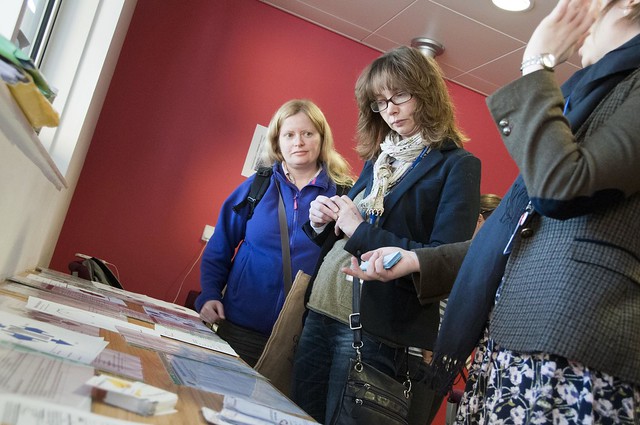
In the summer of 2011, we asked people visiting the Eden Project in Cornwall, England to write postcards. The architecture of its biodomes, the placement of plants within them, and the signs and activities explaining their cultivation and use are designed to educate visitors about the plants from which many everyday things are made. We stopped passers-by to ask if they had anything on them that was made from the plants they’d seen. Typically, people would mention their clothes or shoes. So we asked them to imagine someone whose job it had been to pick their cotton or tap their rubber. What they would say to that person if they had the chance? We asked them to write this down on a postcard. Almost everyone wrote ‘thank you’ notes. It’s surprising how many people say that they’ve never thought about this before. But, for some, writing a postcard can be a tipping point, the beginning of a process in which curiosity leads to research, which leads to action. Click for more

Continue reading

‘Behind the seams’: from Idea Zone to journal article

Last year we co-ran the Idea Zone at the Geographical Association conference in Guildford. We filled a table with Lego for delegates to recreate scenes described on our website. We set up a card table to make a play our Ethical Trade trump card game. And a Nottingham PGCE student called Hannah Campion brought along some lesson plans, teaching materials and student work showing how she’d used our site and classroom resources to develop a lesson series about ‘The Geographies of my Stuff’.  She was asked if she’d be interested in writing a short paper about all of this in the GA’s Teaching Geography journal. It’s just been published, and here’s an extract.

147 Ideas Zone

Hannah talks to delegates about her lesson plans, materials and student work.

“… My five-lesson sequence was developed for year 8 and followed on from a year 7 unit, ‘The Geography of my Stuff’. I wanted to develop students’ ability to investigate and critically reflect on the hidden connections which link them to often distant global communities, and to empathise with the people who live and work there. To do this, I chose a familiar but often untraceable commodity which students could easily identify with – a plain white T-shirt. … In the first lesson we used a ‘who, what, why’ starter, with images of horses, clothes and the Rana Plaza factory collapse to stimulate students’ curiosity. … Lesson 2 introduced the £4 T-shirt as the commodity to be investigated.  After we had covered the role of the first link in the chain, the cotton farmer, the main activity required students to explore, in groups, ‘How much of the £4 should x get paid?’ …  Lesson 3 focused on manufacturing and worker conditions. The enquiry question was: ‘Who was to blame for the Rana Plaza collapse?’ … Having helped students to step into the shoes of ‘others’ and investigate the structures and processes of the clothing industry, in lesson 4 we focused on the ethical standards of global retailers. The class was divided into two groups, representing H&M and Primark … [and] students played the Top Trumps game to compare multiple retailers. … [Finally] The assessment activity was to produce a newspaper article … entitled ‘Behind the seams… the story of a £4 T-shirt’.”

Source

Hannah Campion (2015) Behind the seams… the story of a £4 t-shirt.  Teaching Geography Spring, 26-28 (Click to access)

‘Love At First Bite – The Ad Doritos Don’t Want You to See’

‘That sound when you bite down on Doritos? That’s the sound of rainforests being “crunched” to make way for massive palm oil plantations in Southeast Asia. Workers, and even children, are trapped in modern slavery on the plantations. Forests and peatlands are burned to the ground, driving endangered species like orangutans to extinction and polluting the Earth’s atmosphere with gigatons of greenhouse gases — all to make palm oil. ‘

Sign the Sum of Us petition here.