Its aim is to encourage its players to think about their clothes and fashion ethics, a topic that’s more important than ever after the Rana Plaza factory collapse in Dhaka, Bangladesh on 24 April last year.
It’s a playful way of encouraging some serious discussion about who and what we are wearing.
Here, we want to showcase the new FRD pack – which was published yesterday – and to provide a match report that will give you an idea of how the game can be made and played in your classroom, home, shed … wherever you play cards!
followthethings.com is a resource and output for coursework produced, among others, by students at the University of Exeter taking a final year module called ‘Geographies of Material Culture’.
The module finished in December last year, so we thought we’d share its reading list.
This was put together primarily in response to student ideas, and grew in some strange and unexpected ways.
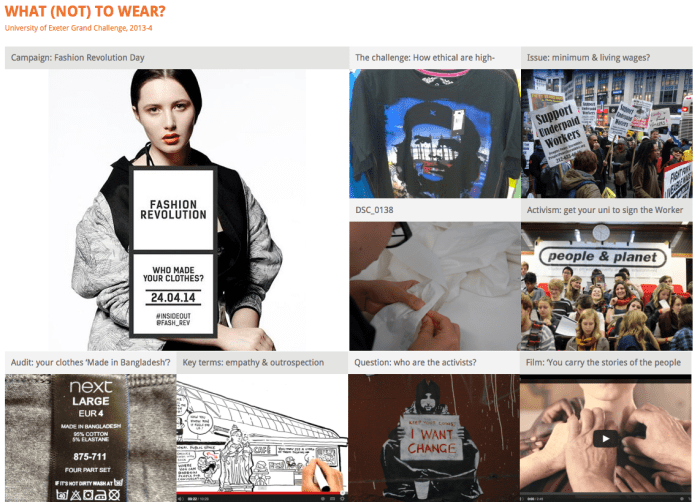
Things have been a bit quiet on the blog since the ftt Awards Ceremony in December. We have been busy on another project, at the University where we’re based, introducing First Year Students to the challenge of to how to help develop a more ethical fashion industry, in the wake of the Rana Plaza factory collapse in April last year.
We’ve been putting together a website for the Challenge, but it’s open to everyone to use, comment on, and get involved in.
Please do so via the website (click the screen grab below) or get in touch with us via followthethings@yahoo.com, @followthethings or our Grand Challenges Facebook page.
At a packed followthethings.com 2013 award ceremony last night at the University of Exeter (entirely made from Lego), actor Daniel Radcliffe presented the awards.
was recognised as an open access academic publication;
was made more accessible and useful for school geographers through newly created and collected classroom materials(big thanks to Alan Parkinson);
was used in class by NQTs involved in our new #followtheteachers project, who blogged about what they did right here!;
provided the Ethical Trade Trumps card game that has been adapted and test-driven for Fashion Revolution Dayon April 23rd 2014 (watch out for more); and
was researched and introduced to the Finnish school system by a Masters students at the University of Helsinki (read Eeva Kemppainen’s thesis here).
At least one class of Year 8 students at an Exeter high school are doing some Nike homework this weekend.
Natalie Batten, one of the newly qualified Geography teachers who has been using followthethings.com with her students as part of our #followtheteachers project, has already blogged about an assignment like this. Click this button to read about her experience and advice.
If you’re interested in what it life and work can be like for the people who make sports clothing, we have some other recommendations that aren’t on our sire. The first film is on Nike and could be a vivid and useful source. But other students in other schools may have been given Adidas to research. We have a couple of films for you too, if that’s what you’ve been asked to research. And, at the end, we bring things right up to date: with a way to compare these two companies / brands.
Nike: behind the Swoosh
A student at the US’s largest Catholic University feels disgusted with what he reads about Nike and ‘sweatshops’ and, when he refuses to wear his University’s Nike soccer kit, he’s fired. So he sets off to Indonesia with a friend to find out if the factory and living conditions he’s read about are as he imagines. People at University keep telling him that things are fine. What he sees, what he does, and the people he meets in Indonesia have a powerful effect on them and what they decide to do next.
Pester Power
If you’re studying Geography and your homework is about Adidas, you should find this next film interesting. It’s a 2001 episode of the Mark Thomas Comedy Product TV series that involves a class of Geography students in London finding out – with the comedian/activist’s help – about the company’s labour practices in a unique, face-to-face way, in their classroom. Fast forward to 6 minutes 13 seconds. That’s where it starts.
Not OK here, not OK anywhere
This short video was produced by the charity War on Want as part of its campaign to highlight the abuse of workers making Adidas sportswear for fans and athletes attending the 2012 Olympic Games in London. It was part of a wider campaign whose webpages are listed here.
Commitments to workers: 2013 update
If you have been studying the collapse of the Rana Plaza garment factory in Bangladesh in April this year, you may find it interesting to see which company has and which has not signed the Accord on Fire and Building Safety in Bangladesh. There’s a story about one signing and the other not signing in this newspaper story. But check the latest list that’s published here. The situation may possibly change…
Because of our involvement in the commemoration of the Rana Plaza factory collapse through ‘Fashion Revolution Day’ (and its ‘Who made your clothes?’ theme), and the University of Exeter’s ‘What (not) to wear?’ ethical fashion Grand Challenge, we’ve been collecting films and other resources designed to engage consumers with the hidden social relations in their clothes, the lives in their things.
This short film, just published on YouTube, and it’s ‘behind the scenes’ sequel are fascinating, we think.
In response to a student query today about the pride that factory workers can have in making consumer goods for others, I recommended that the two short films below were watched one after the other.
Both are about the notorious manufacturer of Apple and other electronic goods: Foxconn.
Dreamwork China
This is an extract from a documentary film in which young factory workers are interviewed in a photo studio across the road from the factory.
iProtest
This is an episode of from the Al Jazeera TV series Activate, about the investigation into worker rights, health and safety in Foxconn factories by Hong Kong based NGO Students and Scholars Against Corporate Misbehaviour.
There’s an undergraduate module at the University of Exeter called ‘Geographies of Material Culture’. It’s one of two University modules whose student coursework form the basis of almost every followthethings.com page. The module is assessed through students’ critical self-reflections on whatever comes to mind through reading the academic literature and working together to research and publish draft ‘compilation’ pages and new work for the site. They are encouraged to be creative, to express themselves in ways that rework the traditional essay formal that everyone is used to. The work is diverse and fascinating. You never read the same thing twice.
‘How am I gonna be an activist about this?’
One type of work that’s started to emerge in 2013 are original songs, written, recorded and published online by students and written about on paper. There have been two so far. The first is by Jenny Hart, who submitted her song at the start of the module this year (in October). She’s trying to get her head around the key theoretical baselines of the module. The second is by Tommy Sadler, who submitted his song at the end of the module last year (in January). He’s expressing what the module was about, for him. Both shared their songs via Soundcloud, and you can listen to them here:




 the back office