
Category: University of Exeter
Fashion Revolution Day: the first Trump card game
Yesterday at the Department of Geography at the University of Exeter, we heard Carry Somers talking about Fashion Revolution Day at our ‘What (not) to wear?’ conference. There was mention of an Ethical Trade Trump card game invented by students taking ‘Geographies of Material Culture’ in 2012 – using data from free2work.org – being adapted as followthethings.com’s contribution to this campaign.
A new Fashion pack will soon be designed, but today we tested out the idea in class. Students each made a card based on something they were wearing, sketched it, added the grades from free2work and – for extra information at the bottom of each card – added whether that company / brand had signed the Accord on Fire & Building Safety in Bangladesh.
The match report
6 teams of 8 students each made one or more cards in the first 15 minutes. One student was elected from each group as their player, and we staged a 6 player tournament at the front of the classroom. The cards were shuffled and dealt. The game began with player one calling out a brand (Cheap Monday!), a category (policies!), a grade (A+!), and then slamming the card on the table (drama!). The other players then took the card at the top of their pack, one after the other, called out its brand (Calvin Klein! or Adidas!), and its policy grade (C-! or A+), and slammed their cards on the table. The audience gathered round, watching their cards being played, helping their players to win and lose each round.
In each round, the player who called out the highest grade took all of the cards, and started the next round. If there was a draw – like between Cheap Monday and Adidas, both with A+ grades for their policies – the ‘key fact’ could be played: had the brand / company signed the Accord? In this case, only Adidas had (only very recently, the referee had to say), so that was the winning card.
The game went on with rounds in which, for example, only ‘worker rights’ scores could be played. It ended with a ‘winner takes all’ round, with the 3 remaining contestants. This was dramatic: a draw that was resolved by the key fact. The Accord-signatory won. Well done Adidas! Good job you signed the accord. Nobody wants a losing card. Whoops all around.
After the game ended, we discussed what had happened, why some cards were worse to play that others, why – with one exception – the policy grades were higher than the ‘workers’ rights’ grades, and how to find out why by looking at brands’ detailed free2work ‘score cards’. So, 40 minutes into class, we were talking about, asking informed questions about, and having a good idea how to find out more about the relations between ethical trade policies, transparency, monitoring, workers’ rights and the Accord.
This game can be made and played by any group of people trying to learn the basics and/or intricacies of Ethical Trade and Corporate Social Responsibility.
This is our 46 card pack, scanned after the game. What would your pack be like?


If you want to have a go:
- download the pack template, research and playing instructions here
- find the grades for your cards here www.free2work.org
- find out who has signed the Accord here www.bangladeshaccord.org/signatories/
Let us know about your game, send us your packs and match reports!
Thanks
Ian
Credits
This game was devised in 2012 as coursework ‘Geographies of Material Culture’ at the University of Exeter by Joe Thorogood, Michael Franklin, Sophie Angell, Florence Flint, Bryony Board, Toby Swadling, Jack Saxton, Jake Pincock, Emma Hargreaves & Joe Harrison. This pack was re–designed by Ian Cook, in consultation with the #followtheteachers ‘user crew’ Alan Parkinson, Oprah Whipp, Victoria Salt, Charlotte Wild, Jenny Thomas, Natalie Batten, Heather Taylor & Mary Biddulph for use in schools and universities.
Update
This pack was revised in 2014 as followthethings.com’s contribution to Fashion Revolution Day, an Ethical Fashion Trump Card Game is part of its Education Pack (download link to be added when this this is live).
‘What (not) to wear’ event: an introduction

Click for the facebook event page
Date: 11 November 2013, 4-6pm
Venue: University of Exeter, Streatham Campus, Streatham Court, Lecture Room C.
.
Our sponsor

A taster event for 1st year University of Exeter students: click for details
.
Setting the scene: journalism, activism & ‘Primark on the rack’
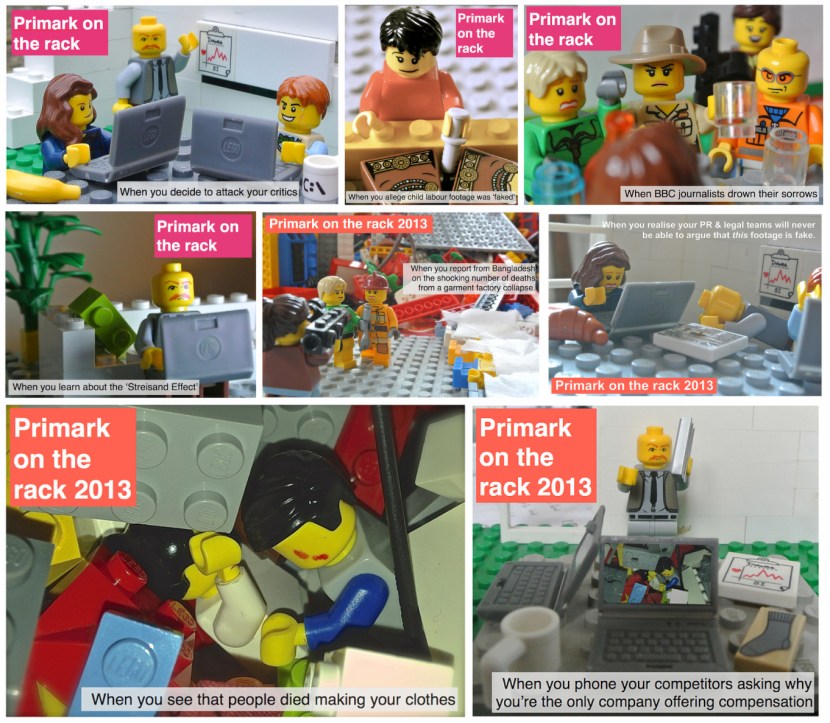
Click for the flickr set with explanations
.
Our audience: curious & expert students

Click to read more about this module

A draft followthethings.com page published last week: click to read

A draft followthethings.com page, published last week: click to read
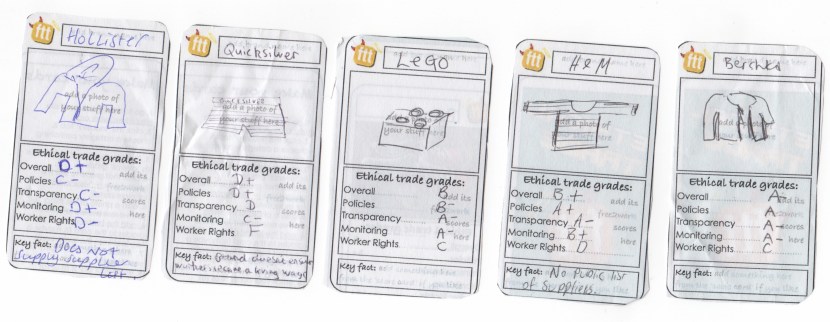
New student work: e.g. Ethical Trade Trumps game
.
Our hashtag

Tweet photos of your ‘Made in…’ labels & ask questions with this.
.
Our speakers
James Christie-Miller
Click for our Grand Challenge Events page
& Carry Somers

Click here for our Grand Challenge events page
Playing cards: ftt’s Ethical Trade Trump game
It’s a game
Students at the University of Exeter designed an Ethical Trade Trumps card game in November last year using data from free2work.org. This summer, we worked this up into a ftt-‘branded’ game, complete with rules, and templates so that groups of people could make and play cards with their stuff. You can download its templates here. This was designed with advice from the secondary school teachers involved in our #followtheteachers project. Natalie is using them with her A-level class to help with Globalisation revision: look!
The idea
When you make cards for your stuff and play them with others, you learn about the companies who make your stuff, their labour policies, transparency, monitoring and worker rights. In one sense, it’s a simple game of trumping – ‘Ha! My shoes’ worker rights score beats your Kitkat’s!’ – but making and playing the cards also raises questions about what you can find out about your stuff, what ‘monitoring’, ‘worker rights’ and a ‘living wage’ mean, how they are measured, and what to think about this.
Playing cards
Yesterday, we ran our first Top Trump workshop, at Bath Spa University, with Ranji Devadason and her students (a big thanks to them for giving this such a good go). Here we share the cards that were played at this first ever Ethical Trade Trump tournament!
The experience
The atmosphere was tense but fun. Poker faces were everywhere. Imagine being dealt some of these cards! How would you play them? What was it like for them to play with their stuff like this? We’re inviting them to say so, in comments on this post…
PS if you are unfamiliar Trump card games, check this Wikipedia page.
Credits
This game was devised in 2012 as coursework ‘Geographies of Material Culture’ at the University of Exeter by Joe Thorogood, Michael Franklin, Sophie Angell, Florence Flint, Bryony Board, Toby Swadling, Jack Saxton, Jake Pincock, Emma Hargreaves & Joe Harrison. This pack was re–designed by Ian Cook, in consultation with the #followtheteachers ‘user crew’ Alan Parkinson, Oprah Whipp, Victoria Salt, Charlotte Wild, Jenny Thomas, Natalie Batten, Heather Taylor & Mary Biddulph for use in schools and universities.
Update
This pack was revised in 2014 as followthethings.com’s contribution to Fashion Revolution Day, an Ethical Fashion Trump Card Game is part of its Education Pack (download link to be added when this this is live).
Happy ‘shopping’: making & using followthethings.com bags
This post began as a contribution to a special issue of the journal ACME on the new ‘impact’ agenda in British Higher Education. Our shopping bags and ‘ladybugging’ activities seemed to fit this bill, although their ‘impact’ wasn’t measurable (and that was the point). In the end, another short piece on impact was written for the journal. We have revised that original paper to post here, and hope it may be interesting for readers who are keen to use our site and/or bags in their teaching and wider ‘shopping’ activities.
Update September 2016: sorry, we have no bags left to give away. They’ve all gone. If you have one, it’s a priceless collector’s item. If you see someone carrying one, please say hi.
——————————————————-
“We need to develop forms of critique that inspire hauntings, feed feelings, come alive, leap out and grab us, … that are not just about vital materiality but are themselves vitally material” (Cook & Woodyer 2012 p.238).
The travels of the container ship Cosco Pacific
This is the ship that brought our shopping bags from China (where they were made) to the UK (where we are located, and from where we send them to you!) in 2011.
.jpg)
Photo courtesy of Wikimedia. Click for original source.
As part of our mission series on Mission:Explore (where you can earn a ‘champion shopper’ badge), we’re asking people to check where it is on this ship tracking website.
The idea is that ‘shoppers’ do this over a period of weeks or months and send us the location (if you want to do this now, just paste its latitude and longitude into a comment on this post). We then pin – with a followthethings.com ladybird – each spotting on the map below and add your name as the spotter. Ian has started this off with a ladybird that shows the ship leaving the southern end of the Suez Canal.
Together, we can map it’s travels. What route does it use to get from here to there and back? Please check back…
Update:
You will notice that we have added an extra icon to the map: a ghostly sunken ladybird. These mark the locations of some container ships that have caught fire or sunk during the course of this followthethings.com project. Click these icons, see the wrecks and find out more about the dangers of container shipping.
St Valentine’s Day: love, following, things.
We are going to love this week at followthethings.com HQ.
We’ve redesigned our website’s header for the season. Here it is:

[click the Cherubs’ banner, and you will get to this page]
We’re adding Finland’s favourite chocolate to our site, a new page created by University of Helsinki MPhil student Eeva Kemppainen. She’s working with us in Exeter this Spring. She is creating our first pages to be simultaneously published in English and Finnish.
We’re re-creating a scene from this new page in Lego, to add to our ‘Made in Lego…’ flickr set.
We’ve started to tweet Valentine’s Day issues, stories and activism. Like this:
“Guidance for consumers on Valentine’s Day” from @f2w & @ilrf laborrightsblog.typepad.com/international_… — followthethings.com (@followthethings) February 10, 2013
Did you know? Valentine’s Day is also ‘International Flower Workers Day”. See @waronwant‘s story waronwant.org/component/cont… — followthethings.com (@followthethings) February 10, 2013
Sending flowers? Wanting flowers? Check this @openuniversity blog post on “The ethics of St. Valentine’s Day” open.ac.uk/platform/blogs… — followthethings.com (@followthethings) February 10, 2013
On Thursday, all of our efforts will come together in a public Lecture at the University of Exeter. It’s ‘The St Valentine’s Day public lecture: love, following, things.” Here’s the opening slide:
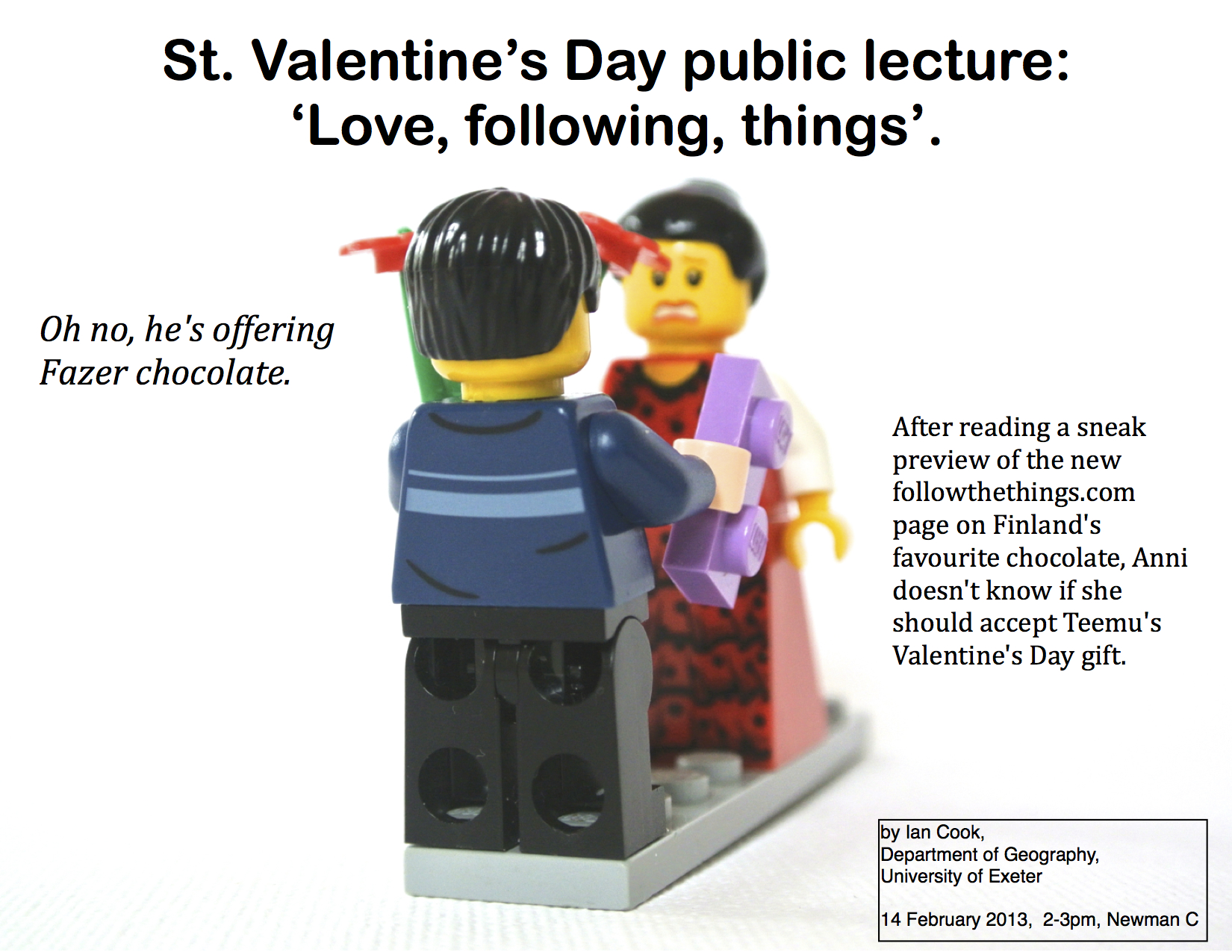
Here’s the description on its facebook event page:
Come take part in a public lecture and discussion that puts chocolate, renowned for its romancing qualities, under the spotlight this Valentine’s Day. Ian Cook (Associate Professor of Geography at the University of Exeter) will be using Finnish chocolate (following them through the world economy as physical goods) as a case study in a broader discussion of trade justice and emphatic socio-economic relations. The discussion will also cover the ways in which this approach to understanding the exchange of material goods can be taught and learned in universities, engaging students in the issue of trade justice activism in critical, creative and enthusiastic ways. The event will take place in the Peter Chalk Centre, lecture theatre Newman C. It will take place at 2pm on Thursday 14th February.
Everyone is welcome.
Our ‘Trade Justice Thinkering Day’, on 13 January.
Our latest project has been brewing throughout 2012. It starts on Friday. It’s a closed workshop with an open hour at the end. It’s being documented to disseminate the ideas that are generated. We will tweet throughout the day via @MoCCofficial. Follow us and watch out for more…

A day of collective imaginings towards new digital happenings in trade justice activism
11th January 10am-6pm, Margaret Rooms, University of Exeter
What if every shop were a museum and the objects for sale part of an ever changing exhibition on contemporary consumer culture? How would their hidden histories be revealed? How could you re-write their future lives?
The Museum of Contemporary Commodities (MoCC) is an idea developed by Dr Ian Cook (University of Exeter and followthethings.com) and Paula Crutchlow (Blind Ditch) to explore trade justice activism in relationship to ubiquitous and pervasive technologies. MoCC’s aim is to move thinking around trade justice out of the classroom, cinema and art gallery, beyond the textbook, computer and TV screen, and in to our personal experiences of everyday commodity worlds.
This ‘Thinkering’ day is the beginning of a journey to discover what kind of critical object-space-people interactions are both possible and necessary in today’s consumer environments. We’d like to open up the MoCC idea into a growing collection of co-authored events by multiple activists. We hope that MoCC will become something self sustaining, infiltrating and subversive… actively moving towards new ways of trading together.
This MoCC trade justice ‘thinkering’ is being supported by REACT, a collaboration led by the University of the West of England, Watershed, and the Universities of Bath, Bristol, Cardiff and Exeter, funded by the Arts and Humanities Research Council (AHRC).
The day will be documented in various ways by ‘us’ the participants, student geographers and REACT, in order to disseminate the project and its ideas more widely in future.
Day outline:
9.30am Arrivals
10.00am Introduction Ian Cook and Paula Crutchlow
10.30am – 11.30 am 10 minute provocations by invited guests
11.30am – 12.15pm – participant intros and set up of prototyping format
12.15pm – 5pm creating prototypes, using as prompts ‘MoCC cards’ 1: smartphones / tablet computers, 2: plastic packaging, 3: bananas, 4: medicine pills & 5: cotton clothing.
5pm – 5.30pm – Open summary of the day by Jon Dovey, REACT and sharing of prototypes for an invited audience of Exeter University – staff and students – and broader local audience.
5.30pm – Drinks
Participants
Jenny Chan – Students & Scholars against Corporate Misbehavior | Ruth Catlow – Furtherfield | Dan Harris – Blind Ditch + Fjord | Dorothea Kleine – The Fair Tracing Project + RHUL, University of London | Ann Light – The Fair Tracing Project + Northumbria University | John Levack Drever – Blind Ditch + Goldsmiths, University of London | Kate Rich – Feral Trade | Alice Angus – Proboscis | James Richards – Chromatrope | Matt Davenport – Pervasive Media Studio + REACT | Sam Kinsley – Digital Cultures Research Centre | Cat Radford – Blind Ditch | Tobit Emmens – Devon Partnership NHS Trust | Jon Dovey – REACT + Digital Cultures Research Centre | Chris Hunt – i-DAT | Meredydd Jones – ROKK Media | Harry Robbins – Outlandish Ideas | Martin Thomas – RAMM | Will Barrett – Exeter University | Anka Djordjevic – Exeter University | Simon Moreton – Pervasive Media Studio + REACT
Documenters: Katie Tyler, Nancy Scotford, Maddy Morgan, Joe Thorogood, Rachel Grant, Elizabeth Baillie & Eeva Kemppainen
Filmmaker: Benjamin Borley | tumblr site
Documentation
Our participants and documenters tweeted throughout the day, and we have assembled from these tweets a Storify that gives a sense of the thinkering that unfolded…
 the back office