Category: Fashion Revolution Day
Guest blog | Hannah asks her students ‘Who are you wearing?’
A couple of weeks ago, we attended the Geographical Association (GA) conference in Manchester. This is a conference for geography teachers, student geography teachers and the people who train them. We talked to many who taught their students the geographies of trade through researching their own clothes. We went to a talk where Hannah Campion, a newly qualified teacher, explained how she sparked her students’ curiosity about these geographies using some of our teaching resources. With the second anniversary of the Rana Plaza collapse only a few days away, we are publishing what she said…
A £4 t-shirt

A cheap white tee (click for image source)
My name is Hannah Campion. I am an NQT at The National Church of England Academy, Nottinghamshire. My fascination around the Geography of my ‘stuff’ developed from undergraduate study of commodity chains, commodity fetishism and Cook’s (2004) ‘follow the thing’ approach at the University of Nottingham. An assignment during my teacher training course on ‘Fantastic Geographies’ gave me the opportunity to bring this controversial issue into the classroom, to enable pupils to investigate and to develop a curiosity around the lives of our everyday commodities. The initial scheme is a 5 lesson sequence unveiling and unpicking the life of a plain white £4 t-shirt from production through to consumption. In 2014, I was asked to display my work at the Geographical Association conference in Guildford as part of the Ideas Zone exhibition. Since then, I have written an article for Teaching Geography (Campion 2015) and presented a Teacher-to-Teacher session at this year’s GA conference entitled ‘Behind the seams: global connections in the classroom (KS3)’.
Who made my favourite dress? Answer in Lego.
Click to watch
In 2011, we spent three weeks making things out of Lego with our summer interns.
We started off by the live tweeting of our Lego Maersk container ship and ended up re-creating scenes from different followthethings pages in Lego.
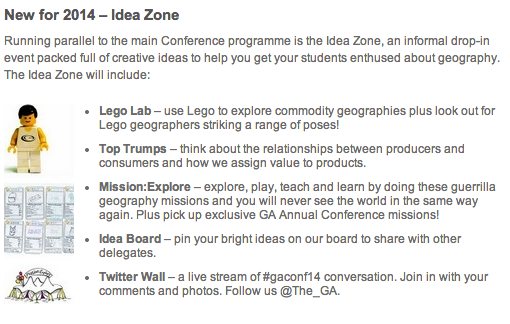
This week, we ran a Lego Lab at the Annual Conference of the Geographical Association in Guildford, in the UK. We have found Legoing to be a fantastic way to imagine and appreciate the relations what our site describes, and also to discuss the issues it contains in toy form.
We’ve also asked people about their favourite things, what they like about them, to imagine someone somewhere who made them for them, and then to write down what they would say to that person if they had the chance.
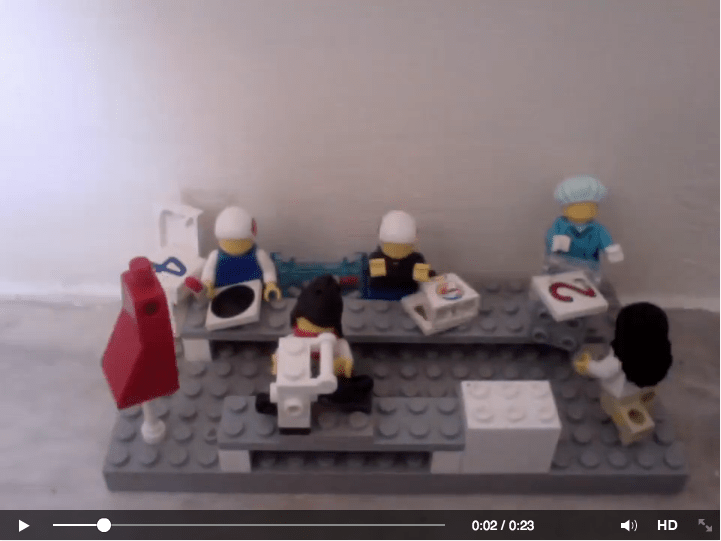
So, what happens when you combine these two approaches: ask people to think of a favourite thing, imagine who made it, and then Lego that imagination?
That’s what happened on the last day of our summer 2012 Lego Lab, when 11 year-old Ruby did this for her favorite dress. We asked for one scene, but she made the stop-frame animation – pictured above – of the whole commodity chain. It’s quick…
This is one way to imagine an answer to Fashion Revolution Day’s 2014 question: who made your clothes? And we’re publishing it today in advance of the first anniversary of the Rana Plaza factory collapse. 24 April. Try it yourself!

Who made Carry’s Pringle dress? We get close…
At the Fashion Revolution Day advisory board meeting last month, we made the rash claim that we could find out (roughy) who made your clothes, through the kind of ‘Follow it yourself’ research that we do. We decided to take as our starting point a tweet by FRD’s founder Carry Somers.
Watch this: BBC Breakfast on Rana Plaza
Great 6 minutes on #ranaplaza & fashion ethics on @BBCBreakfast last week with @LaHamnett & @TansyHoskins
http://t.co/7wyLjFeGev #insideout
— followthethings.com (@followthethings) March 24, 2014
Show us your @fash_rev trump cards!
Today, we started to play with the Fashion Ethics Trump card game we’ve made for, and with, Fashion Revolution Day.
We ended up tweeting some #fashtrumps selfies and a step by step guide for anyone who wants to join the #fashtrumps conversation.
We present to you here: some examples of #fashtrumps selfies, those guiding tweets and a twitter box that will show the ones that you have made…
Give this a go!
Some examples
How to make & play Fashion Revolution’s Fashion Ethics Trump card game
In November last year, we made and played a Ethical Fashion Trump Card game that we were developing for the Fashion Revolution Day Education Pack.
Its aim is to encourage its players to think about their clothes and fashion ethics, a topic that’s more important than ever after the Rana Plaza factory collapse in Dhaka, Bangladesh on 24 April last year.
It’s a playful way of encouraging some serious discussion about who and what we are wearing.
Here, we want to showcase the new FRD pack – which was published yesterday – and to provide a match report that will give you an idea of how the game can be made and played in your classroom, home, shed … wherever you play cards!
New for 2014: our Fashion Ethics ‘Grand Challenge’ at Exeter University
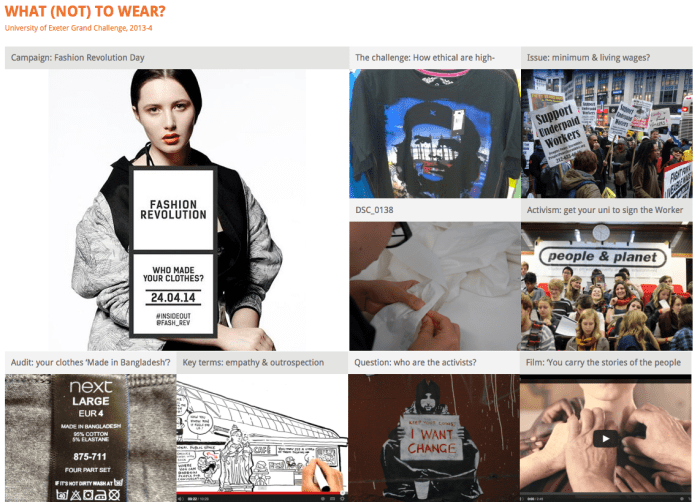
Things have been a bit quiet on the blog since the ftt Awards Ceremony in December. We have been busy on another project, at the University where we’re based, introducing First Year Students to the challenge of to how to help develop a more ethical fashion industry, in the wake of the Rana Plaza factory collapse in April last year.
We’ve been putting together a website for the Challenge, but it’s open to everyone to use, comment on, and get involved in.
Please do so via the website (click the screen grab below) or get in touch with us via followthethings@yahoo.com, @followthethings or our Grand Challenges Facebook page.
“You carry the stories of the people who make your clothes”
Because of our involvement in the commemoration of the Rana Plaza factory collapse through ‘Fashion Revolution Day’ (and its ‘Who made your clothes?’ theme), and the University of Exeter’s ‘What (not) to wear?’ ethical fashion Grand Challenge, we’ve been collecting films and other resources designed to engage consumers with the hidden social relations in their clothes, the lives in their things.
This short film, just published on YouTube, and it’s ‘behind the scenes’ sequel are fascinating, we think.
‘Handprint’: the film.
Behind the scenes: the making of ‘Handprint’.
Fashion Revolution Day: the first Trump card game
Yesterday at the Department of Geography at the University of Exeter, we heard Carry Somers talking about Fashion Revolution Day at our ‘What (not) to wear?’ conference. There was mention of an Ethical Trade Trump card game invented by students taking ‘Geographies of Material Culture’ in 2012 – using data from free2work.org – being adapted as followthethings.com’s contribution to this campaign.
A new Fashion pack will soon be designed, but today we tested out the idea in class. Students each made a card based on something they were wearing, sketched it, added the grades from free2work and – for extra information at the bottom of each card – added whether that company / brand had signed the Accord on Fire & Building Safety in Bangladesh.
The match report
6 teams of 8 students each made one or more cards in the first 15 minutes. One student was elected from each group as their player, and we staged a 6 player tournament at the front of the classroom. The cards were shuffled and dealt. The game began with player one calling out a brand (Cheap Monday!), a category (policies!), a grade (A+!), and then slamming the card on the table (drama!). The other players then took the card at the top of their pack, one after the other, called out its brand (Calvin Klein! or Adidas!), and its policy grade (C-! or A+), and slammed their cards on the table. The audience gathered round, watching their cards being played, helping their players to win and lose each round.
In each round, the player who called out the highest grade took all of the cards, and started the next round. If there was a draw – like between Cheap Monday and Adidas, both with A+ grades for their policies – the ‘key fact’ could be played: had the brand / company signed the Accord? In this case, only Adidas had (only very recently, the referee had to say), so that was the winning card.
The game went on with rounds in which, for example, only ‘worker rights’ scores could be played. It ended with a ‘winner takes all’ round, with the 3 remaining contestants. This was dramatic: a draw that was resolved by the key fact. The Accord-signatory won. Well done Adidas! Good job you signed the accord. Nobody wants a losing card. Whoops all around.
After the game ended, we discussed what had happened, why some cards were worse to play that others, why – with one exception – the policy grades were higher than the ‘workers’ rights’ grades, and how to find out why by looking at brands’ detailed free2work ‘score cards’. So, 40 minutes into class, we were talking about, asking informed questions about, and having a good idea how to find out more about the relations between ethical trade policies, transparency, monitoring, workers’ rights and the Accord.
This game can be made and played by any group of people trying to learn the basics and/or intricacies of Ethical Trade and Corporate Social Responsibility.
This is our 46 card pack, scanned after the game. What would your pack be like?


If you want to have a go:
- download the pack template, research and playing instructions here
- find the grades for your cards here www.free2work.org
- find out who has signed the Accord here www.bangladeshaccord.org/signatories/
Let us know about your game, send us your packs and match reports!
Thanks
Ian
Credits
This game was devised in 2012 as coursework ‘Geographies of Material Culture’ at the University of Exeter by Joe Thorogood, Michael Franklin, Sophie Angell, Florence Flint, Bryony Board, Toby Swadling, Jack Saxton, Jake Pincock, Emma Hargreaves & Joe Harrison. This pack was re–designed by Ian Cook, in consultation with the #followtheteachers ‘user crew’ Alan Parkinson, Oprah Whipp, Victoria Salt, Charlotte Wild, Jenny Thomas, Natalie Batten, Heather Taylor & Mary Biddulph for use in schools and universities.
Update
This pack was revised in 2014 as followthethings.com’s contribution to Fashion Revolution Day, an Ethical Fashion Trump Card Game is part of its Education Pack (download link to be added when this this is live).
‘What (not) to wear’ event: an introduction

Click for the facebook event page
Date: 11 November 2013, 4-6pm
Venue: University of Exeter, Streatham Campus, Streatham Court, Lecture Room C.
.
Our sponsor

A taster event for 1st year University of Exeter students: click for details
.
Setting the scene: journalism, activism & ‘Primark on the rack’
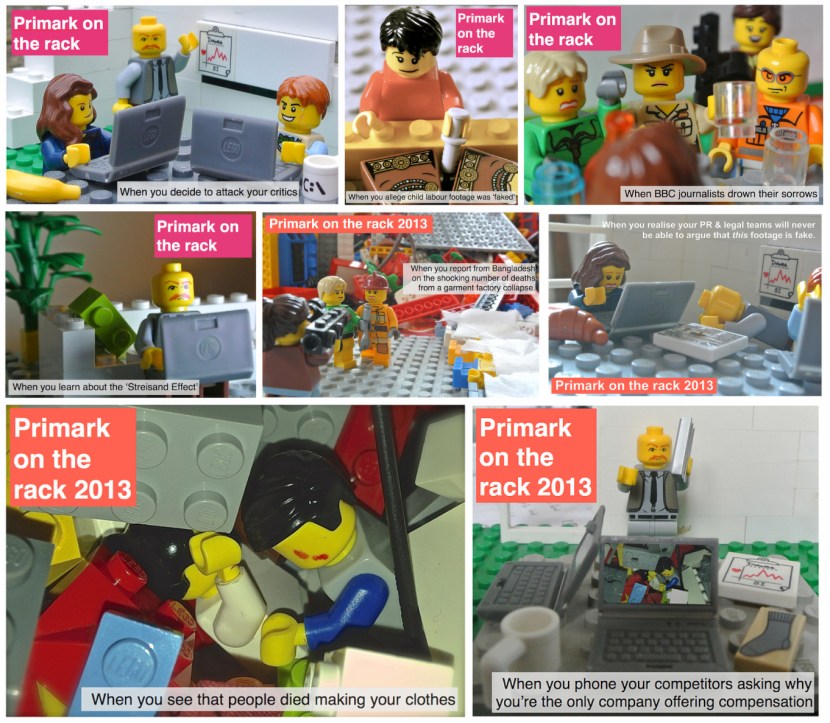
Click for the flickr set with explanations
.
Our audience: curious & expert students

Click to read more about this module

A draft followthethings.com page published last week: click to read
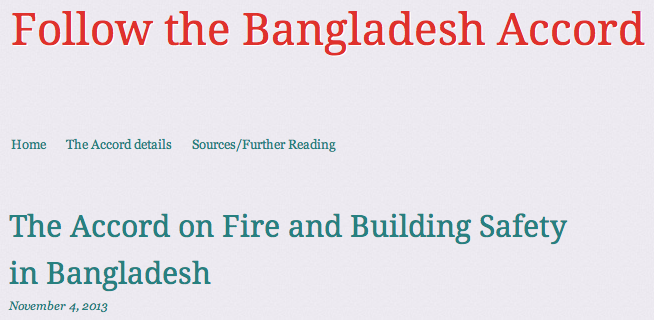
A draft followthethings.com page, published last week: click to read
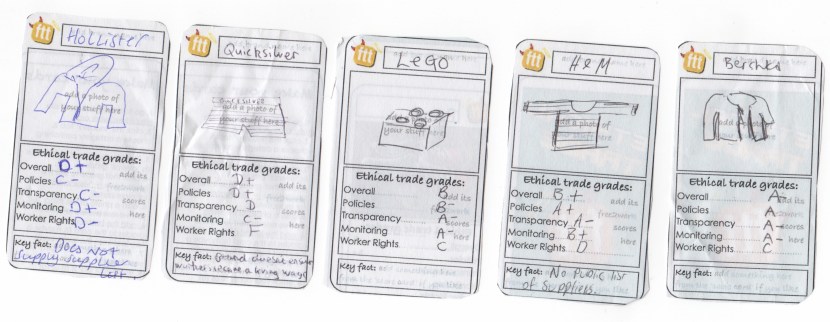
New student work: e.g. Ethical Trade Trumps game
.
Our hashtag

Tweet photos of your ‘Made in…’ labels & ask questions with this.
.
Our speakers
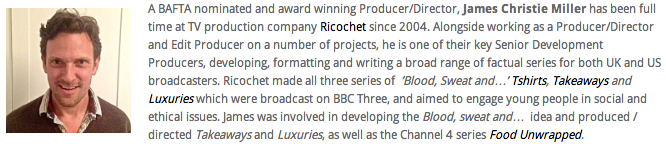
James Christie-Miller
Click for our Grand Challenge Events page
& Carry Somers

Click here for our Grand Challenge events page
 the back office