
Category: Appreciation
‘Behind the screen’: now on demand
There are a lot of follow the thing films that we’re looking forward to watching. We’ve seen the trailers, checked the websites, read the facebook posts, and we wait…
We found out today that this one is now available on demand, although not (we then found out) in the UK. So we’re watching the trailer again, and asking anyone who can watch the whole film on demand, or who has seen it at a festival, to tell us about it! We’re looking forward to the DVD release. This looks awesome!
Happy ‘shopping’: making & using followthethings.com bags
This post began as a contribution to a special issue of the journal ACME on the new ‘impact’ agenda in British Higher Education. Our shopping bags and ‘ladybugging’ activities seemed to fit this bill, although their ‘impact’ wasn’t measurable (and that was the point). In the end, another short piece on impact was written for the journal. We have revised that original paper to post here, and hope it may be interesting for readers who are keen to use our site and/or bags in their teaching and wider ‘shopping’ activities.
Update September 2016: sorry, we have no bags left to give away. They’ve all gone. If you have one, it’s a priceless collector’s item. If you see someone carrying one, please say hi.
——————————————————-
“We need to develop forms of critique that inspire hauntings, feed feelings, come alive, leap out and grab us, … that are not just about vital materiality but are themselves vitally material” (Cook & Woodyer 2012 p.238).
followthethings.com and the National Curriculum

This summer, we have been working with Alan Parkinson – legendary Geography teacher, ‘Living Geography‘ blogger and GeoBlogs tweeter – to develop some new pages and downloads for school teachers and their students. Our site has been open for almost two years, and we have found that these ‘shoppers’ are (among) our most enthusiastic. But we’ve also had feedback from some saying that it’s difficult to know where to start with our site: guidance and teacher-generated ideas were needed.
Today, we publish the first completed resource from our work together – a guide to how Geography teachers in England and Wales can use our site in the light of changing National Curriculum requirements. This document will, we are sure, be helpful for many other teachers across disciplines, in different kinds of schools, and in many countries.
This is where we’re publishing it first. You can download it by pressing the button below. We’ll update it as the Curriculum develops. [We made up the NC logo].
This, along with many other resources, will be published on followthethings.com later in the summer. As soon as each on is finished, however, we’ll publish it here!
Please send us any feedback and ideas by commenting on this post or emailing us on fttclassroom@yahoo.com And, if you have already been teaching with followthethings.com, we would love to see how! Please get in touch and join our ﹟followtheteachers project on twitter (see below).
‘Changing habits for good’ with followthethings.com
We have recently started working with the Scottish Development Educational Council (SCOTDEC) who have invited us to run a followthethings.com workshop at a ‘development education’ conference in Krakow this week. This is the first teacher conference in the ‘Changing habits for good’ project which brings together school teachers from Scotland, Poland, Slovenia and Bulgaria (for more, see the project outline below). We’re taking part via a videolink, and this is the blog post that will hopefull organise what happens. We’ve been asked to introduce our website and the wider project, including our ongoing ‘classroom’ project, and then to talk through some of the shopping bag activities we’ve posted on the Guerrilla Geography education website Mission:Explore.
This is followthethings.com

What is followthethings.com?
- It’s an online shopping website, if you understand ‘shopping’ to involve betraying the origins of things, like you might ‘shop’ a person to the police.
- It’s designed to have the look, feel and architecture of familiar online stores.
- It’s stocked with examples of art work, documentary film, journalism, activism, academic, student and other work revealing the lives of everyday things, i.e. the relations between their producers and consumers hidden by commodity fetishism.
- It shows how their makers tried to make these relations apparent, visible, tangible in ways that might move their audiences to act by trying to make them feel guilty, shocked, appreciative, awkward and/or involved in other people’s lives and work.
- It researches what its makers and viewers have said online about each example: what it aimed to do, how it was made, what discussions it provoked, and what impacts it had.
- It’s full of quotations that are arranged so that they read like a conversation, a conversation that can move from the computer screen into the classroom as teachers create lesson plans and schemes of work with its contents.
- It aims to inform and inspire new ‘follow the things’ work (by teachers, their students, as well as artists, filmmakers, journalists and others), which we hope to publish on the site too. Some examples of new work have already been published.
- It has become a popular website for teachers looking to engage their students in North-South relations via the geographies of commodities. So, we’re working on a new ‘classroom page’ to bright together materials and ideas already developed for this purpose.
First: let’s browse!
Click the homepage image above and you’ll get to the store. Get a sense of what’s available by browsing its departments. Where do you want to look? I’ll talk about any page you choose!
Second: a preview of our classroom page
Our site isn’t intended for any particular group of people.But we know that school teachers and their students are keen to use it. This is a page whose contents we’ve been working on for the past couple of months, with a teacher trainer, student teachers, an educational consultant, and undergraduate students. It’s not published yet, but will be by the end of this month.
.
Third: workshop activities

To get a sense of the educational materials and activities on this page that could imaginatively engage students in ‘development’ issues, we were hoping to give out some of our shopping bags (they didn’t arrive on time, unfortunately). We had these made in a factory in China that makes them for UK supermarkets. They are made by the same people, in the same way, to the same specifications. And we have produced a series of missions based on their lives and travels on the Guerrilla Geography education site Mission:Explore.
To get a vivid sense of Guerrilla Geography and Mission:Explore are all about, this video is excellent ( you don’t have to be a geographer to find this interesting!)
.
There are six shopping bag missions, starting with ‘get the bag’, and ending with ‘go ladybugging’! You can complete the series to win the ‘followthethings.com champion shopper’ badge, and you can borrow and adapt these missions for classroom, fieldwork or homework activities for your students.
1. get the bag – 2.where was it made? – 3. who made it?
4. where has it been? – 5. go secret shopping – 6. go ladybugging.
We’ll go through the missions this afternoon, and then try one or two now (perhaps even setting one as homework). These aren’t impossible if you don’t have the bags. We will have to improvise! And feed back tomorrow morning…?
Finally: questions
If you want to find out more, please comment on this post or email us at followthethings@yahoo.com . Thanks!
You can also follow us on Twitter and Facebook. We’re happy to answer questions there too!
—–
PS: ‘Changing habits for good’
This is a 3 year project funded through the European Commission’s programme for ‘Raising public awareness of development issues and promoting development education in the European Union’ (details here). It brings together a organizations in Scotland (SCOTDEC), Poland (Polish Green Network), Bulgaria (Creative Effective Grassroots Alternatives) and Slovenia (Institute for African Studies).
St Valentine’s Day: love, following, things.
We are going to love this week at followthethings.com HQ.
We’ve redesigned our website’s header for the season. Here it is:

[click the Cherubs’ banner, and you will get to this page]
We’re adding Finland’s favourite chocolate to our site, a new page created by University of Helsinki MPhil student Eeva Kemppainen. She’s working with us in Exeter this Spring. She is creating our first pages to be simultaneously published in English and Finnish.
We’re re-creating a scene from this new page in Lego, to add to our ‘Made in Lego…’ flickr set.
We’ve started to tweet Valentine’s Day issues, stories and activism. Like this:
“Guidance for consumers on Valentine’s Day” from @f2w & @ilrf laborrightsblog.typepad.com/international_… — followthethings.com (@followthethings) February 10, 2013
Did you know? Valentine’s Day is also ‘International Flower Workers Day”. See @waronwant‘s story waronwant.org/component/cont… — followthethings.com (@followthethings) February 10, 2013
Sending flowers? Wanting flowers? Check this @openuniversity blog post on “The ethics of St. Valentine’s Day” open.ac.uk/platform/blogs… — followthethings.com (@followthethings) February 10, 2013
On Thursday, all of our efforts will come together in a public Lecture at the University of Exeter. It’s ‘The St Valentine’s Day public lecture: love, following, things.” Here’s the opening slide:
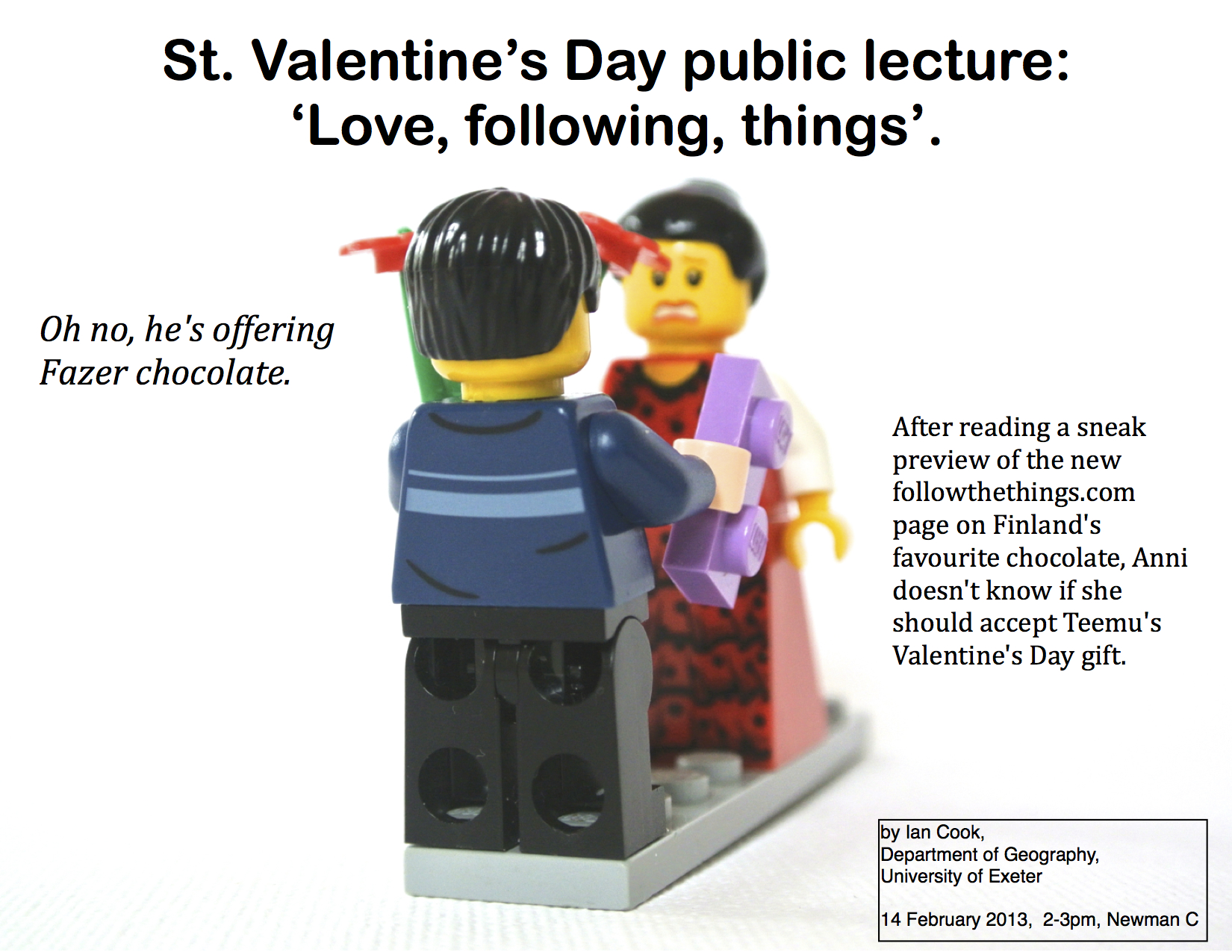
Here’s the description on its facebook event page:
Come take part in a public lecture and discussion that puts chocolate, renowned for its romancing qualities, under the spotlight this Valentine’s Day. Ian Cook (Associate Professor of Geography at the University of Exeter) will be using Finnish chocolate (following them through the world economy as physical goods) as a case study in a broader discussion of trade justice and emphatic socio-economic relations. The discussion will also cover the ways in which this approach to understanding the exchange of material goods can be taught and learned in universities, engaging students in the issue of trade justice activism in critical, creative and enthusiastic ways. The event will take place in the Peter Chalk Centre, lecture theatre Newman C. It will take place at 2pm on Thursday 14th February.
Everyone is welcome.
Celebrating the patenting of Lego
Yes. A story appeared in Gizmodo today saying that, 55 years ago, Lego bricks were first patented. We are interested not only in their origins, but also in their powers…
For the most part, Lego is one of the great levelers in the toy world: kids love it, adults get excited about it, and you can build practically anything you like out of it. While most wholesome family fun turns out boring or desperate, Lego transcends age and gender and makes everyone want to play.
Here at followthethings.com, we use Lego for our own means,re-creating scenes from ‘follow the things’ examples showcased on our site, posting them on Flickr and hoping that they will generate interest in our site. See a sample from our Flickr set in the right hand column of our blog.
What the Gizmodo article includes is one of Lego’s earliest commercials, in German, illustrating its playful, leveling effects… Enjoy!
Defining the ‘living wage’ bananas* want farmers to be paid.
When doing the background research for the MoCC banana card (see below), we came a cross these definitions of ‘survival’ and ‘sustainable’ wages in a 2004 report on The real wage situation of male and female workers in eleven banana plantations in Costa Rica, in comparison to a sustainable living wage (link: p.11-12). The research was undertaken by Costa Rica’s Association of Labour Promotion Services (ASEPROLA) and Union of Agricultural Plantation Workers for the UK NGO Bananalink. We found the report on the Make Fruit Fair website. Its definitions of different kinds of wages should be useful in any classroom discussion in which students are asked to look at and/or research followthethings.com examples. It’s not only about the amount of money that people are paid, but what they can do with it…
The Centre for Reflection, Education and Action Inc (CREA) defines four levels of wages according to the categories of ‘survival wage’, ‘wage allowing for short-term planning’ and ‘sustainable living wage’.
In the first category, the marginal survival wage is not enough to cover the adequate basic needs. Even though it is enough to avoid hunger, it can lead to malnutrition, illnesses and probably early death.
Secondly, there is the basic survival wage, enough to meet immediate needs, including basic food, second-hand clothing, minimum shelter and energy to cook, but little else.
Thirdly, is a wage allowing for short-term planning, covering basic survival needs as well as the possibility of a small surplus income that allows for minimum planning. Such minimum planning allows improvement of survival, only from the payday until the next wage. Occasionally, it is possible to buy other basic products.
Fourthly, is the sustainable living wage, which allows workers to cover satisfactorily all their basic needs: food, clothes, housing, energy, transport, health services and education. It also allows the participation in cultural activities such as births and other religious festivals: celebration of First Communion, weddings, christenings, funerals, etc. With this wage, it is possible to save a small amount to plan future purchases of other products and the fulfilment of other needs that may arise.
Additionally, a sustainable living wage allows enough “discretional income” so that the worker can participate in the establishment of small businesses or activities in their communities, contributing also to the development of cultural and civic activities. In this sense, the level of wage makes long-term planning possible.
What we also like is the Make Fruit Fair’s short animation in which bananas and pineapples want YOU to take action on this. They have seen it all…
*and pineapples
followthethings in a nutshell? Just watch these.
At followthethings.com HQ, we are big fans of the RSA Animate series. They really do bring those RSA lectures alive.
They’re also brilliant ways to introduce school and university students to key ideas and literatures.
These two, we think, make awesome introductions for anyone teaching with followthethings.com
The first is perhaps the most well known, with over 2m views. The second has just been published, and complements it beautifully.
.
.
PS for more on the animator and the animation process, read this and look here.
To celebrate followthethings.com’s 1st birthday…
we publish an article (never published) describing the site, its motivations, and its low key ‘opening ceremony’ in the Eden Project’s Humid Tropics Biome on October 2nd 2011.
‘What would you say to the person who picked the banana in your lunchbox?’
Ian Cook et al, Department of Geography, University of Exeter


This are just two of the touching personal messages written by Eden Project visitors during 2011’s Harvest Festival week. Three Exeter University students and I set up a stall by the smoothie stand in the Humid Tropics Biome. We talked to passers-by about the plants that they had seen that day. ‘Which ones had produced ingredients for your clothes, shoes, lunch, anything you have with you?’ ‘Imagine a person who had, for example, picked the cotton in your top, tapped the rubber in your shoes or packed the banana in your lunchbox.’ ‘What would you say to her or him, if you had the chance?’
Almost everyone stopped to talk to us. Many said that they hadn’t thought much about this before. We provided postcards and pencils, and people spent time talking with their friends and family about exactly what they should write. We collected the cards. At the end of the day, we had 160 heartfelt, friendly and sometimes humorous messages.
Among them were [click a photo to see the whole set]:


That spot among the banana trees, coffee bushes and sugar canes was great for getting people thinking and talking about the ways in which the travels of things connect the lives of people. What we tried to do there was part of a much larger project. It’s focused around a ‘shopping’ website called followthethings.com.
Created with colleagues and students from Exeter and Brown Universities, it’s a database of documentary films, art work, journalism and other writing that aim to show the ‘hidden lives’ in everyday things. It has the look, feel and organisation of a normal online store, with goods available from grocery, fashion, electrical and other departments. This is, however, another kind of shopping.
In the Grocery department, for example, you click on the bananas and end up watching a trailer for, and reading all about, a 2009 documentary film that followed a group of Central American banana workers as they took the Dole fruit company to court for using a banned pesticide that had allegedly made them sterile. It’s a gripping ‘David versus Goliath’ courtroom drama. They win. They lose. Who is right? Who is wrong? How do you prove or disprove a case like this? Dole’s lawyers tried to prevent the film being released. This stirred up a heated discussion about corporations’ attempts to censor films that are critical of their treatment of workers. The debate continues…
Dole spent considerable time, money, and energy trying to silence this Swedish documentary … Ultimately these efforts … proved a public relations disaster.
Also in Grocery, you could click on the packet of mixed nuts. That would take you to a 23 minute animated film called ‘The luckiest nut in the world’, first shown on Channel 4 TV in 2002. The nut trade is skewed because the production of US peanuts is subsidised while that of the world’s other nuts is not. An animated peanut tells the story, strumming his guitar and singing Country & Western songs about the inequities of global trade regulation. This has been shown to countless school pupils. Comments on YouTube show that many found this funny, and some admitted that they couldn’t help humming its song about the World Trade Organisation. It seemed to stick in their minds…
No longer stuffy, didactic or earnest, the new breed of documentary … is attracting audiences who would normally shy away from the genre.
Also in Grocery, you could click on the fresh papaya, and find an academic paper that I wrote in 2004 called ‘Follow the thing: papaya’. This is what ultimately brought me to the Eden Project’s humid tropics biome, encouraged me to put this website together, and sparked me to question what we might say to the people who make the things we buy. I did my PhD in the early 1990s when the range of tropical fruits on UK supermarket shelves was starting to expand. All of the papaya on these shelves were grown in Jamaica. So I spoke to supermarket executives and importers in the UK, and to government officials, farm managers, foremen, pickers and packers in Jamaica. I spent 6 months working on one farm, spending long hours talking with packing house workers, washing, grading, wrapping and boxing the fruit with them.
… geographers require new techniques to provide consumers with resources to imagine their location in commodityscapes…
The way that they helped to get thousands and thousands papayas, of uniform size, quality and price from farm to shelf was a complex and often fraught business. Nothing seemed to be straightforward. Nobody along this commodity chain seemed to have a detailed sense of how its various parts worked together. They kept asking me! Everyone admitted partial responsibility, but nobody ultimately responsibility, for the farm workers’ increasing poverty and hardship. This was supposed to be Jamaica’s post-sugar, post-plantation, post-colonial export agriculture. It was. But also it wasn’t. The past was alive and present in the ruined plantation buildings at the centre of the farm, and in the conflicts that occasionally erupted between pickers, packers and their bosses. Meanwhile, these fruits were being marketed in the UK as products of some tropical paradise, where the fruit just fell from the trees.
This experience convinced me that stories of lives and trade shouldn’t be over-simplified. There was no straightforward right or wrong, cause or effect, supply and demand, ‘do nothing’ or ‘do something’ story to tell. When I returned to the UK, I went back in to the supermarkets, and looked for the papayas picked, packed and shipped by the people I had met. They looked and felt very different to me, now. They had much more ‘life’ to them. So, I wondered, how could I encourage people who read my research papers to appreciate papaya – or any commodity for that matter – in the way that I had learned to appreciate them? How could I write about what I had learned in ways that might grab people, stick in their imaginations, provoke thought and discussion, have the same effect on them that it had had on me?
Researching with my students the 50-plus examples showcased on followthethings.com has begun to address these questions. The ways in which different examples try to encourage deeper appreciations of global trade via courtroom drama, cartoon humour, reality TV (have you seen ‘Blood, Sweat and Tshirts’? [not yet on the site]), fake websites advertising things that should but don’t exist (a ‘conflict free’ iPhone?), and many more, is fascinating and important. Now that there’s so much user generated content on the internet, the effects of this work on its audiences is much easier to appreciate. By putting in one place these examples and what’s been said about them, we hope that followthethings.com will inform and encourage discussions about trade justice in schools, universities, and plenty of other places, as well as informing and encouraging new following work not just by filmmakers, artists and academics, but by anyone with a computer and broadband connection. FIY: follow it yourself…
Extra information
Ian is an Associate Professor of Geography at the University of Exeter [more]. He took part in the Eden Project’s Harvest Festival events on Sunday 2nd October 2011 with students Jack Parkin, Maura Pavalow and Alice Goodbrook. A shorter version of this article was published on the Eden Project Blog on 9 October 2011: here.
 the back office