
Category: documentary
‘Behind the screen’: now on demand
There are a lot of follow the thing films that we’re looking forward to watching. We’ve seen the trailers, checked the websites, read the facebook posts, and we wait…
We found out today that this one is now available on demand, although not (we then found out) in the UK. So we’re watching the trailer again, and asking anyone who can watch the whole film on demand, or who has seen it at a festival, to tell us about it! We’re looking forward to the DVD release. This looks awesome!
Why Lego ‘Primark on the rack 2013’?
We researched a 2009 BBC Panorama documentary ‘Primark on the rack’ for followthethings.com. This was a documentary exposing Primark for producing its notoriously cheap clothes in Indian sweatshops. It contained a 45 second scene in which child labourers were filmed checking that sequins were firmly attached to its sequined tops. Primark claimed that this scene had been ‘faked’ and made a concerted effort to discredit the whole film, with mixed success (detailed on our site here).
As with many of our pages, we made a few scenes in Lego, uploaded them to a flickr set, and embedded them. Today, we added a couple of new scenes to our ‘Primark on the rack’ set, to bring the story up to date.
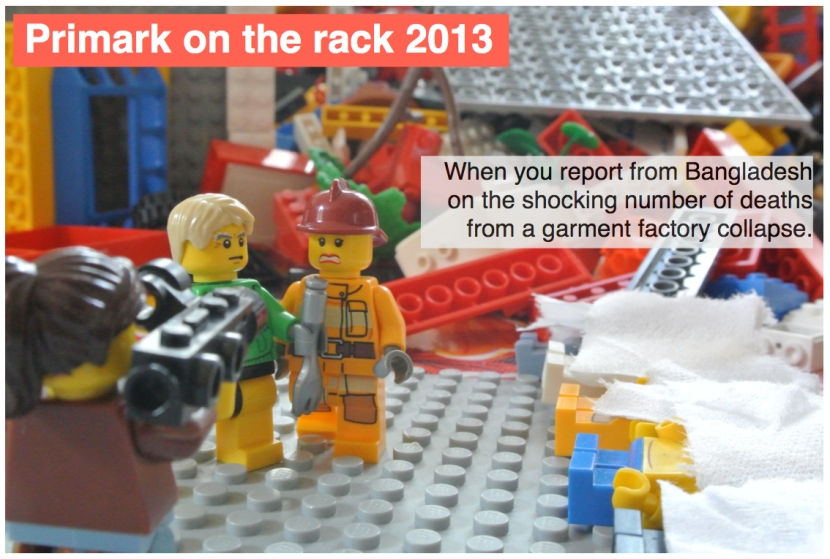
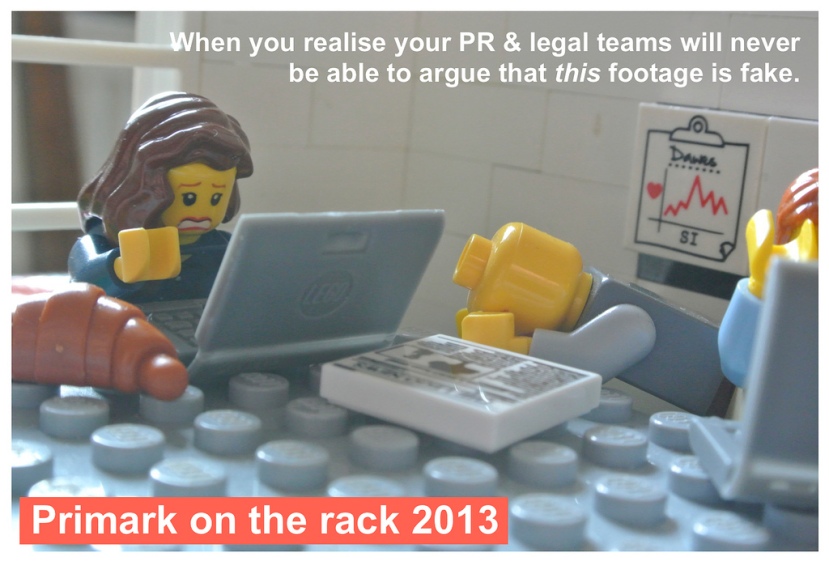
These scenes are intended to highlight a theme that cuts across a number of examples of followthethings filmmaking on our site: corporations responding to sweatshop, worker health and environmental destruction exposures by employing public relations and/or legal teams to ‘prove’ that key scenes – and, by implication, whole films – are ‘faked’. This is, for example, how Primark responded to the BBC documentary in 2009, how Dole responded to Fredrik Gertten’s documentary ‘Bananas!*’ in 2009 (link), and how Chevron responded to Joe Berlinger’s documentary ‘Crude: the real price of oil’ in 2009 (link).
This past week has seen relentless TV news footage and newspaper column inches devoted to the Savar Rana garment factory collapse. Journalists have told unfolding stories of dramatic rescue efforts and the shocking numbers of people who made Primark, Joe Fresh, Matalan, Mango, Benneton, Bon Marche and other branded clothes being found dead in the wreckage of their workplace or missing, presumed dead.
NGOs and others are putting pressure on these clothing brands to respond appropriately to this disaster by properly compensating its victims and their families, by signing agreements that they’d been reluctant to sign before, and by putting into place more comprehensive auditing practices so that what they agree to is more likely to be done in the future.
This pressure continues to be applied, and companies are responding. On Monday, for example, the BBC reported that Primark had released a statement saying that it ‘accepts all its responsibilities in this disaster’ (Source: BBC 2013 link). ALL of them. We shall see.
This is not a single documentary with a named director, whose work can be ‘discredited’ with the right PR and legal teams in place. This is ‘Primark on the rack 2013’. Click the photos to get to the whole 6 scene set.
Postscript: why Lego?
We’ve been inspired by Lego re-creations that we found online of hidden scenes from the ‘War on Terror’. They had been made and posted online in 2009 by an artist/blogger called Legofesto (see her flickr sets here). She argued that:
‘By using toys, I hope the viewer will linger longer over the image and think again about what is actually being depicted or described, in a visual language that is recognised by us all: LEGO. … The incongruity between the immoral and horrific acts and events depicted and the smiley-faced children’s toy create a tension’ (legofesto in Time Magazine 2009 link).
By photographing re-creations and publishing them online, she argues:
‘I want to keep the debate going. To keep it in people’s minds, to remind us of our atrocities because the media has moved on and they don’t want to dwell on the tactics [of the ‘War on Terror’]. … People are using Legofesto to talk about torture and state violence’ (legofesto in Carling 2009 link).
We want our Lego re-creations to help keep trade (in)justice debates going, to keep them in people’s minds, etc. in a similar way.
February 14th: the revolution is love
This is a film trailer we come back to again and again at followthethings.com. It’s particularly appropriate to watch on February 14th, although every day is – of course – International Flower Workers Day.
.
Love is the felt experience of connection to another person.
Today, we live in a money economy, where we don’t really depend on the gifts of anybody but we buy everything. Therefore we don’t need anybody. Because whoever grew my food or made my clothes or built my house, well, if they died or if I alienated them or they don’t like me, that’s OK. I can just pay somebody else do do it. It’s really hard to create community if the underlying knowledge is ‘we don’t need each other’.
So people get together and act nice, or maybe they consume together. But joint consumption doesn’t create intimacy. Only joint creativity and gifts create intimacy.
On a day devoted to people expressing their love for other people through exchanging things, this film’s take on these relations is the hand in our glove.
To celebrate followthethings.com’s 1st birthday…
we publish an article (never published) describing the site, its motivations, and its low key ‘opening ceremony’ in the Eden Project’s Humid Tropics Biome on October 2nd 2011.
‘What would you say to the person who picked the banana in your lunchbox?’
Ian Cook et al, Department of Geography, University of Exeter


This are just two of the touching personal messages written by Eden Project visitors during 2011’s Harvest Festival week. Three Exeter University students and I set up a stall by the smoothie stand in the Humid Tropics Biome. We talked to passers-by about the plants that they had seen that day. ‘Which ones had produced ingredients for your clothes, shoes, lunch, anything you have with you?’ ‘Imagine a person who had, for example, picked the cotton in your top, tapped the rubber in your shoes or packed the banana in your lunchbox.’ ‘What would you say to her or him, if you had the chance?’
Almost everyone stopped to talk to us. Many said that they hadn’t thought much about this before. We provided postcards and pencils, and people spent time talking with their friends and family about exactly what they should write. We collected the cards. At the end of the day, we had 160 heartfelt, friendly and sometimes humorous messages.
Among them were [click a photo to see the whole set]:


That spot among the banana trees, coffee bushes and sugar canes was great for getting people thinking and talking about the ways in which the travels of things connect the lives of people. What we tried to do there was part of a much larger project. It’s focused around a ‘shopping’ website called followthethings.com.
Created with colleagues and students from Exeter and Brown Universities, it’s a database of documentary films, art work, journalism and other writing that aim to show the ‘hidden lives’ in everyday things. It has the look, feel and organisation of a normal online store, with goods available from grocery, fashion, electrical and other departments. This is, however, another kind of shopping.
In the Grocery department, for example, you click on the bananas and end up watching a trailer for, and reading all about, a 2009 documentary film that followed a group of Central American banana workers as they took the Dole fruit company to court for using a banned pesticide that had allegedly made them sterile. It’s a gripping ‘David versus Goliath’ courtroom drama. They win. They lose. Who is right? Who is wrong? How do you prove or disprove a case like this? Dole’s lawyers tried to prevent the film being released. This stirred up a heated discussion about corporations’ attempts to censor films that are critical of their treatment of workers. The debate continues…
Dole spent considerable time, money, and energy trying to silence this Swedish documentary … Ultimately these efforts … proved a public relations disaster.
Also in Grocery, you could click on the packet of mixed nuts. That would take you to a 23 minute animated film called ‘The luckiest nut in the world’, first shown on Channel 4 TV in 2002. The nut trade is skewed because the production of US peanuts is subsidised while that of the world’s other nuts is not. An animated peanut tells the story, strumming his guitar and singing Country & Western songs about the inequities of global trade regulation. This has been shown to countless school pupils. Comments on YouTube show that many found this funny, and some admitted that they couldn’t help humming its song about the World Trade Organisation. It seemed to stick in their minds…
No longer stuffy, didactic or earnest, the new breed of documentary … is attracting audiences who would normally shy away from the genre.
Also in Grocery, you could click on the fresh papaya, and find an academic paper that I wrote in 2004 called ‘Follow the thing: papaya’. This is what ultimately brought me to the Eden Project’s humid tropics biome, encouraged me to put this website together, and sparked me to question what we might say to the people who make the things we buy. I did my PhD in the early 1990s when the range of tropical fruits on UK supermarket shelves was starting to expand. All of the papaya on these shelves were grown in Jamaica. So I spoke to supermarket executives and importers in the UK, and to government officials, farm managers, foremen, pickers and packers in Jamaica. I spent 6 months working on one farm, spending long hours talking with packing house workers, washing, grading, wrapping and boxing the fruit with them.
… geographers require new techniques to provide consumers with resources to imagine their location in commodityscapes…
The way that they helped to get thousands and thousands papayas, of uniform size, quality and price from farm to shelf was a complex and often fraught business. Nothing seemed to be straightforward. Nobody along this commodity chain seemed to have a detailed sense of how its various parts worked together. They kept asking me! Everyone admitted partial responsibility, but nobody ultimately responsibility, for the farm workers’ increasing poverty and hardship. This was supposed to be Jamaica’s post-sugar, post-plantation, post-colonial export agriculture. It was. But also it wasn’t. The past was alive and present in the ruined plantation buildings at the centre of the farm, and in the conflicts that occasionally erupted between pickers, packers and their bosses. Meanwhile, these fruits were being marketed in the UK as products of some tropical paradise, where the fruit just fell from the trees.
This experience convinced me that stories of lives and trade shouldn’t be over-simplified. There was no straightforward right or wrong, cause or effect, supply and demand, ‘do nothing’ or ‘do something’ story to tell. When I returned to the UK, I went back in to the supermarkets, and looked for the papayas picked, packed and shipped by the people I had met. They looked and felt very different to me, now. They had much more ‘life’ to them. So, I wondered, how could I encourage people who read my research papers to appreciate papaya – or any commodity for that matter – in the way that I had learned to appreciate them? How could I write about what I had learned in ways that might grab people, stick in their imaginations, provoke thought and discussion, have the same effect on them that it had had on me?
Researching with my students the 50-plus examples showcased on followthethings.com has begun to address these questions. The ways in which different examples try to encourage deeper appreciations of global trade via courtroom drama, cartoon humour, reality TV (have you seen ‘Blood, Sweat and Tshirts’? [not yet on the site]), fake websites advertising things that should but don’t exist (a ‘conflict free’ iPhone?), and many more, is fascinating and important. Now that there’s so much user generated content on the internet, the effects of this work on its audiences is much easier to appreciate. By putting in one place these examples and what’s been said about them, we hope that followthethings.com will inform and encourage discussions about trade justice in schools, universities, and plenty of other places, as well as informing and encouraging new following work not just by filmmakers, artists and academics, but by anyone with a computer and broadband connection. FIY: follow it yourself…
Extra information
Ian is an Associate Professor of Geography at the University of Exeter [more]. He took part in the Eden Project’s Harvest Festival events on Sunday 2nd October 2011 with students Jack Parkin, Maura Pavalow and Alice Goodbrook. A shorter version of this article was published on the Eden Project Blog on 9 October 2011: here.
New examples for followthethings.com now being researched
Students taking Ian Cook’s ‘Geographies of material culture’ module are now researching the following examples to produce new ‘compilation pages’ for publication on followthethings.com.
Help with our research?
If you know of any good discussions, interviews, videos and any related information on any of the sources below, please comment on this post. Thanks…
Grocery dept.
Starbucks Coffee, iPhones and tents: Louise Mensch on Occupy London (BBCTV Have I Got News For You, 26 October 2011: watch here).
Various food: Food Inc documentary (2009: watch trailer).
Hamburber: McLibel film (2005: watch trailer).
Fashion dept.
Nike training shoes: Jonah Perretti’s Nike ID emails (2001: read emails).
Various clothing: ‘Primark: on the rack’ BBCTV Panorama documentary (2008: doc webpage).
Jeans: China blue documentary (2005: watch trailer).
Various clothing: Kelsey Timmerman’s Where am I wearing? book (2008: watch trailer).
Electrical dept.
iPhone: The agony and the ecstasy of Steve Jobs, Mike Daisey monologue (2011: watch interview)
Various electricals: Maquilapolis documentary (2006: watch trailer).
iPhone: PhoneStory app (2011: watch review/demo).
Gifts dept.
Various toys: Santa’s workshop: inside China’s slave labor toy factories documentary (2006? watch whole film).
 the back office