
Category: student work
Our #followtheteachers blogging begins
We’ve been working with a group of trainee high school teachers at the University of Nottingham this year. We’ve talked in detail with them about how followthethings.com could help them engage their students in a variety of complex and sometimes controversial geographical issues.
We enjoyed working together so much that, after hosting together a ‘Teaching with followthethings.com’ workshop at the 2013 Geographical Association conference, we decided to continue our work as they begin their careers as Geography teachers.

We decided to call what we were doing the ‘follow the teachers’ project. This would a) follow the use, adaptation and creation of followthethings.com resources to teach geography and related subjects, and b) share these experiences and resources online for others to use. Over the next few months, we’ll be hearing from seven teachers involved in this project.
We begin with Oprah Whipp’s use of our page on a Simpson’s couch gag to teach her students about globalisation and geographical thought.

I had a class of 30 year 7 pupils, mixed ability who had never studied the concept of globalisation, however this is a topic covered in detail in year 9, and again at GCSE and A Level. What could I do to put a spin on this topic, that wouldn’t become repetitive?
I began looking through the followthethings.com web page, which I was introduced to during my PGCE course at the University of Nottingham and came across the video clip directed by Banksy, and the opening sequence he created for an episode of the cartoon series ‘The Simpsons’. This was something I felt that my class would relate to, and capture their imagination.

Get a bag from followthethings@yahoo.com
In the lessons prior to this, I had introduced key terms, and completed followthethings.com shopping bag missions 1-3 on the Mission:Explore website. I adapted mission 3 – ‘Who made it?’ – by splitting the class into two groups, and asking one what they would say to a person who had made their bags, and the other what they thought those workers would say to them. This allowed pupils to gain a brief understanding of the concept of globalisation, focusing on worker’s rights.
This lesson began with me recapping the term globalisation, and then introducing Banksy by showing the pupils a picture of one of his guerrilla artworks (download my powerpoint slides). I asked them to think geographically, and about the topic we had been looking at over the past two weeks to help them do so. The class coped really well with this, and a couple of the higher levelled pupils even knew the artist and were able to inform their peers on his background.

From pupil to factory worker.
The detailed walk through of the clip provided on its followthethings.com page enabled the gifted and talented pupils to read out loud to the rest of the group, which ensured the initial material (the video clip) was accessible to each member of the class and they understood Banksy’s reasoning behind it.
My main task was for the pupils to create their own piece of guerrilla art. Here is where differentiation became apparent. The lower levelled pupils interpreted Banksy’s work, and wrote a vague description and reasoning behind their work, whereas the higher achieving pupils really came to life, incorporating ideas from the previous lessons (the postcards and the meaning of the word globalisation).
I really enjoyed this lesson, teaching it was a highlight of my teaching practice, especially because of the positive feedback I received from my pupils.
Update: twitter feedback
@JarradNorthover thank you for taking the time to read it! Me and my colleagues have more blogs to come over the summer #followtheteachers
— Oprah Jade (@OprahJade) July 22, 2013
@OprahJade Write for us next!!:)
— Protocol Education (@ProtocolEd) July 22, 2013
Preview: classroom page
This is the week when the work that we’ve been doing this year with and for school teachers is brought together and made available on our site. We’re bringing together ideas and resources developed with student teachers, undergraduate students, followthethings interns, and educational consultant Alan Parkinson.
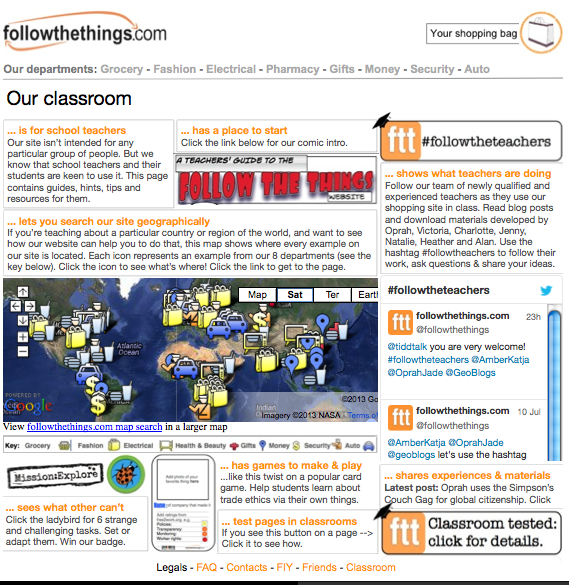
We’ll explain more about our longer-term project with teachers – #followtheteachers – in another post. Below, for those who like advance warning, is a screengrab showing roughly what our new classroom page will look like.
If you have any questions or suggestions, please post a comment, tweet us @followthethings or email us at followthethings@yahoo.com.
Thanks!
Thinking geographically: with followthethings.com
In this post, I want to briefly set out ways in which High School Geography teachers in the USA (and elsewhere) could use our site with their students. Why? Totally by coincidence. We’re visiting the Watson Institute at Brown University this week. Across the hall, a conference for High School Geography teachers is taking place that’s organised via Brown’s Choices program. When they found out that we were here and have been working this year on our classroom project – creating resources for UK school Geography teachers – I was asked to talk about this just before dinner today (for 10 minutes). This is the blog post that I’ll be showing on screen, combining what we’ve already done and what’s coming next in the followthethings.com project.
.
1. the main idea
This is explained in the short paper circulated at the conference. This was published in a journal produced by the Geographical Association – the professional association of Geography teachers in the UK – for High School Geography students and their teachers. The paper begins:
Many of us pay little or no attention to where the things in our lives come from. We may be concerned about factory conditions in other parts of the world, but not feel any direct sense of connec- tion with the people working there. ‘Made in…’ labels and ingredient infor- mation don’t tell us much about these connections and relationships. But they can be starting points for ‘geographi- cal detective work’ (Hartwick, 2000). This can allow teachers and students to piece together their understanding of commodities and their complex geographies, and provoke classroom discussion about the impacts of con- sumers’ decisions, which inevitably draw upon the key geographical concepts including:
globalisation – uneven development – interdependence – scale and connection –
proximity and distance – relational thinking – identity responsibility
This paper includes examples of student ‘follow it yourself’ research on socks, chewing gum and an iPod. You can download it here.
.
2. the website
This is the spoof online shopping site that opened in 2011. It contains over 60 examples of films, art work, and activism that aims to show consumers who makes our stuff, and to encourage us to discuss the rights and wrongs of globalisation and international trade. Each example has been thoroughly researched, and that research is showcased here. There are also examples of original student work, including the 3 examples in the paper quoted above. Please click the image to get to the site and browse…

.
3. the missions
The site isn’t made for teachers and their students. It’s made for anyone and everyone who makes this kind of work, or wants to teach with this kind of work. But its core ideas and content fits into the UK High School Geography curriculum in many ways. So we’re now working with Geography teachers and teacher-educators to develop and publish ideas and teaching resources for schools. The first of these was a series of missions on the Guerilla Geography site Mission:Explore. Its Explorers do missions, earn points and can win badges.

We have a series of six missions focused on the reusable followthethings.com shopping bags that we had made in China and are now giving away free to anyone who wants one (see our site’s Shopping Bag page here). The links for the missions are here (you don’t have to do the missions, some teachers just borrow and adapt the ideas):
1. get the bag – 2.where was it made? – 3. who made it?
4. where has it been? – 5. go secret shopping – 6. go ladybugging.
These are the postcards that one trainee teacher asked her students to write based on Mission 3:
Woop. The postcards for our @The_GA conference workshop on Friday are back from the printers. Nice work @OprahJade pic.twitter.com/Wnnsjf2QtA
— followthethings.com (@followthethings) April 3, 2013
.
4. our classroom page
This is what we’re working in at the moment with educational consultant and soon-to-be-a-Geography-Teacher-again Alan Parkinson (see his excellent Living Geography blog here). We’re pooling resources in a soon-to-be published ‘classroom page’, which includes this searchable map (draft copy below).
5. get in touch!
St Valentine’s Day: love, following, things.
We are going to love this week at followthethings.com HQ.
We’ve redesigned our website’s header for the season. Here it is:

[click the Cherubs’ banner, and you will get to this page]
We’re adding Finland’s favourite chocolate to our site, a new page created by University of Helsinki MPhil student Eeva Kemppainen. She’s working with us in Exeter this Spring. She is creating our first pages to be simultaneously published in English and Finnish.
We’re re-creating a scene from this new page in Lego, to add to our ‘Made in Lego…’ flickr set.
We’ve started to tweet Valentine’s Day issues, stories and activism. Like this:
“Guidance for consumers on Valentine’s Day” from @f2w & @ilrf laborrightsblog.typepad.com/international_… — followthethings.com (@followthethings) February 10, 2013
Did you know? Valentine’s Day is also ‘International Flower Workers Day”. See @waronwant‘s story waronwant.org/component/cont… — followthethings.com (@followthethings) February 10, 2013
Sending flowers? Wanting flowers? Check this @openuniversity blog post on “The ethics of St. Valentine’s Day” open.ac.uk/platform/blogs… — followthethings.com (@followthethings) February 10, 2013
On Thursday, all of our efforts will come together in a public Lecture at the University of Exeter. It’s ‘The St Valentine’s Day public lecture: love, following, things.” Here’s the opening slide:
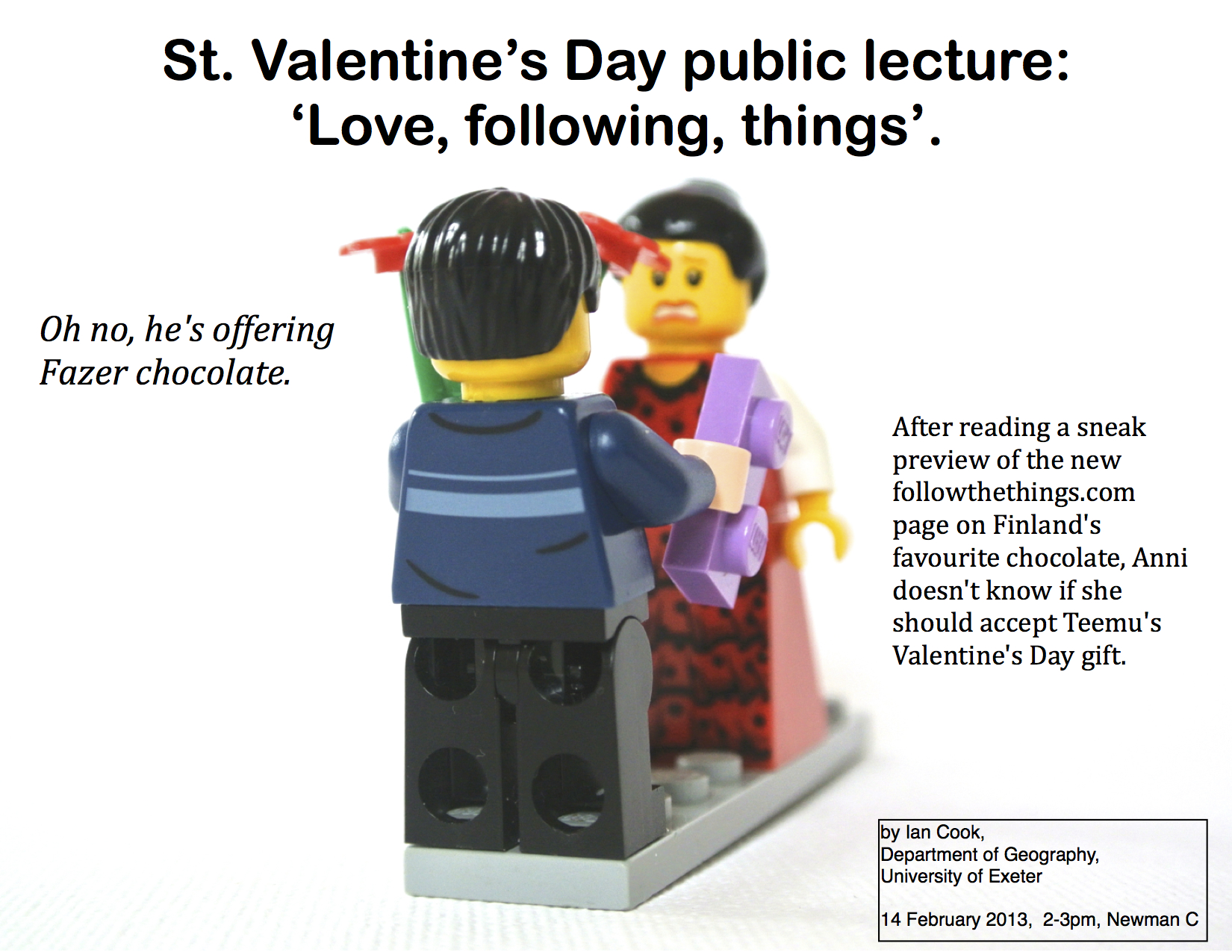
Here’s the description on its facebook event page:
Come take part in a public lecture and discussion that puts chocolate, renowned for its romancing qualities, under the spotlight this Valentine’s Day. Ian Cook (Associate Professor of Geography at the University of Exeter) will be using Finnish chocolate (following them through the world economy as physical goods) as a case study in a broader discussion of trade justice and emphatic socio-economic relations. The discussion will also cover the ways in which this approach to understanding the exchange of material goods can be taught and learned in universities, engaging students in the issue of trade justice activism in critical, creative and enthusiastic ways. The event will take place in the Peter Chalk Centre, lecture theatre Newman C. It will take place at 2pm on Thursday 14th February.
Everyone is welcome.
ftt summer intern Ellie Bird reviews Kelsey Timmerman’s ‘Where am I wearing?’
 Kelsey Timmerman is the all-American guy, stereotypically easy going and enthusiastic. Great, but how does this lie with the seriousness of the issues he addresses in his book: Where Am I Wearing?
Like others, I was in two minds. They say first impressions count; but if I’d gone with mine Timmerman wouldn’t have got the credit he perhaps deserves. He begins with a trip to Honduras. It’s brief, the entire experience based on a quick opportune chat with a random worker called Amilcar outside the factory gates. Was Timmerman taking this seriously or just using the motive as a holiday? Where was the in-depth exploratory enthusiasm needed to give the topic of social injustice, well, justice?!
This set the theme for the style of the book throughout. Drive-by ethnography to put an academic spin on it. Timmerman didn’t immerse himself, get involved, recognize the importance of the little bits of everyday that make up the patchwork of life. The chapters were brief reflecting the lack of depth into places: I was left wanting more. I started to become irritated with his light-hearted, fun, immature approach. He shouldn’t have taken the people out to a theme park, he should have bought them food, or some educational supplies. Short sighted. Selfish. It was a very negative first impression.
I contacted Timmerman when undertaking this review. He is such a genuine bloke. I felt guilty for my negative and maybe ‘aloof?’ stance on his work. I’d fallen into the academic trap: I must be critical, I know best! I gave him a second chance… it was an easy read. It wasn’t challenging, why should it be? I’d actually enjoyed reading it, after all.
Timmerman was funny. He injected his happy-go-lucky humour into his experiences. Considering the pessimism associated with his topics, I wasn’t left feeling depressed and helpless. He accepted the enormity of the problems and went, albeit naively, and did his best in the situations encountered. Ultimately, his written style allowed for a wide target audience, furthermore it conjured debate. Was this the right way to go about things?
In a forthcoming followthethings.com page that I researched and wrote with other Exeter Geography undergraduates, you will see for yourself how Timmerman’s style opens a space for discussion and debate. With discussion and debate comes an increase in awareness. Is that not the most important thing to come out of his work? Is the content (and perhaps it’s flaws) merely by-the-by?
Give the book’s second edition a read and see what you think (it is the same as the first but with some added chapters which I will discuss in a minute!). Apart from the overarching issue of style that I have highlighted, you may find like me that Timmerman’s little observations and thoughts stand out to you, academically and/or personally. For example, his decision to pretend to be an underwear buyer rang with ideas of covert research and the associated morals that go with it. Timmerman himself says on the issue: “He’s just trying to make it in this world, I’m completely wasting his time” (p.37).
Timmerman’s ability to capture poignant moments was a highlight of the book for me really overriding my first negative impressions. At the same time, he managed to bring the people of his experiences alive and make them human. He made me think what choices I would have made; would I have given Arifa the $20? What’s my view on boycotting?“To buy or not to buy that is the question” (p.117).
As the book progresses, so does he. He writes of his experiences with a more reflexive attitude. Perhaps it’s important that as the reader you develop with him. First impressions don’t have to count. You enter the book as naively as Timmerman enters his journey. So with him you begin to develop your own personal debates. Personally I enjoyed grappling with myself alongside Timmerman about what it means to be Western- what should I do about it, should I even think about it at all!? “Perhaps we are both better off not thinking about the other’s life”. Conscientious consumer vs. deliberate ignorance. “Can I afford to worry about a garment worker in Bangladesh…?” (p.238). Indeed. Grappling with my moral conscience continues…“It’s unnatural for producer and consumer to meet” (p.67).
Had Timmerman done some background reading here? The assumed naturalness of our commodities, our clothes just appearing on the well socked racks of the High Street…fetishization…invisible human labour…
In this updated and revised second edition, he opens with admitting his flaws in brevity; “I’ve always felt this book was missing something”- turns out he simply ‘chickened out’ of asking the meaty questions! “I think deep-down I didn’t want to know the realities of Amilcar’s life, so I didn’t ask…” In fact he even says that if it weren’t for the complete silliness of him giving Amilcar his T-shirt in the first place, Amilcar wouldn’t have remembered him at all! So his naivety did have its place in the end.
The updated version contextualizes consumerism in the economic downturn and the far reaching effects, from American garment workers to those in Mexico. He tried to get an update of the individuals we met in the first edition. However, although Amilcar’s story created some excitement, the other updates were rather brief and somewhat lacking excitement. I suppose the fact that he could not trace the couple in China at all was if brief on paper, poignant in other ways. Like they were lost forever and it was the tidal wave of capitalism and consumerism that had engulfed them. Two individuals disappeared into the masses…
Overall, the updates for the second addition were perhaps necessary for closure. Timmerman is to be applauded for his enthusiastic uptake of a big idea and for his ability to open spaces for debate. The book is not an instruction manual; it does not lecture the reader nor drill into them the author’s opinions. For this reason they are an important step towards raising a public awareness of our power (or lack of) as consumers.
Ellie Bird / 5 October 2012
Exeter ‘Money talks’ press release.
Exeter students understand the financial crisis through ‘making money’.


Local people have been enjoying work by University of Exeter Geography students at an exhibition at The Hub on the Green this week. ‘Money Talks’ features artworks showing the human stories in our cash, credit cards, bank accounts and money markets.
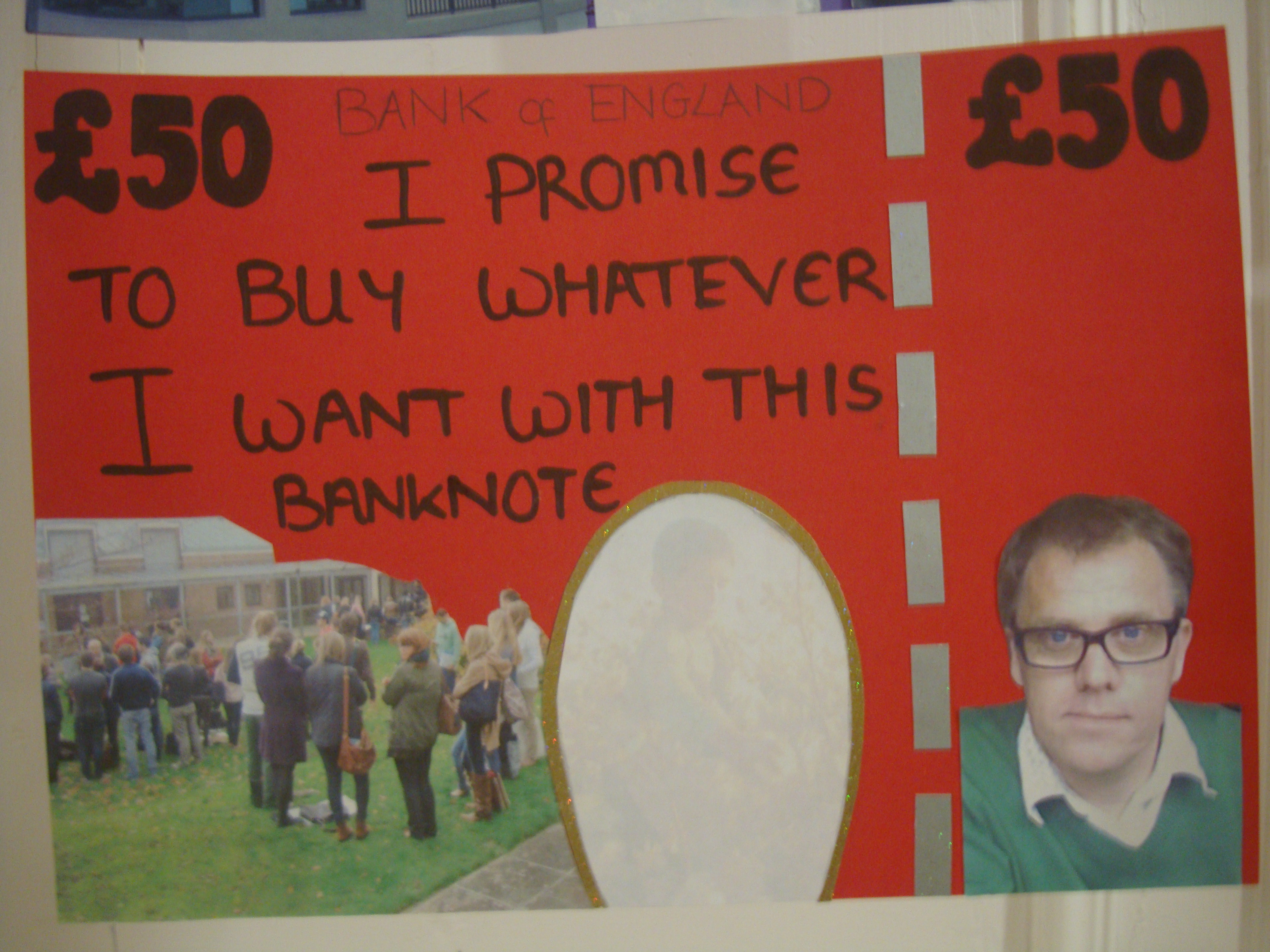
These works were produced by University of Exeter Geography students who have been trying to understand the ongoing financial crisis and the Occupy activism that it has provoked around the world. They were inspired by the giant Monopoly set made by the artist Banksy for the Occupation site outside St Paul’s Cathedral in London. They were challenged to rethink, modify and design new kinds of money that could tell us about the lives of the people who had made, earned, spent, borrowed and traded it. They discussed these issues with people participating in Exeter’s Occupation on Cathedral Green. Their class met there, rather than on campus, throughout the project. This exhibition was the result of the conversations that took place.
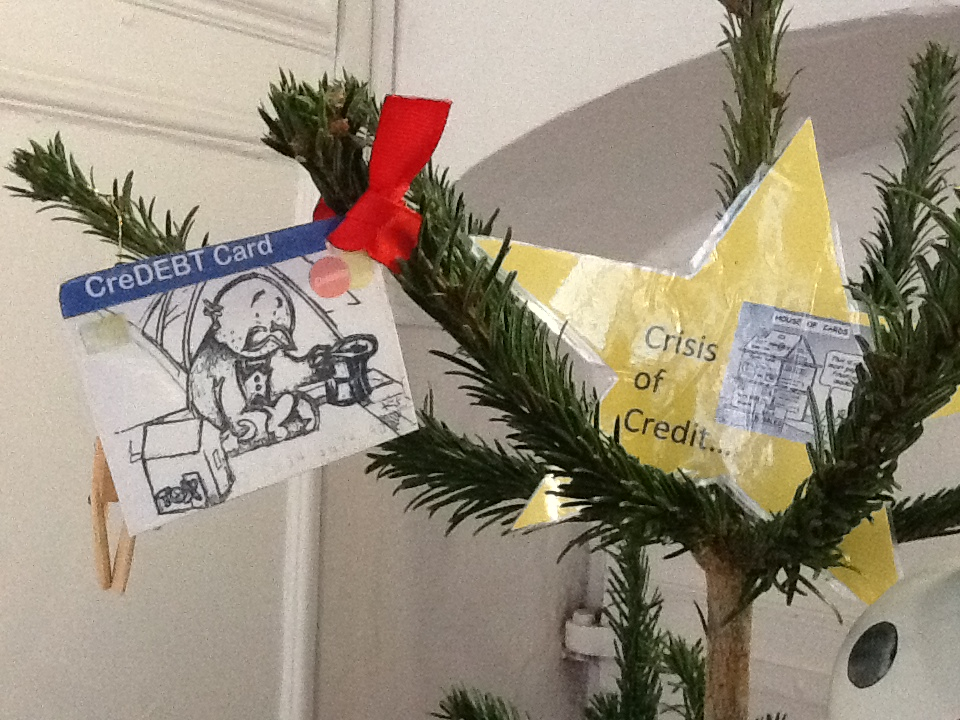
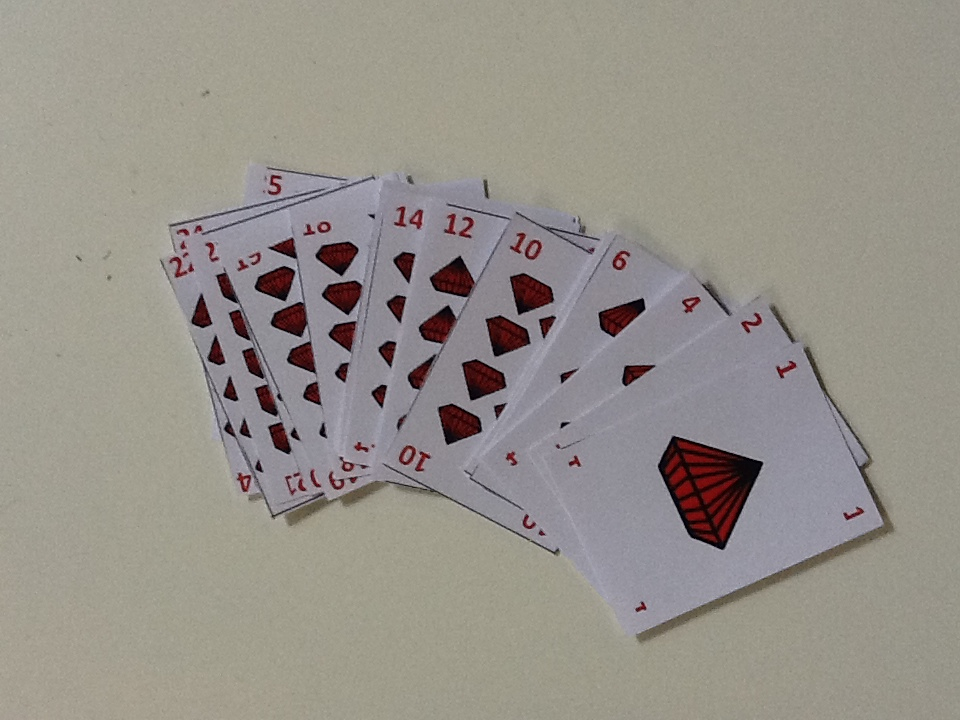
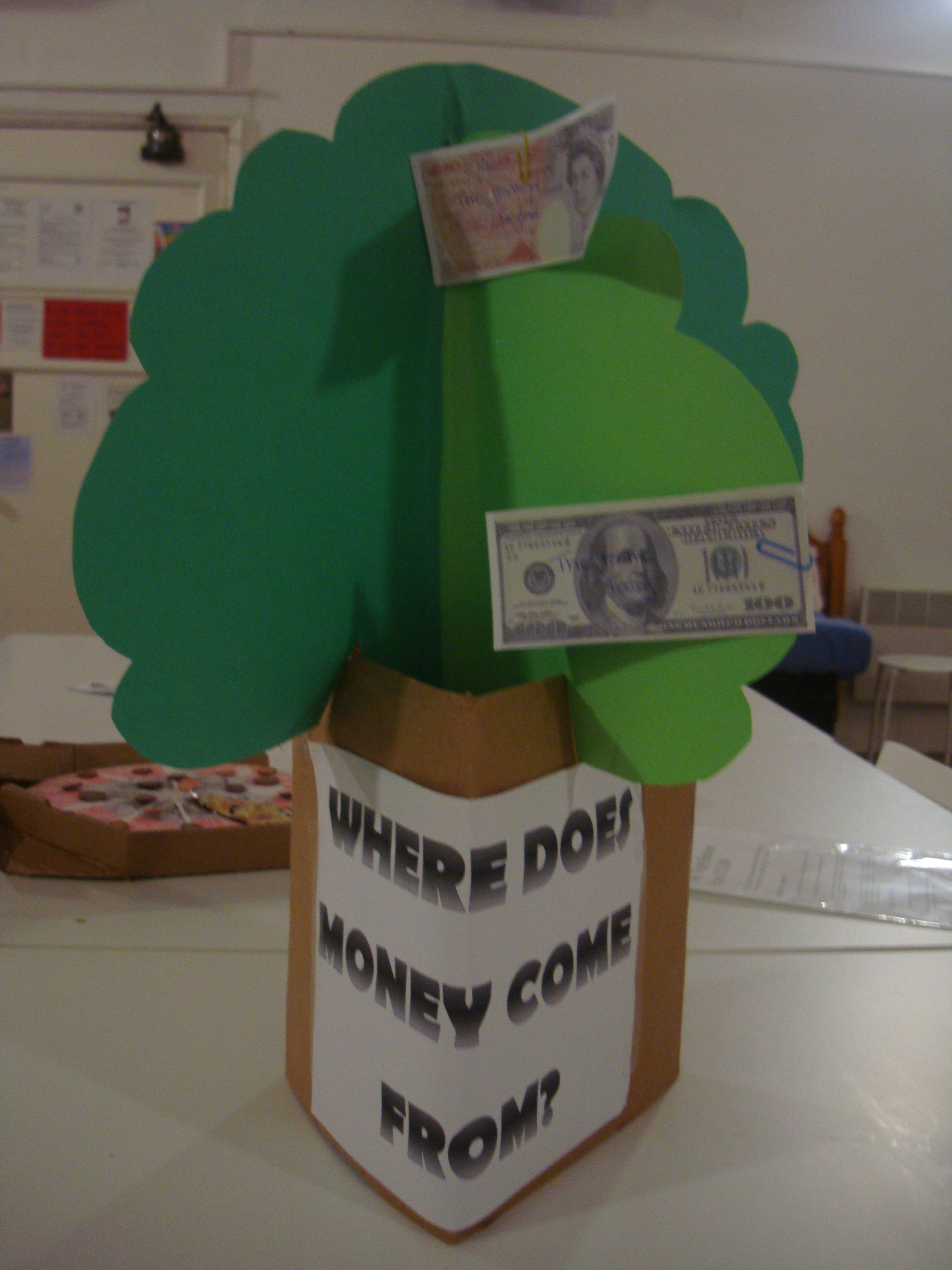
One group of students asked people to write on the back of a five pound note what they had done to earn it. ‘Sell two copies of the Big Issue, which usually takes an afternoon’ wrote one. ‘My Dad gave it to me’, wrote another. Another made a stamp for visitors to print the question ‘Whose is this?’ on the banknotes in their wallets and purses. Another designed credit cards that would stop them from using them so often, covered with ‘health warnings’ like cigarette packets for example, and hung like baubles from the gallery’s Christmas tree. Another created a new online bank (http://bank.dotbill.co.uk/) based on the recent Justin Timberlake movie ‘In Time’.
Student Olivia Bailey, one of the online bank’s creators, said “We want visitors to go away, look at their statements and see much more than the numbers”. Charlotte Edwards, whose group designed the banknote stamp, explained, “We want it to act as a catalyst to debate alongside the Occupy movement, to encourage people to think about their money. Where’s it from? What’s it been spent on? Who will have it next? What’s the true worth of that money? And what’s it worth to you, its temporary owner?”
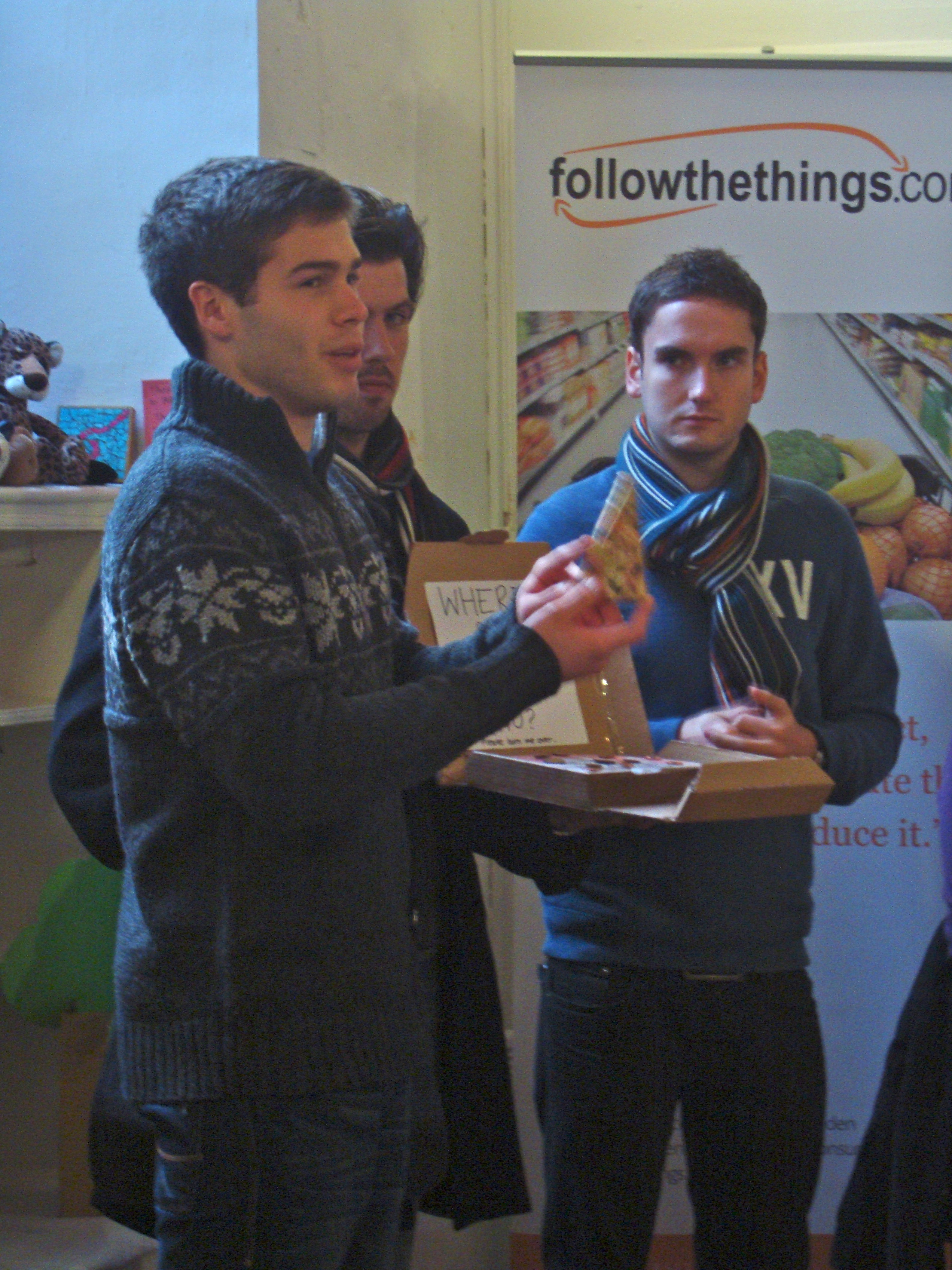
Their lecturer, Ian Cook said, ‘Working this way is much more exciting and relevant for all of us than hours of lectures where I’m supposed to be the only expert on these issues. Students have had to understand and imagine things differently, get out of our campus comfort zone, try to find new ways to talk to people about the financial crisis that we’re all experiencing, and work like artists. This is so much more than learning what you need to know to pass an exam! Huge thanks must go to Occupy Exeter and the Hub on the Green for being such generous hosts. This has been an important example of what can happen when ‘Gown meets Town.’
‘Money Talks’ opened at the Hub on the Green, 8 Cathedral Close, Exeter on Saturday 10th December, and is open to the public from 12.00-1.30 every day this week, except Thursday.
To find out more, see what visitors are saying, and join the conversation, please see our Facebook page here.






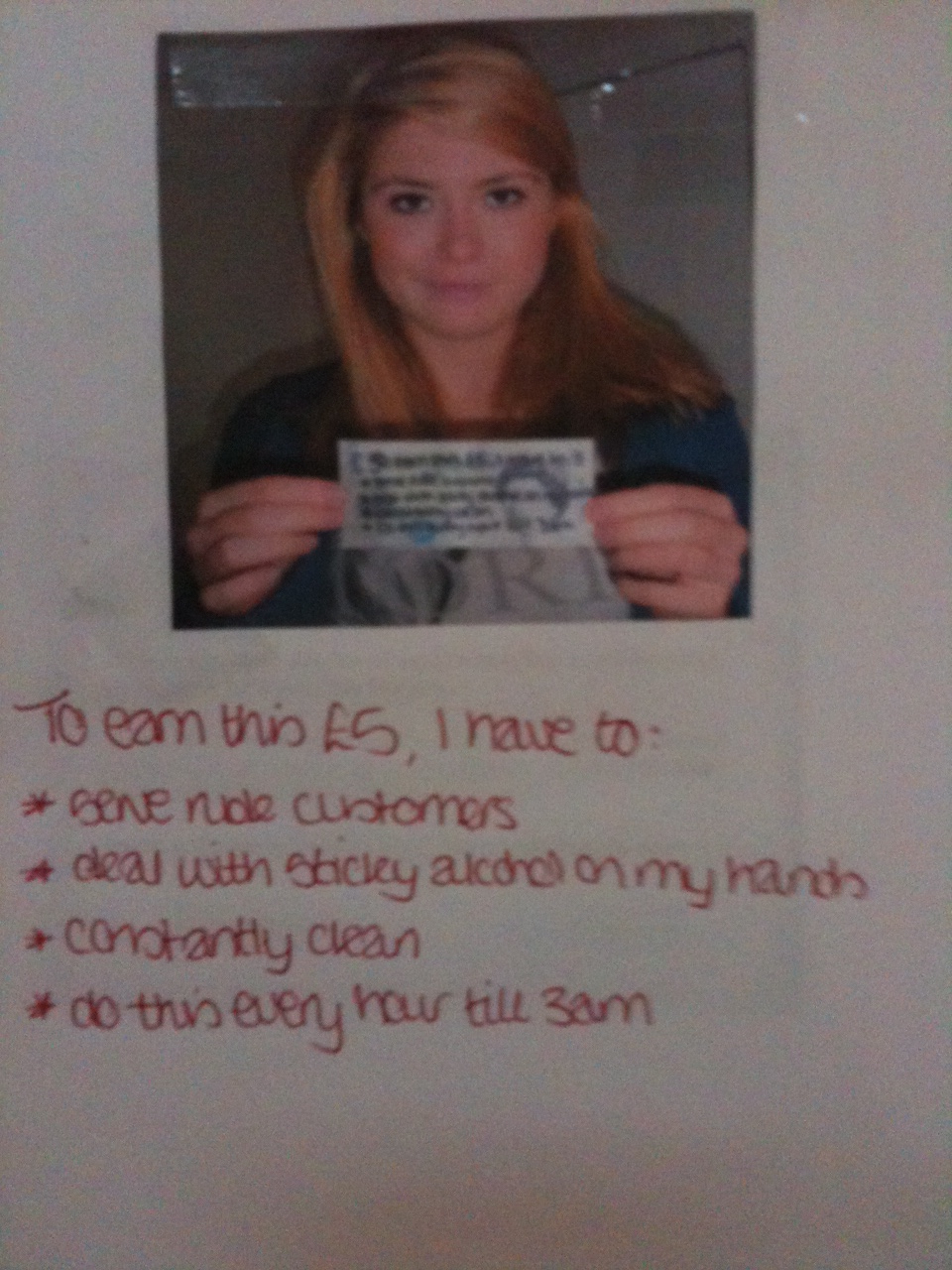
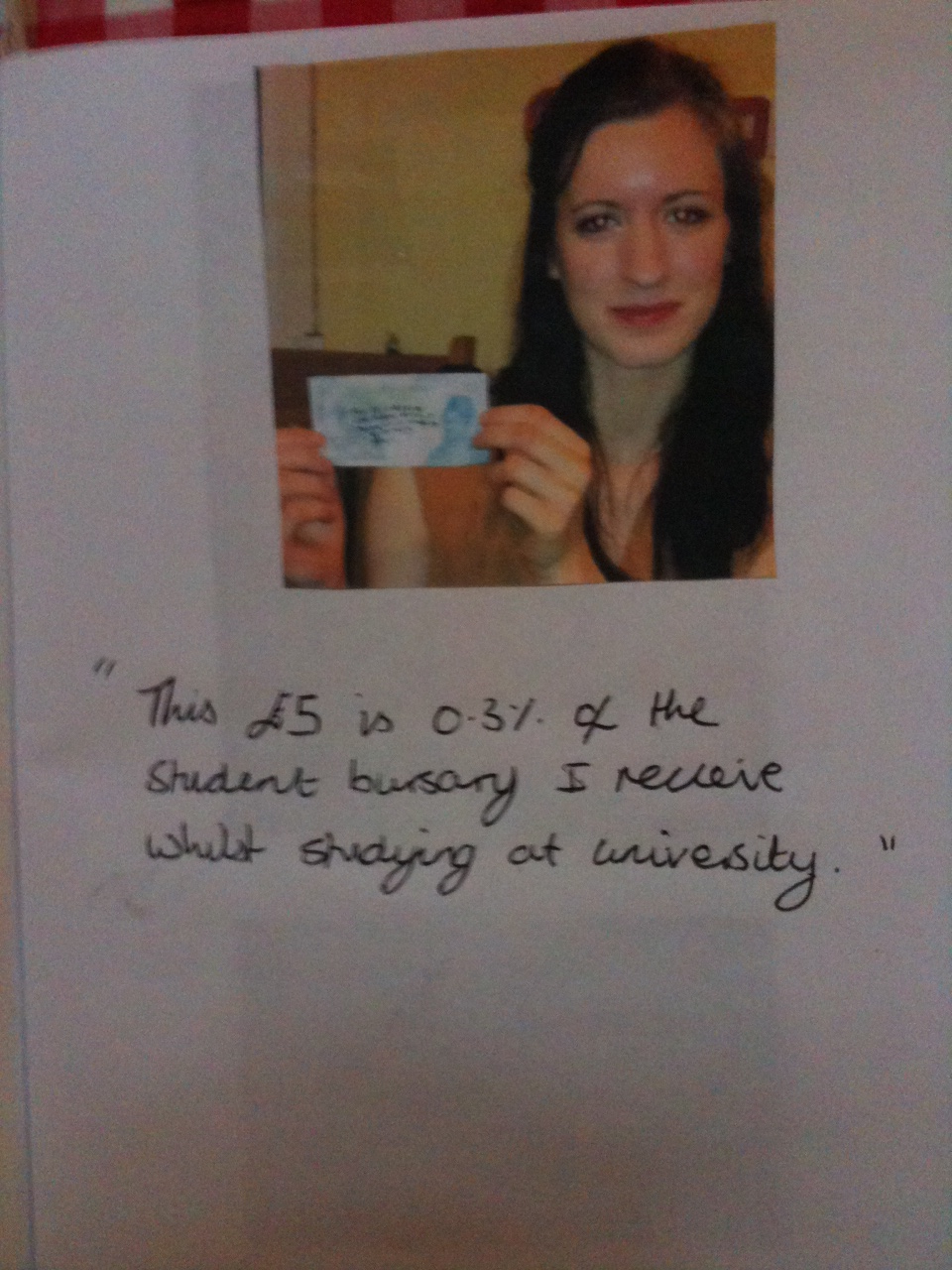


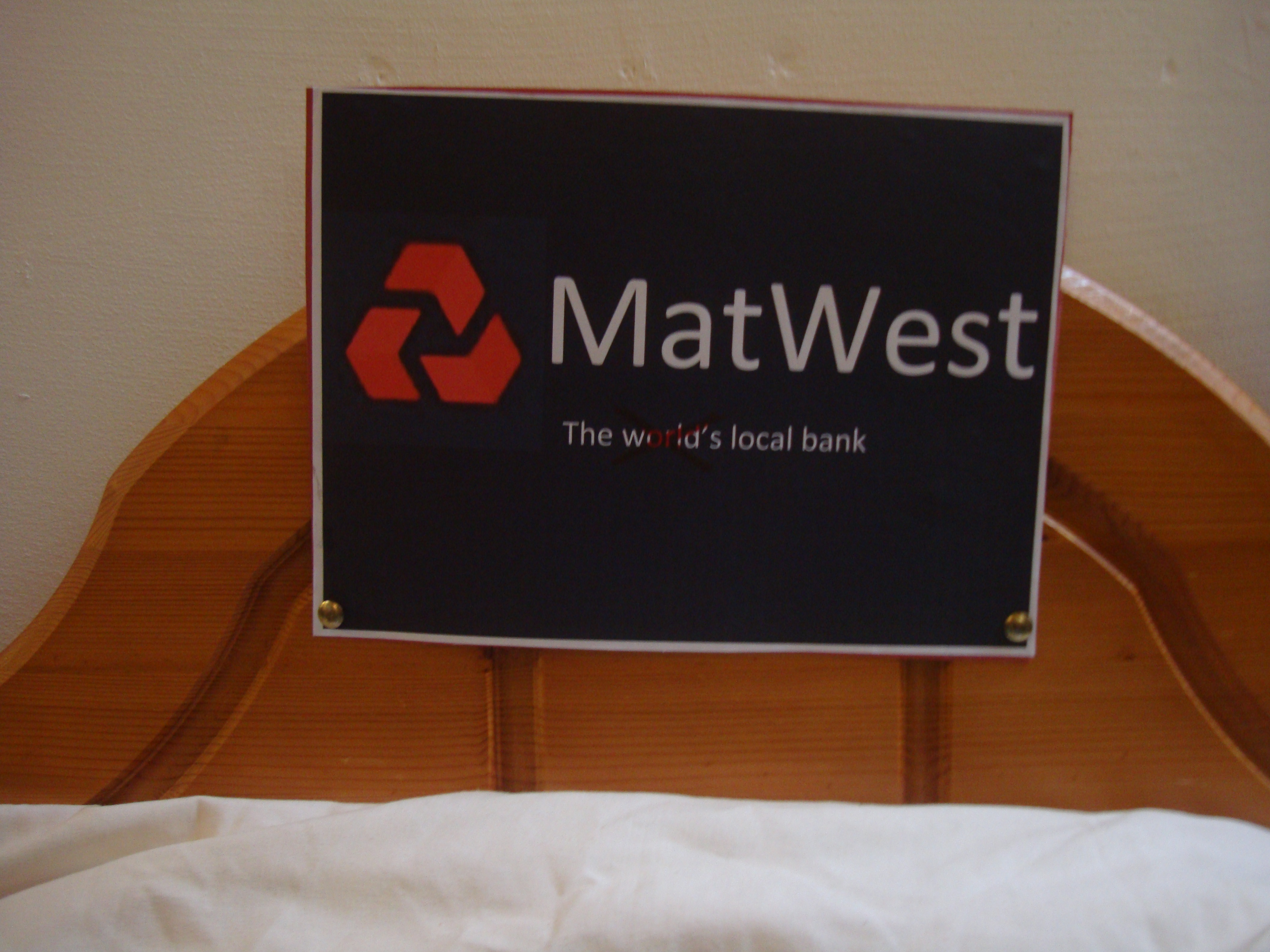
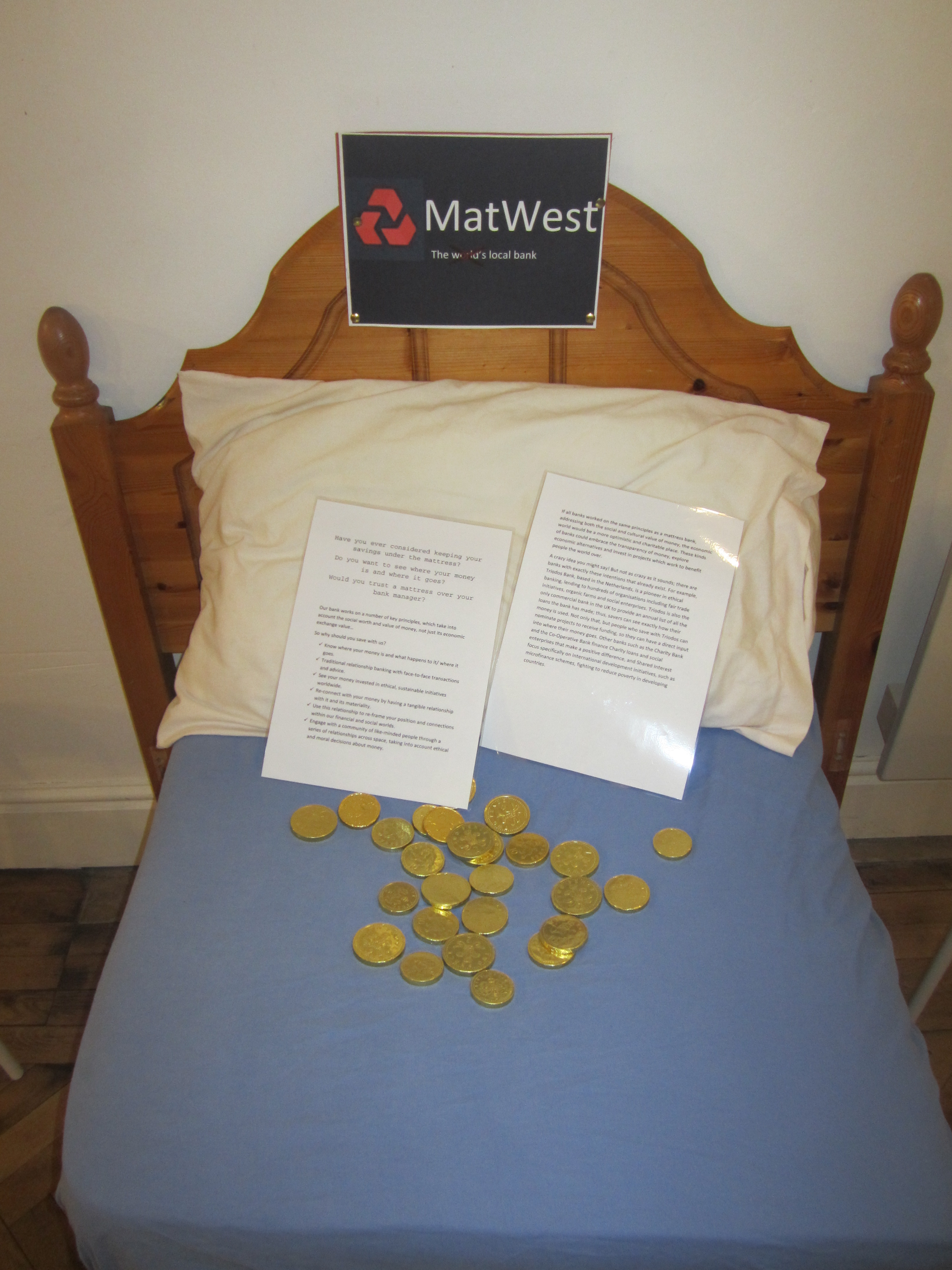




Photos by Ian Cook, Maura Pavalow & Tom Surr.
New examples for followthethings.com now being researched
Students taking Ian Cook’s ‘Geographies of material culture’ module are now researching the following examples to produce new ‘compilation pages’ for publication on followthethings.com.
Help with our research?
If you know of any good discussions, interviews, videos and any related information on any of the sources below, please comment on this post. Thanks…
Grocery dept.
Starbucks Coffee, iPhones and tents: Louise Mensch on Occupy London (BBCTV Have I Got News For You, 26 October 2011: watch here).
Various food: Food Inc documentary (2009: watch trailer).
Hamburber: McLibel film (2005: watch trailer).
Fashion dept.
Nike training shoes: Jonah Perretti’s Nike ID emails (2001: read emails).
Various clothing: ‘Primark: on the rack’ BBCTV Panorama documentary (2008: doc webpage).
Jeans: China blue documentary (2005: watch trailer).
Various clothing: Kelsey Timmerman’s Where am I wearing? book (2008: watch trailer).
Electrical dept.
iPhone: The agony and the ecstasy of Steve Jobs, Mike Daisey monologue (2011: watch interview)
Various electricals: Maquilapolis documentary (2006: watch trailer).
iPhone: PhoneStory app (2011: watch review/demo).
Gifts dept.
Various toys: Santa’s workshop: inside China’s slave labor toy factories documentary (2006? watch whole film).
 the back office