
Category: public geographies
Next week: we’re in a shopping centre talking clothes
We’ve been working on one of 12 ‘Grand Challenges’ that the University of Exeter runs each year for first year students. The idea is that academic staff introduce first year students from across the university to the Grand Challenges of the 21st Century, through some hands-on learning and with the help of visiting experts (who students refer to as ‘real people’, in my experience).
Challenges this year include Climate Change, Global Security and Mental Health, and the one that we’re running is on Fashion ethics after the Rana Plaza collapse.
There are four ways to find out more, to get involved, and to follow us next week:
1) Our blog
All the background information we’ve put together to prepare for this challenge. The Rana Plaza collapse and its ripple effects, and how we’re trying to appreciate and work with these ripples in the space of Exeter’s Guildhall Shopping centre, where we’re be occupying 2 disused shops and its main square for 4 days next week.
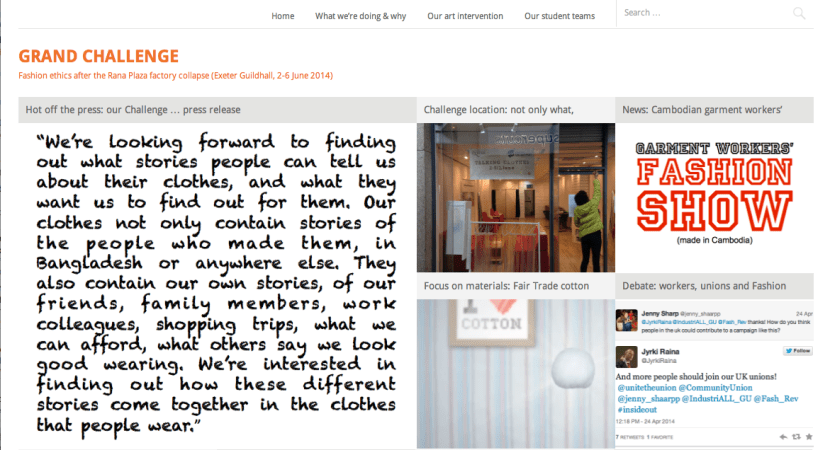
Click image for blog
Show us your @fash_rev trump cards!
Today, we started to play with the Fashion Ethics Trump card game we’ve made for, and with, Fashion Revolution Day.
We ended up tweeting some #fashtrumps selfies and a step by step guide for anyone who wants to join the #fashtrumps conversation.
We present to you here: some examples of #fashtrumps selfies, those guiding tweets and a twitter box that will show the ones that you have made…
Give this a go!
Some examples
followthethings & research impact
There’s a new special issue of the online, open access Geography journal ACME on the impact of academic research. This has become one of the ways in which the value of academic research is assessed in UK Higher Education, through the Research Excellence Framework.
One of the papers is by Ian Cook et al (that’s me/us), about the longstanding ‘follow the things’ research and public pedagogy that led to the creation and opening of followthethings.com in October 2008. To give a flavour of its approach to impact, here’s an extract from the paper:
When you publish academic work and make it freely available online, people read it and get in touch with you asking if you’d like to take part in work they’re (thinking of) doing. So you end up doing all kinds of unexpected things. This way of working is a core principle of ‘organic public geographies’ (Fuller and Askins, 2010; Hawkins et al., 2012). And it involves writing critical, radical, scholarly papers that are both publishable in academic journals and books, and accessible to more than academic audiences – like school teachers, journalists, filmmakers and artists: the people who make and use the work you’re researching. This is not the kind of “unidirectional knowledge” transfer that aims to make clear interventions in public debates (Pain et al., 2010, 185). It’s the kind that has critical pedagogy at its heart, that treats knowledge as “emerg[ing] only through invention and re-invention, through the restless, impatient, continuing, hopeful inquiry human beings pursue in the world, with the world, and with each other” (Freire, 1996, 52-3). Here, as Rich Heyman (2010) argues, academic writing should not be treated as the end point of research. Instead, it should aim to encourage research and conversation to continue beyond publication by offering its readers, for example, catchy and surprising narratives to engage with, unheard voices to listen to, unfamiliar concepts to use, tricky problems to think through, new skills to learn, and intriguing detective work to do (Cook and Woodyer, 2012).
Cook et al (2014, 48).
If you want to read the rest of the argument, download it here.
If you have any comments or questions, please submit them below.
Thanks
Ian
 the back office